
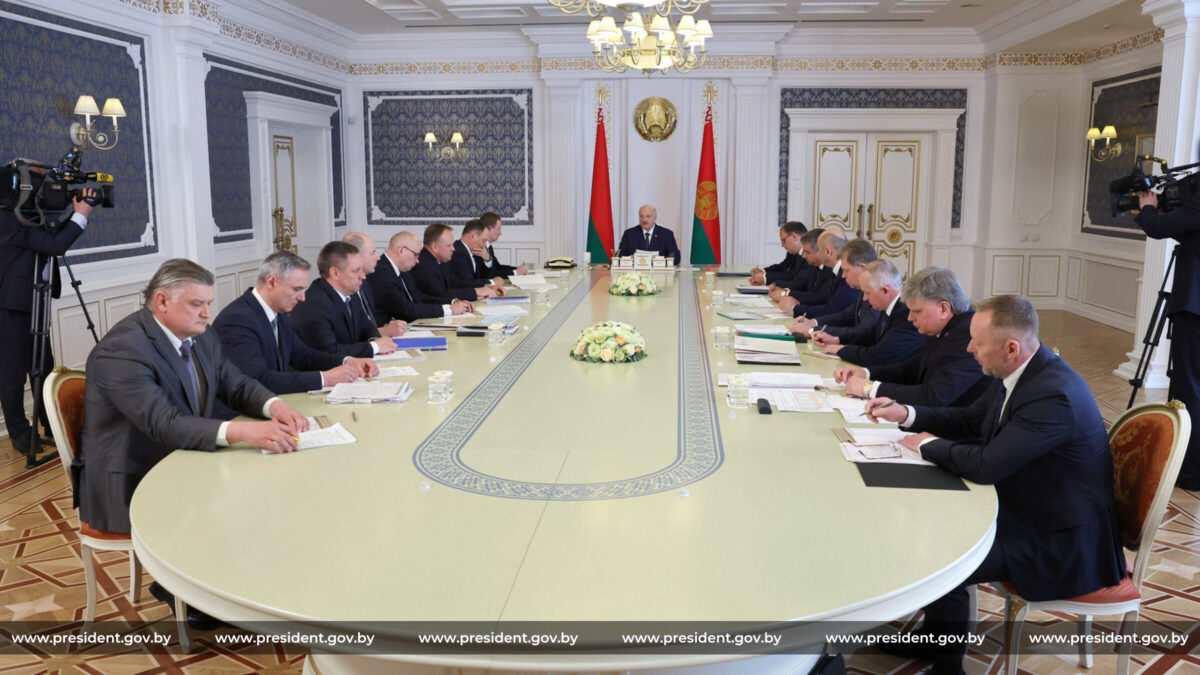
Aliaksandr Lukashenka reproached Prime Minister Aliaksandr Turchyn for frequent requests for “benefits and handouts.” A meeting on economic issues was held under Lukashenka today, with the agenda including the restructuring of debts in the cement industry, support for the Svetlahorsk Pulp and Paper Mill, and the transfer of the Orsha Meat Processing Plant to the management of the Dziarzhynski Agro-Combine.

“Frankly speaking, I am concerned by this stream of requests for benefits and ‘handouts.’ Especially with the appointment of a new prime minister. I would not want to think, Aliaksandr Henrikhavich, that in this way you are opening some new policy: we will give this, we will give that. It is clear — exchange rate differences and so on…
A specific director has taken over an enterprise — go and work, push forward. Some benefits, the budget, and so on. And you begin to describe to me in a roundabout way how to take circumstances into account. I fear that the government may adopt such a course, if it has not already. That it is necessary to help someone, write something off… Perhaps someone needs help if it is in the interest of the state. But we must not allow this to happen,” Lukashenka said at the start of the meeting.
His dissatisfaction was triggered by another request to restructure the debts of cement plants.
“That is why I very often demand conclusions from both the State Control Committee and the Chairman of the National Bank on this or that issue. So that we have one line. Because the prime minister is new, but the president is the same. And the president determines the line, and it must be followed. Yet time and again we see restructuring of debts of organizations in the cement industry. What does ‘debt restructuring’ mean? I understand what you are proposing, but I have always insisted: the manager must be made to work. If you came — do it.
I am now observing our light industry, ‘Kamvol’ and other leather enterprises. I am thinking when you will once again submit proposals to restructure debts or something else. We have placed people there. Go, push forward and work, deliver results under the conditions that exist today. What does it mean that we should help some and not others? Everyone is in equal conditions. They must work,” he continued.
It should be noted that significant measures to restructure the debts of cement plants were undertaken in 2019. At that time, proposals were also presented by Aliaksandr Turchyn, who served as First Deputy Prime Minister. In May 2019, a decree was signed granting OJSC Belarusian Cement Plant, Krychawtsementnashifer, and Krasnaselskbudmateryialy deferrals and installment plans on debts to the republican budget.
Repayment of these debts was to begin no earlier than 2029. The decree also provided installment plans for loans issued by Belarusbank and the Development Bank until December 31, 2024. It stipulated that until the end of 2026, interest on these loans would be paid from the republican budget, while the enterprises would settle with the state only in the following decade. Measures were also provided for loans from other banks, including deferrals, installment plans, and reduced interest rates.
However, these measures did not help the three cement plants achieve profitability. In 2024, all of them recorded net losses. For 2025, only Krychawtsementnashifer has reported so far. Its revenue increased by 12.3% to nearly 487 million rubles, while its net loss grew by 2.8% to 138.3 million rubles. Long-term liabilities on loans and borrowings decreased by 46.7% over the year to 123.37 million rubles.
Lukashenka recalled the provisions of the 2019 decree, noting that around $1 billion had been spent on modernizing cement production in 2012–2013.
“And what, did the cement workers do this with their own money? Six years ago, a decision was made to restructure the debt of these organizations — its repayment was extended until 2049. Until 2049! And what? Six years have passed, and we have returned to this issue again. That is why such proposals concern me,” he said.
Now, according to him, it is proposed to convert the foreign currency debts of cement plants into Belarusian rubles and accelerate repayment from 2029 to 2026.
“Perhaps you are right. But I emphasize once again: I am concerned that today the managers of these cement plants calmly sit at the same table with the president and feel that they are right,” he said.
Lukashenka was informed that the enterprises currently have no overdue debts.
“That is good. But it would be very good if everything were normal for them. A billion dollars was invested — go and work,” he responded.
Another issue is that the price of exported cement is up to 40% lower than on the domestic market.
“That is, you sell cement to your own people at almost half again the price than abroad. As a result, intermediaries engage in re-export, while our consumers are forced to buy imported low-quality products. And we are going to subsidize this today… Why are we not holding anyone accountable for this?” Lukashenka said.
He asked what the government had done to develop the cement industry; whether enterprises would be able to ensure stable and profitable operations if another debt restructuring were approved; whether the plants would continue to modernize production; and why the domestic market cannot be supplied with cement.
The government’s proposal regarding the Svetlahorsk Pulp and Paper Mill concerns funds from the National Development Fund. It proposes returning the money transferred to the fund so the enterprise can service its loan.
“The government’s proposal is as follows: to return all funds transferred by the company this year to the National Development Fund back to it for loan repayment.
That is, roughly speaking, they must pay a tax. We are not taking it from them — they will use this tax, which the enterprise should pay, to repay their obligations.
At the same time, both the government and the State Control Committee agree that this amount is calculated not from real profit, but from so-called paper profit obtained from positive exchange rate differences. In fact, there is no real money,” Lukashenka stated.
Lukashenka demanded an explanation as to why the Svetlahorsk enterprise cannot meet its obligations independently.
“Is there no manager there? There is. What is he doing? We must look into this in principle and give an assessment with appropriate conclusions. Why such a complicated scheme as you propose? As reported by the State Control Committee, the government has sufficient authority to make a decision. Why did you come to me?” he said.
Finally, the meeting addressed the fate of the Orsha meat processing enterprise.
“Previous attempts to rehabilitate this loss-making combine with the participation of representatives of the Viciebsk Regional Executive Committee, the Orsha District Executive Committee, and regional associations involved in agricultural development have not produced results. We have found a new formula. You did not find it — I agreed with the head of ‘Dziarzhynski’ that he would take over the zone; it will be his combine,” Lukashenka said.
He again recalled state investments in modernization.
“What private owners ask for: ‘Give us a raw material zone.’ We have provided it. They should say thank you, cross themselves and move forward. Invest in collective and state farms, as he knows how, and make personnel work,” he said.
A new manager has now been appointed, reserves for improving efficiency have been identified, and approaches for further development have been developed. Lukashenka asked the Chairman of the Viciebsk Regional Executive Committee Aliaksandr Rahozhnik to report on the assessment and effectiveness of the anti-crisis plan.
“You propose granting financial concessions to ‘Dziarzhynski,’ including restructuring Orsha’s debts so that the new owner can develop and rehabilitate the crisis-ridden combine. Plus an additional burden in the form of developing the raw material zone. Of course, lending a shoulder may be fair if necessary. But in my view, we are already doing everything this agro-combine asks for,” he noted.
As Lukashenka was informed, the draft order provides only for changing the timing of repayment of accumulated obligations.
“But I want him to pay on time. We would not mind that extra kopeck tomorrow. He has that money. And not everything was created by his own hands — the state supported and helped,” Aliaksandr Lukashenka said.
“All the issues — money, postpone, restructure, give from the budget, help… This is the wrong approach. That is why it concerns me most. And in the end, it results in underpayment of taxes to the budget. A sacred matter! And the State Control Committee treats this calmly. Although this is your bread. The budget is the main thing. And this must be stopped immediately,” Lukashenka concluded.