
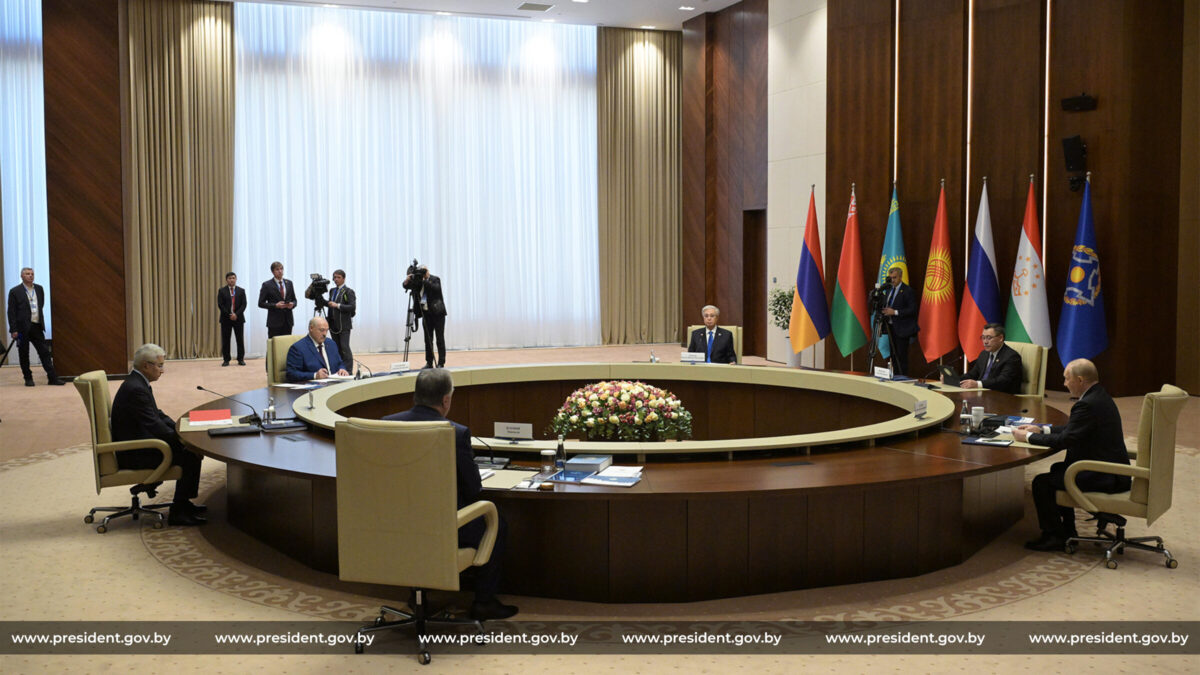
Alyaksandr Lukashenka accused European politicians of preparing for war and emphasised the relevance of the CSTO during the organisation’s summit. He spoke at the narrow-format session of the Collective Security Council. The extended session was brief and featured no speeches from member states except Kyrgyzstan and Russia, which will assume the CSTO chairmanship next year.
“We are witnessing tectonic shifts in international relations,” Lukashenka said, according to his press service.
He repeated that multilateral arms-control mechanisms have either been completely dismantled or have lost effectiveness due to confrontation and lack of trust. Lukashenka also claimed that military risks and threats are growing along the CSTO perimeter, especially on the western flank.
“The situation resembles a besieged fortress in which Belarus lives today,” he said.
Lukashenka cited rising defence spending among NATO countries, which he said will amount to around USD 1.6 trillion this year. He pointed to the growing military ambitions of Germany and Poland, which are increasing defence budgets and troop numbers. According to him, the Baltic states are also boosting defence spending.
“All of this together, combined with aggressive rhetoric, shows that Western politicians are deliberately preparing for war. It is not we, Vladimir Vladimirovich, who are preparing for war — all the facts show that they are,” Lukashenka said.
It should be noted that Russia, led by Vladimir Putin, has been waging a full-scale war against Ukraine since 2022. Russian drones have periodically violated the airspace of EU countries, including Romania and Poland. In September, several dozen Russian drones entered Polish airspace, some flying through Belarus.
Lukashenka also claimed that weapons supplied by Western countries to Ukraine are allegedly “spreading around the world.”
“In addition to increasing military potential, our neighbours are actively promoting a policy of isolation and dividing lines. The range is wide — from illegal economic sanctions to closed skies and closed borders. At the same time, we are in favour of dialogue. And we demonstrate this in our policy — honest, open, without ultimatums or preconditions,” Lukashenka continued.
“European countries are effectively shifting their economies onto military tracks, increasing investment in the defence industry and expanding arms production. We in the CSTO must respond to this — and we are responding,” he said.
He believes that in this context, the relevance of the CSTO does not diminish. However, the organisation must be adapted to modern challenges.
“It is necessary to constantly adapt the CSTO to changing security challenges and threats so that it can respond to them promptly and as effectively as possible. We have a system for the military component, crisis-response tools, and combating terrorism and drug trafficking,” he said.
“In the current security configuration in the Eurasian space, the CSTO remains relevant. The CSTO is needed. The demand for our organisation is confirmed by the dynamic development of all its components — military-political, military-technical, and cooperation against transnational threats,” Lukashenka added.
He said that work to further improve the CSTO’s core conceptual documents is essential.