
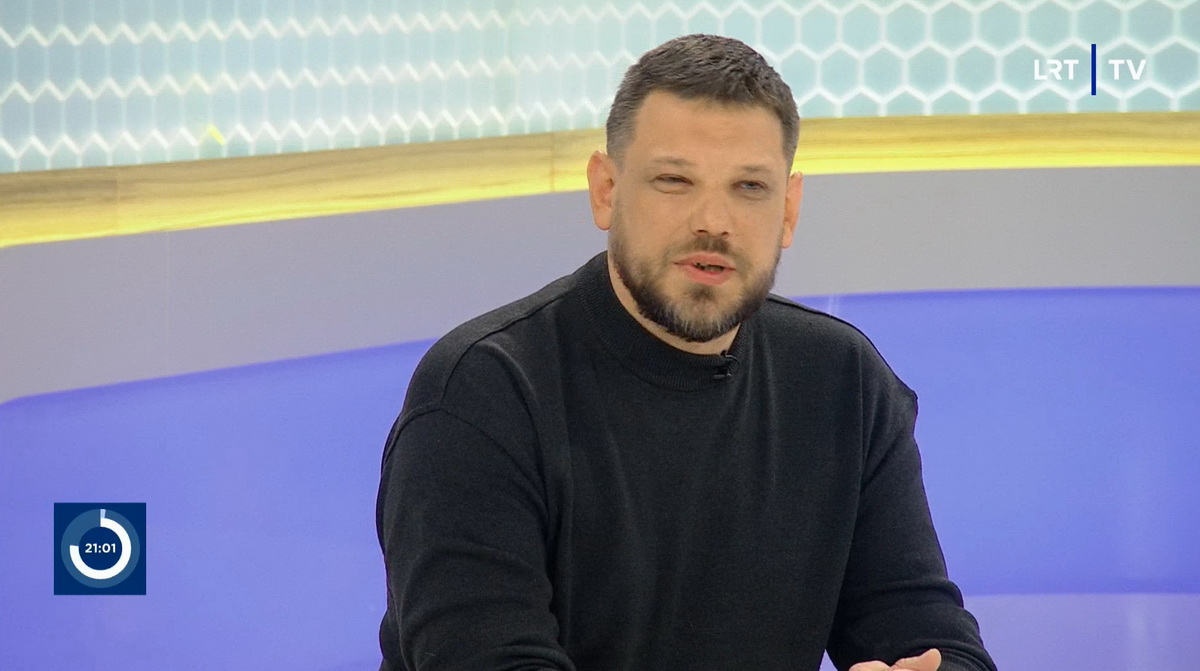
Lithuanian citizen Vyacheslav Papsho, who was released from detention in Belarus in December 2024 as part of arrangements with the United States on the release of political prisoners, has spoken about his arrest and the conditions of his imprisonment. He shared his story on the LRT television program “Topic of the Day.”
Papsho was detained in August 2024 in Hrodna, where he had traveled to visit the relatives of his wife, a Belarusian citizen who has lived in Lithuania for more than ten years. His wife’s family and friends still live in Belarus.
“I didn’t travel there often until the end of 2022. Since 2020 I hadn’t gone at all. And the time when I was arrested was the fourth visit — all those trips were for family matters,” Vyacheslav said.
According to him, about six or seven security officers burst into the apartment that day, forced him to the floor, handcuffed him and took him away.
“Unexpectedly, very unexpectedly, officers appeared. It probably hadn’t even been 24 hours when someone knocked very hard and aggressively on my mother-in-law’s door. No one answered the question ‘who’s there?’ I immediately understood that they had probably come for me. As soon as the door opened, they threw me face down on the ground, tied my hands and quickly took me outside, where they put me into a bus face down,” he said.
“They didn’t touch my wife because she had opened the door and they simply pushed her aside and entered the apartment. They told me to turn my back to them, because the first thing I saw was a shield. The second thing I saw was a pistol pointed at me, and there was no time for discussion,” he recalled.
During interrogations he was accused of criticizing the Lukashenka regime on social media and suspected of working for Lithuanian intelligence. A polygraph test was used to verify the latter accusation. Investigators threatened to arrest his wife and her parents and to place his child in an orphanage as a form of pressure. In exchange for cooperation, they demanded access to his YouTube and Telegram channels.
“They accused me of being a bad person, of speaking badly about the Lukashenka regime. And the second main idea was that I was probably an agent of Lithuanian security and that they thought I was spying here,” he said.
Papsho was charged with desecrating state symbols, insulting a representative of authority, insulting and defaming the president, inciting hatred and assisting extremist activity.
He was forced to record several short videos for social media in which he had to criticize Lithuania and NATO. In particular, he was made to voice a version about the deaths of NATO soldiers in a Lithuanian swamp and the alleged concealment of this information from the public.
He spent about 20 days in a detention center in Hrodna before being transferred to a prison in the city, where he remained until December. He never heard a court verdict.
“I had to say very favorable things. Not on the first day of my arrest, but maybe two days later, if I remember correctly, they organized an interview with a journalist who supposedly filmed me somewhere in a park to show that everything was fine and that I was almost free. But at that time the entrance to the park was closed from both sides. They completely blocked the area. There was a camera, a journalist, and behind her stood an armed man who essentially told me what I should say about how beautiful and wonderful everything is here in Belarus,” Vyacheslav said.
He spent between 20 and 22 days in the detention center and was transferred to prison on August 20, where he remained until December last year.
Papsho said he realized he was being taken home only after seeing Lithuanian flags at the border.
“When they were taking me to Lithuania, I thought they were taking me to be killed, because it was like in an action movie: shackled, blindfolded. We stood somewhere in a forest for a long time, no one spoke around me, and then they took me somewhere else. They remove the handcuffs, remove the blindfold, and you see a bus they lead you to. The people there also don’t talk to each other because everyone was strictly ordered to remain silent. I realized I was returning home only when I saw Lithuanian flags at the border. It was my second birth,” the former political prisoner said.
The case of Vyacheslav Papsho was also mentioned in the national security threat report published on Friday by Lithuania’s State Security Department.