
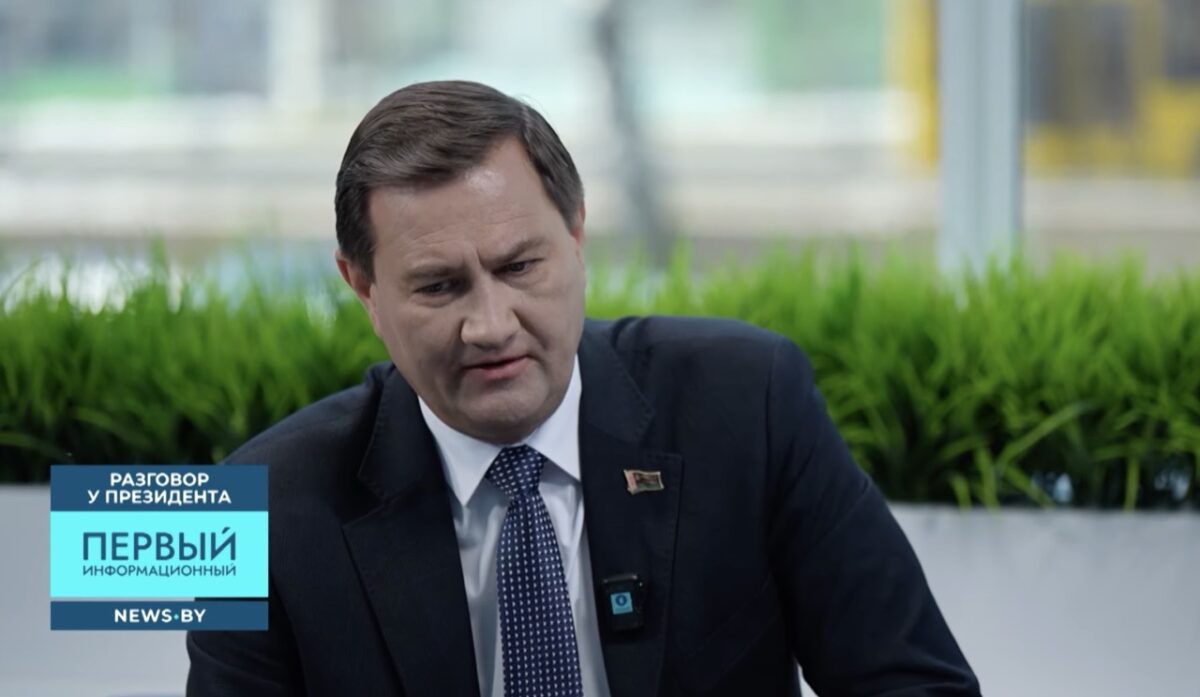
Belarusian Foreign Minister Maksim Ryzhankou believes the European Union is seeking ways to normalize relations with Belarus but has not yet responded to the release of some political prisoners in the country. He said this on March 9 in an interview with the Belarus 1 television channel.
Asked about prospects for cooperation with the EU if sanctions on Belarus are lifted, Ryzhankou said that “there is always hope.”
“We see, based on information coming from Western countries and the European Union in particular, that the mentality within their political elites is also shifting toward searching for ways to normalize relations with Belarus.
There are simply many people still in power in those countries who were the architects of this unrestrained sanctions policy toward Belarus and Russia,” Ryzhankou said.
According to the head of Belarus’s foreign ministry, sanctions against Belarus have not produced results and the EU understands this but cannot admit the mistake.
“The political system in Belarus and Russia has not changed. The authorities have only consolidated even more around their leaders and around those public associations that formed the basis of the overall social development of the states.
And today these sanctions are hitting Europe itself like a boomerang. But to stand up today and say: ‘We were wrong. Let’s work with Belarus’ — not every politician in the European Union can afford that. Because they will immediately be asked: ‘So tell us, were these five years, now entering the sixth year, simply wasted years that led to economic problems for the European Union, which were a very serious issue for citizens on both sides of the border, tearing apart many multicultural and humanitarian ties?’ This entire policy is primarily damaging for the countries of the European Union. Someone will have to answer for it,” he said.
Belarus has released some political prisoners and is now waiting for a response from the EU, Ryzhankou added.
“That is why such appeals are heard: ‘You in Belarus should do something more than what you are doing, supposedly in some humanitarian dimension, so that we can save face at home before our voters and say: ‘Belarus has done something.’
Well, something is being done. You wanted certain people to be released — people who nearly led the situation in our country to collapse. Well, they were released. So where is your reaction to these humanitarian steps by our president? There is none. You say: do something else.
Well, guys, that is not how it works. Moreover, if this cooperation is to be mutually beneficial, then let’s take steps together. This mantra ‘you must, you must, you must’ does not work,” the minister said.
Ryzhankou stressed that Belarus owes nothing to anyone and feels comfortable expanding cooperation with Russia, China, Iran, the Middle East and Africa.
“I will say that over these six years we have reoriented virtually all of our main trade. We have not lost anything in exports. Every year there is growth — over the five-year period, I think, about 40%, and it continues to grow. We have ensured our technological security. We have stopped depending on the European Union,” he said.
The EU, having refused Russian energy resources and Belarusian products, has fallen into dependence on the United States, the Belarusian foreign minister argued.
“That is why we are still waiting, considering this entire policy of the European Union to be essentially self-isolation. If you look at the borders of the European Union, there are few places where there is a stretch of that border without hostilities or without unstable countries through which EU states can communicate with the rest of the world,” Ryzhankou said.
The minister added that the conflict in the Middle East carries catastrophic consequences for the EU and urged it to remember the “stable state of Belarus.”
“It is high time for them to come to their senses and remember that there is a stable state here — Belarus — and this section of the border through which one can go further to Russia and all the way to China and Southeast Asia. But while such politicians remain in power, the peoples of the European Union are their hostages — with the exception, of course, of several countries with which we are developing very stable and dynamic relations, such as Hungary and Slovakia,” Ryzhankou said.
According to human rights defenders, since 2020 Belarus has “pardoned” 605 political prisoners, while during the same period 4,499 people were granted political prisoner status. Some of those “pardoned” were forcibly expelled from Belarus, in some cases without documents. More than 1,000 political prisoners remain behind bars.