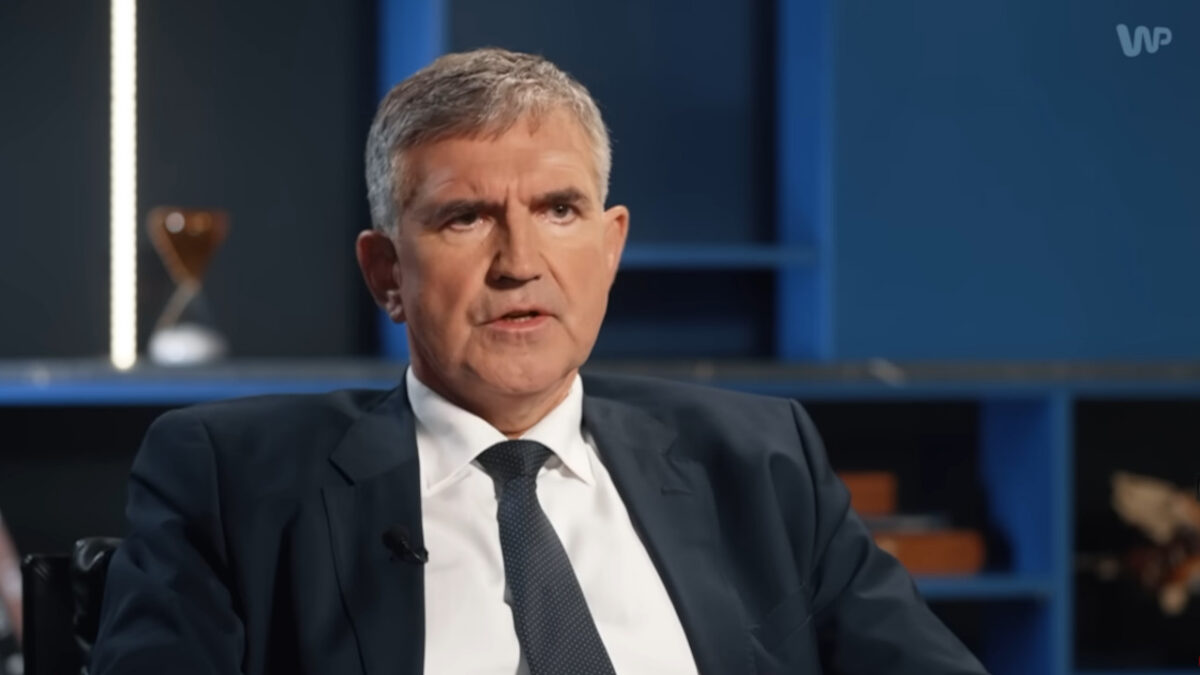
Deputy Minister and Coordinator of Poland’s special services, General Radosław Kujawa, was a guest on the “Didaskalia” programme. During the interview, the discussion repeatedly turned to Polish-Belarusian relations. How does Polish intelligence assess the threat posed by the Belarusian KGB, do the intelligence services of the two countries maintain contacts, and how were the negotiations for the release of Andrzej Poczobut conducted?

According to Radosław Kujawa, the greatest threat to Poland’s security comes from the Russian Federation’s aggressive policy, while Belarus poses a much smaller risk.
“Russia is a state that genuinely considers military action as a means of achieving political objectives. In this context, Belarus does not pose a threat to us, and the primary task of the Belarusian services is to protect the current government.
For this reason, they view us as a threat from the largest neighbouring member of the European Union and NATO. In this context, they also regard the Belarusian diaspora in both Poland and the rest of Europe as a threat,” Radosław Kujawa said.
The Belarusian KGB is dangerous for Poland, Kujawa concluded, but no more dangerous than Russian security structures.
Nevertheless, in the deputy minister and coordinator’s view, the situation requires certain decisions from the Polish leadership.
“From the perspective of the functioning of our two states, the challenge for us — people who grew up in solidarity and in the struggle against totalitarianism — is to come to terms with the fact that we have neighbours whose democratic mandate is illusory.
And we must decide how to manage our relations in this reality, while bearing in mind that Belarus’ sovereignty, its independence, its statehood and its ability to define its own goals despite its proximity to Russia are all within the sphere of our interests,” General Kujawa said.
One of the questions during the interview concerned the ethnic Pole and chairman of the Belarusian KGB, Ivan Tertel. What does Polish intelligence know about him?
“Lukashenka says, ‘Our Poles.’ Well, he is his Pole. Does that make it any easier for us to talk? I think that, in his Polish soul, the interests of President Lukashenka come first, and that is something we need to understand,” Kujawa replied.
“On the other hand, from their point of view, we are the most interesting neighbour. They understand Russia very well, they understand Ukraine, and they are able to explain the nature of both countries’ capabilities and interests in this conflict. In their own way, they are part of that world. We, too, are learning by looking at the dilemmas they face,” he continued.
What, then, are Poland’s interests with regard to Belarus? What practical issues do the two countries need to resolve?
Answering these questions, Radosław Kujawa stressed that migratory pressure on the Polish-Belarusian border has decreased. In addition, most political prisoners have been released. There is also no evidence that Belarus is conducting sabotage activities on Polish territory.
“This is the basis for dialogue,” he said. “How Belarus itself, or Russia, will perceive the fact that we can talk is a separate issue. It is more of a dilemma for the Belarusian side, while on our side there is a psychological barrier that we need to get somewhat used to.”
The interviewer asked whether contacts with Minsk are maintained at the intelligence level.
“We did not hide the fact that, during the effort to secure the release of Mr. Andrzej Poczobut, it came about as a result of negotiations with the Belarusians,” Radosław Kujawa replied.
“Intelligence services have the privilege of communicating without publicity and without issuing communiqués. We have a long border. The world we see today is such that we need to discuss various issues with each of our neighbours.
We have diplomatic relations with Belarus, and the fact that we succeeded in securing Andrzej Poczobut’s release is one of the pieces of evidence that such negotiations are worth conducting,” the deputy minister and coordinator of Poland’s special services explained.
According to Kujawa, everyone maintains dialogue at some level.
“We see this in the case of the conflict involving Iran, we see it in prisoner exchanges between Ukraine and Russia, and we see it in the agreements between Israel and Hamas. Of course, in the end, the question arises of the legitimacy of President Aliaksandr Lukashenka.
And that is what matters from our point of view. I will put it this way: Belarus should know that it faces no threat of aggression from Poland. If it can assure us that there will likewise be no aggression from the other side of the border, then I believe that has value for the Polish state,” Radosław Kujawa said.
Asked to elaborate on the Poczobut case and the contribution of the Polish services to his release, General Kujawa explained that the process began in July 2024 in the context of a major prisoner exchange, when, at the request of the United States, Poland handed over Russian spy Pavel Rubtsov.
“At that time, we received assurances that they (the United States – Reform.news note) understood our preferences and expectations regarding whom we most wanted to secure the release of. The process took a long time, and its catalyst was the fact that we managed to detain individuals for unlawful activities (in two cases, activities directed against our interests) whom the Russians and the Belarusians later asked us to hand over.
That allowed us to control the course of the negotiations, in which the Americans played a very significant role, as they had already developed the necessary know-how and were speaking directly (with representatives of the Belarusian regime – Reform.news note), including in Minsk.”
Kujawa described Poczobut’s release as a “joint effort”, in which “dialogue with the Belarusians was also necessary.”
The interviewer then asked why the Polish services have still not brought to justice before Polish courts judge Tomasz Szmydt, who fled to Belarus.
Radosław Kujawa said the issue was one of the resources and capabilities that the Polish services would have had to commit to such an operation, as well as the broader context of relations with Belarus, the state where the fugitive judge is currently located.
“We have a completely different assessment of international realities and a different understanding of the law,” the deputy minister and coordinator of Poland’s special services said. “However, it is our neighbour and a state with which we have, both in practice and potentially, many issues to discuss.”
According to him, it is a delicate balance. The ability to maintain dialogue is therefore incompatible with planning “any kind of active measures.”
“I understand that answer. Does the same apply to the killer of the Polish soldier on the border with Belarus?” the interviewer asked.
Kujawa replied that the Polish services possess extensive information about the individual.
“The killer is an unusual criminal carrying out tasks on the Polish-Belarusian border aimed at destabilisation and creating conditions for effective migratory pressure,” he said. “In these circumstances, even from the perspective of international law, would it make sense to request that Belarus extradite him to us, or to seek that state’s assistance in apprehending him?
Especially since the Belarusians have consistently claimed that they were unable to prevent this migratory pressure,” Radosław Kujawa said, adding that “in the context of this incident, we are even prepared to believe that, and therefore we would expect cooperation.”
At the same time, the deputy minister and coordinator of Poland’s special services declined to answer whether the killer of the Polish serviceman is still on Belarusian territory.
The interviewer also asked whether Radosław Kujawa could envisage Belarus becoming a member of the European Union in the future, noting that a friendly buffer state on Poland’s eastern border would be in Poland’s interests.
“Are we even in a position to effectively support Ukraine’s aspirations to join the European Union, when there is willingness on both sides?” the deputy minister and coordinator responded.
“We focus not on fantasies but on areas where we can clearly define our interests and pursue them firmly, regardless of the emotions of many of our fellow citizens,” he said.