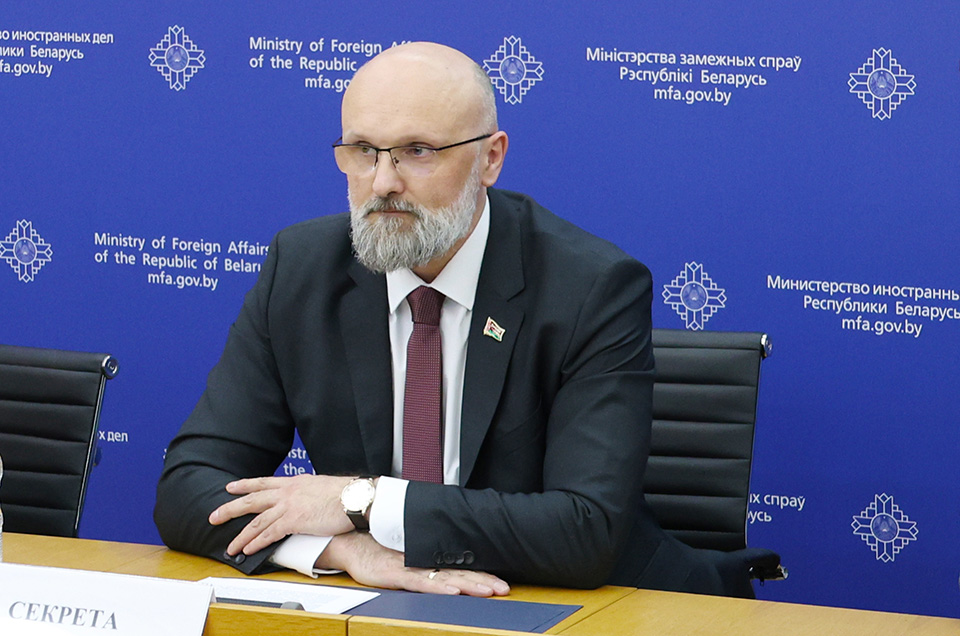
Belarusian Deputy Foreign Minister Ihar Sekreta gave an interview to NachDenkSeiten in which he made several statements about Belarus’ relations with its neighbors, illegal migration and sanctions. A translation of the interview was published on the Foreign Ministry’s website.

NachDenkSeiten is a blog founded in 2003 and focused on social and political issues. The project describes itself as a “critical website” for people who “question mainstream public opinion leaders and oppose common slogans.” The website has been criticized for spreading conspiracy narratives and pro-Russian rhetoric.
Sekreta said that foreigners enter Belarus legally and stay in the country legally, but later decide to cross the border outside official checkpoints.
“When these people come to Belarus, we have no questions for them. They arrive completely legally — usually from Russia, with Russian visas. They have passports and tickets, and many sign agreements to study. For us, they are not illegal migrants but legal tourists. They spend money here, buy food, stay in our hotels and are practically no different from ordinary travelers. But at some point, they decide to cross the border into the European Union. And how can they do that legally? Polish and Lithuanian border guards do not let them through official checkpoints and do not allow them to apply for asylum. As a result, people use the ‘green border’ and cross it where there are no border patrols,” the deputy minister said.
He accused neighboring countries of being unwilling to cooperate with Belarus to resolve the migration crisis and said that Belarus would not protect Europe from migrants.
“Unfortunately, our western neighbors — Poland, Lithuania and Latvia — do not want to work with us to resolve this crisis. For some reason, they believe that we should unconditionally work for them — protect their borders from these migrants. But excuse me, we are under your sanctions. We are not liked in Europe and are not wanted there, and at the same time we are supposed to protect you? Why should our border guards protect the peace and security of Lithuanians or Poles? If relations were normal, we could reach an agreement on everything. But if they are not, then protect yourselves,” Sekreta said.
Sekreta said that migrants seek to reach the EU, Germany in particular, because of the social benefits they can receive there. He compared this system with the Belarusian one and explained why migrants do not want to stay in Belarus.
“We have a completely different approach in Belarus: if you want to have equal rights with Belarusians, you have to work like a Belarusian. You have to become one of us: learn the language, obey the laws, earn money and pay taxes. Then you will be treated as one of us. That is precisely why we do not attract a huge influx of migrants — they know that here they have to work,” the Foreign Ministry representative said.
Sekreta said that Minsk had no confirmed information about mistreatment of migrants in Belarus and accused neighboring countries of beating people and throwing bodies onto Belarusian territory.
The Belarusian Foreign Ministry representative also proposed a solution to the problem of illegal migration. According to him, Western countries should stop wars, restore order and invest in Syria, Iraq and Afghanistan. He also proposed creating “civilized conditions” at the border: checking documents, establishing people’s identities and introducing integration programs.
Sekreta suggested that politicians follow the example of criminals and smugglers, who cooperate despite living in different countries.
“Politicians, diplomats, the military, police and intelligence services must establish contacts. This is where real cooperation is needed! Instead of expanding armies, clear objectives should be set so that the police forces of all countries work in a coordinated manner. Criminals and smugglers work remarkably well, if I may put it that way; their horizontal links are much better established than those between diplomats. They have not fallen out with one another and are making huge amounts of money. But we, government institutions, have fallen out with each other. This primarily harms public security,” Sekreta said.
Sekreta also cited statistics on migrants who violate Belarusian law.
In 2025, temporary and permanent residence permits in Belarus were revoked for more than 24,000 foreigners. A total of 4,860 people were expelled from the country for serious violations of the law (compared with 5,512 in 2024). Another 3,885 foreign nationals were denied entry.