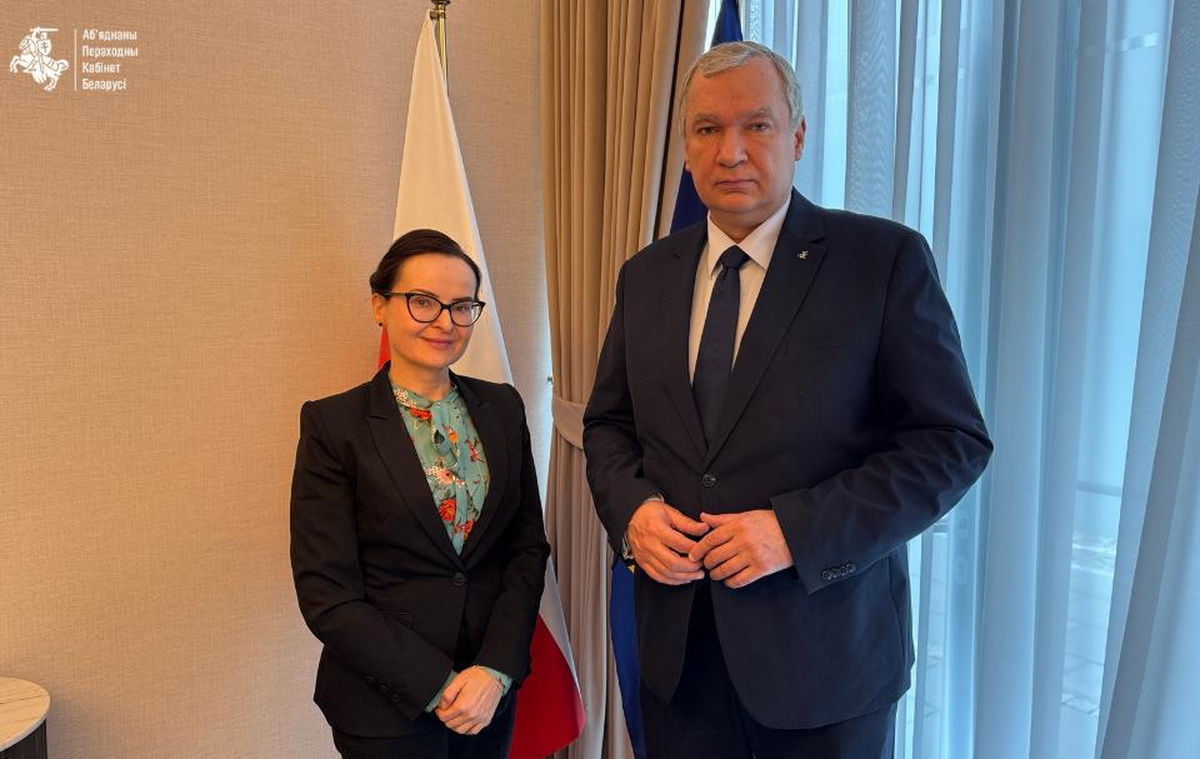
Pavel Latushka, Deputy Head of the United Transitional Cabinet and Head of the National Anti-Crisis Management, met with Justyna Chrzanowska, director of the Consular Department at Poland’s Ministry of Foreign Affairs. One of the main topics of the talks was the issuance of Polish humanitarian visas to former political prisoners, their relatives and other Belarusians subjected to repression.

The meeting was also attended by Mikhail Kirylyuk, a lawyer with the National Anti-Crisis Management and a delegate to the Coordination Council.
The parties discussed the legalization of the stay in Poland of former political prisoners and their family members, the possibility of inviting close relatives of Belarusian citizens holding Polish residence permits on humanitarian grounds, and the provision of international protection to Belarusian citizens in light of changes to Poland’s migration policy.
According to the United Transitional Cabinet, solutions were found during the meeting for a number of complex individual cases related to humanitarian assistance for Belarusian citizens.
Latushka also presented the Polish side with information on the human rights situation in Belarus. According to the political prisoner support initiative Dissidentby, 78 new politically motivated criminal cases were recorded in July 2026. Since the beginning of the year, 694 cases of politically motivated persecution have been documented. According to the Viasna Human Rights Center, 38 people were recognized as political prisoners in July.
The politician also reported an increase in cases of transnational repression targeting Belarusians living in Poland. These include trials in absentia, recruitment attempts, blackmail and pressure on activists through relatives who remain in Belarus.
Latushka stressed that the human rights situation in Belarus remains unchanged. Politically motivated convictions continue to be handed down, while the list of organizations and materials designated as “extremist” by the Belarusian authorities continues to expand. As examples, he cited the designation of Euronews and the Polish Press Agency (PAP) as “extremist materials,” as well as the designation of the European Humanities University as an “extremist organization.”
“Representatives of Poland’s Foreign Ministry agreed that there were no grounds, and there continue to be no grounds, to believe that the Lukashenka regime is reducing repression in Belarus,” the United Transitional Cabinet said.
The sides also discussed travel to Belarus by people holding dual Belarusian and Polish citizenship. Representatives of the Polish Foreign Ministry noted that Belarusian law treats such individuals exclusively as Belarusian citizens, meaning that in the event of a crisis, a Polish consul may not always be able to provide them with assistance.
Latushka thanked Poland’s Foreign Ministry for its support in issuing humanitarian visas to Belarusian citizens and helping resolve complex individual cases. The sides agreed to continue providing the Polish ministry with information on the situation regarding repression in Belarus.