
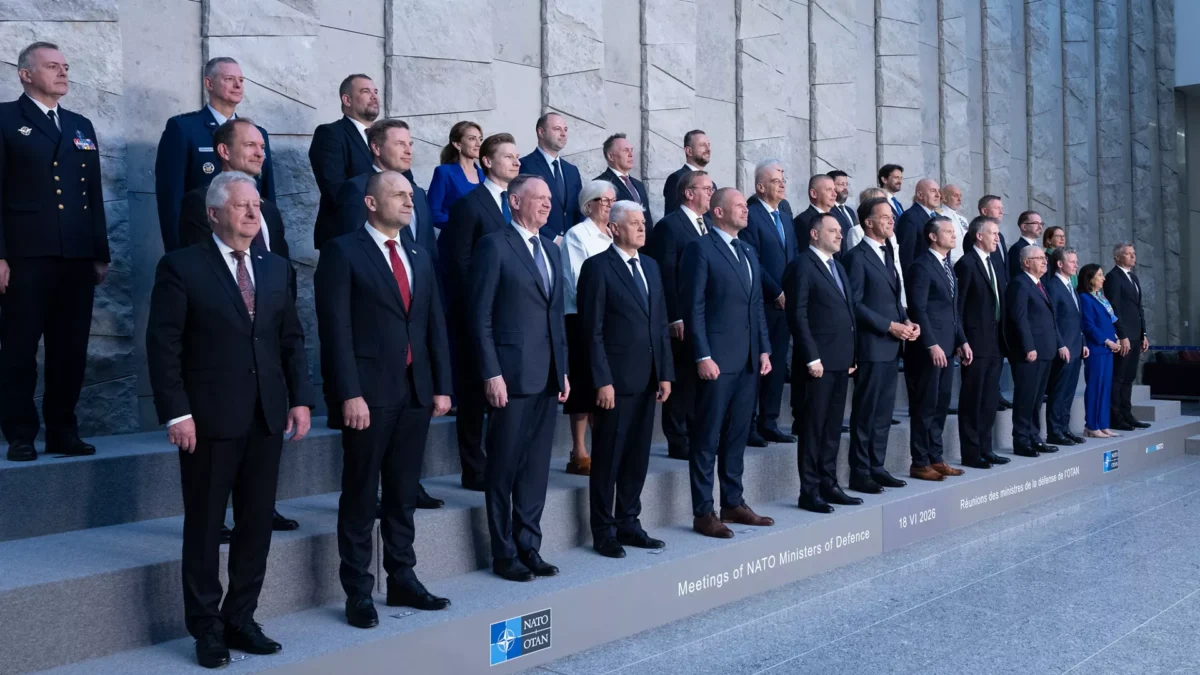
A Reform.news journalist attended the NATO defence ministers’ meeting and compiled the key takeaways.

A meeting of NATO defence ministers took place in Brussels. It was the last high-level meeting before the Alliance summit, which will be held in Ankara in July and is expected to define NATO’s priorities and plans for the coming years.
The main topics discussed included increased defence spending, the revival of the defence industry, nuclear deterrence, and assistance to Ukraine in its fight against Russian aggression. According to NATO Secretary General Mark Rutte, European NATO allies and Canada increased their defence spending by more than $90 billion in 2025, resulting in overall growth of 20% in just one year.
A Lot of Money Is Needed
A year earlier, during the summit in The Hague, defence ministers from the Alliance’s 32 member states confirmed their intention to increase defence spending to 5% of GDP. Of that amount, 3.5% is to be spent directly on defence and 1.5% on defence-related expenditures. All member states are expected to reach this funding level by 2035, although it may be achieved sooner. At present, only three countries are ahead of schedule in meeting these commitments.
“These substantial investments are translating into real capabilities, and we are already seeing European Allies and Canada becoming more capable and taking greater responsibility for our security. In particular, they are assuming more key leadership positions within NATO’s military command structures and taking on a greater share of responsibility for the forces and capabilities needed by the Alliance for peacetime deterrence and for defence in times of crisis or conflict,” Mark Rutte said.
The Prioritised Ukraine Requirements List (PURL) programme is also being implemented ahead of schedule. The mechanism compiles a list of Ukraine’s priority requirements for weapons and ammunition. Based on this list, the United States and its allies organise deliveries and procurement of the required equipment, while European NATO countries, Canada and other partners finance the packages. The mechanism allows the most critical shortages in the Ukrainian military to be addressed quickly.
PURL is primarily used to procure US-made air defence systems, Patriot missiles, HIMARS ammunition and other weapons that Ukraine cannot rapidly obtain from European stockpiles. The programme was initially expected to finance procurements worth around $4 billion. However, as of June 2026, approximately $5.5 billion in arms deliveries had already been financed or contracted through PURL. This figure does not include funds or weapons supplied to Ukraine by NATO countries through bilateral cooperation.
Twenty-three NATO member states, as well as Australia and New Zealand, contribute to PURL. Japan joined the programme in May, allocating approximately $16 million for the procurement of non-lethal equipment for Ukraine.
Nuclear Deterrence
A meeting of the Nuclear Planning Group was held alongside the defence ministers’ gathering. It is effectively the only permanent NATO body where the Alliance’s nuclear policy is discussed. All NATO member states participate except France, which maintains full national control over its nuclear forces and traditionally does not take part in NATO nuclear planning.
NATO defence ministers reaffirmed that the Alliance’s nuclear weapons remain the ultimate guarantee of Allied security. This was stated in the declaration issued following the Nuclear Planning Group meeting on June 18.
Participants said they would continue modernising nuclear forces, improving nuclear planning mechanisms and adapting deterrence policy to emerging threats, including funding the weapons, infrastructure and forces involved in NATO’s nuclear mission.
The United States’ allies reaffirmed their commitment to extended deterrence obligations, commonly referred to as the nuclear umbrella over Europe. Alliance members also confirmed their readiness to continue sharing responsibility for nuclear deterrence through NATO’s nuclear sharing arrangements. Under this practice, the United States deploys nuclear weapons on the territory of European allies, and in wartime their delivery could involve not only US personnel. According to a senior NATO official, one element of expanding this approach is the re-equipment of allied air forces with F-35 aircraft, which are capable of carrying US nuclear weapons within NATO’s nuclear-sharing mission.
The Divorce From the United States Is Off
The NATO Secretary General thanked US President Donald Trump for the operation directed against Iran. According to him, US actions strengthened overall security, eliminated the threat of Iran acquiring nuclear weapons and limited its ballistic missile capabilities. He also praised the role of the United States, President Trump and Defence Secretary Pete Hegseth in strengthening NATO.
“Thank you for your leadership over the past year, for your inspiring speech, and for what you have done in the field of defence production. This is extremely important. We need to increase production both in the United States and in Europe to ensure our security. One of the key priorities for you, your team and the President is expanding the defence industrial base in the United States. We are doing the same in Europe and Canada because we need not only to keep pace with but to outpace China, Russia and other countries that are rapidly increasing defence production. For all these reasons, I want to thank you for what you are doing, for your leadership, your dedication, and for being here today,” Mark Rutte said while welcoming Pete Hegseth at NATO headquarters.
Ukraine Is Seizing the Initiative
According to a senior NATO official (NATO headquarters media rules require information obtained at non-public events to be attributed in this way — Reform.news), the nature of the Russia-Ukraine war is changing in ways that are unfavourable to Russia. Ukraine is gradually seizing the initiative. Russia lacks offensive potential and its losses continue to rise. NATO intelligence estimates Russian casualties at between 1.3 million and 1.5 million personnel, including around 500,000 killed.
Ukraine is increasing the number of strikes along the front line, in the near rear areas and deep inside Russian territory, and this trend is expected to continue. Ukrainian air defences intercept up to 90% of Russian drones but still face shortages of interceptors for ballistic missiles. Only 17% of ballistic missiles launched against Ukrainian territory are intercepted. The official noted, however, that this does not mean the remaining 83% reach their targets. According to him, Ukrainian air-defence operators are currently among the best in the world and often avoid using scarce interceptors against missiles that are not heading towards populated areas.
Another senior NATO official told reporters during a closed briefing that reports claiming the US operation in Iran had led to a halt in ammunition and equipment deliveries to Ukraine were incorrect. According to him, Ukraine continues to receive US supplies in full, as well as increased deliveries from Europe. He added that NATO does not view support for Ukraine as charity but as a partnership in which both sides help each other prepare for various aspects of modern warfare.
At the same time, NATO sees no prospects for a rapid end to the Russia-Ukraine war. Although Russians are increasingly beginning to feel the consequences of the war even in Moscow and St Petersburg, where they were previously less noticeable, the Russian leadership is sending no signals indicating a willingness to end the conflict.
Belarus Left on the Sidelines
The word “Belarus” was not mentioned once during the main press conferences and briefings held as part of the defence ministers’ meeting. On the sidelines, it was raised mainly by Belarusian journalists. In response to a question from a Reform.news journalist, a senior NATO official said Alliance intelligence sees no signs of Russian nuclear weapons being deployed in Belarus, despite numerous statements by the Russian and Belarusian leadership and various exercises involving such weapons.
At the same time, he said these exercises indicate that Belarusian forces are training to be ready for rapid integration into Russia’s military machine, and that tactical nuclear weapons could be deployed in Belarus relatively quickly if required. He also assessed that the deployment of Russian nuclear weapons in Belarus would not change the military balance and would amount to another nuclear threat from the Kremlin, which, in his view, uses such threats to divert attention from setbacks on the battlefield.