
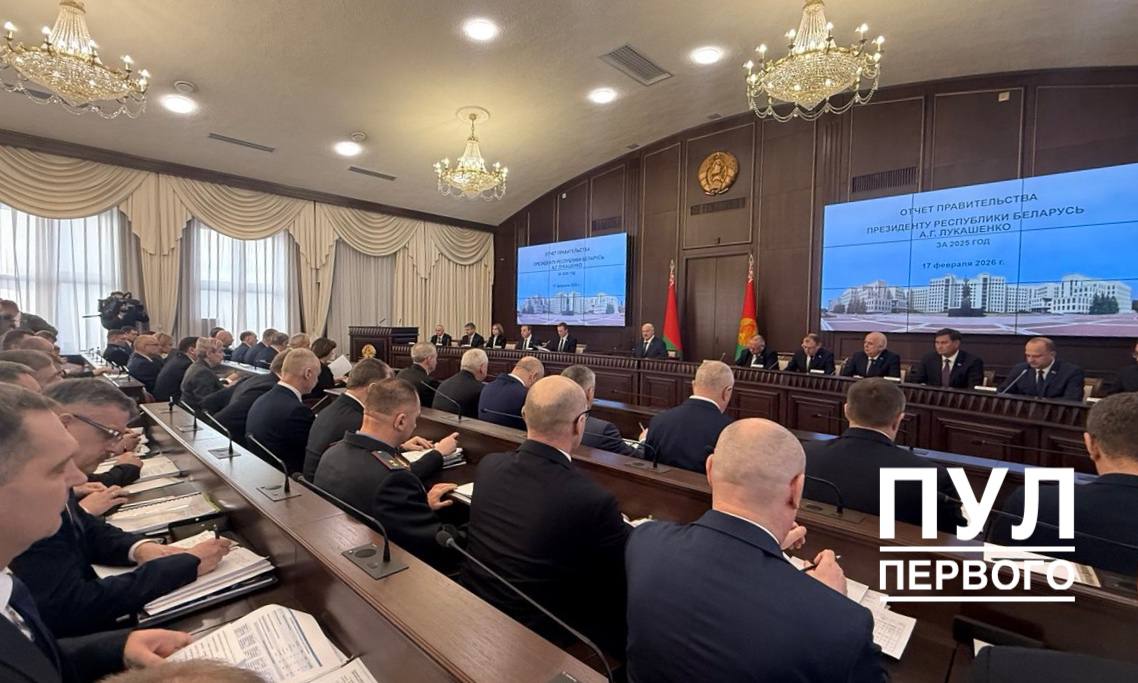
Alyaksandr Lukashenka said the Belarusian economy is operating under near-military conditions and is facing “extremely serious pressure” from both the East and the West. He made the remarks while hearing a government report on economic performance in 2025 and prospects for the new year.

“As you understand, today’s event is not ceremonial in nature. I would very much like it to be a working one.
You all understand, and so do I, that we are in a very difficult, at least a far from simple, situation. Under extremely serious pressure from both the east and the west. I am talking about the economy. Although politics is, as the classics said, a concentrated expression of the economy.
It will not be easy. That is why we exist — as we are called — the elite, the most prepared and informed people. And in any situation we must work and deliver results,” he said as he opened the meeting.
Lukashenka stressed that the current time for the economy is almost wartime.
“The time is almost wartime. Why? Because the economy has become a real battlefield. Economic instruments are being used to achieve the goals of classical warfare: to seize resources, provoke social protests, and force others to live by rules that are not our own,” he added.
Describing the “near-wartime” conditions, Lukashenka referred to sanctions, which he said must not exist for the government.
“But for you and for me, they do not exist. If we had started referring to sanctions, we would no longer exist,” the Belarusian leader stressed. “The moment we convince ourselves that it is impossible to work — that’s it, we are finished. If there is no result, we will slide into a wartime economy.” He noted that more than fifty countries worldwide are currently under sanctions.
“Today, 50 countries in the world are already under direct sanctions. Secondary effects probably affect hundreds of states. And Russia’s Foreign Ministry approached me, as chairman of the Supreme State [Council], asking that we consider this issue and somehow unite everyone who is under sanctions. They persuaded China as well — although there is no need to persuade it, it understands that it will be next. To unite and show strength and power. If we unite and reach agreement, those who imposed sanctions against us will be afraid,” Lukashenka added.
His remarks also touched on embargoes, tariff wars, currency attacks and competition over technologies.
“Through restrictions on the circulation of dollars, pressure on exchange rates and settlements in certain currencies, they tried to engineer a colour revolution in Iran,” he said.
“This is competition in its most blatant, neo-colonial form,” the Belarusian leader noted. “This includes bans on the supply of equipment, chips and software, and blocking access to high-tech industries.”
Another element he mentioned was control over supply chains.
“Belarus has fully experienced this entire bouquet of ‘civilised rules’. At the same time, as we once agreed, we study and understand external conditions, but we must work under restrictions and sanctions,” he stated.
Ahead of the meeting, Belstat published data on Belarus’s GDP in January. It amounted to 23.3 billion rubles and declined by 1.2% compared with the same period last year. Industrial output in January fell by 3.4%. Lukashenka also pointed to the industrial downturn.
“Throughout the year, this crucial sector showed a steadily slowing trend; in the second half of the year, the result was negative at 98.2%. January 2026 is another minus 3.4%. Half of manufacturing is in a difficult situation. On the key Russian market alone, the Industry Ministry failed to secure one billion dollars last year. All its enterprises are in the red zone. We are seeing a decline in output of key goods,” he said.
It should be noted that on Saturday Prime Minister Alyaksandr Turchyn held a meeting on the fulfilment in January 2026 of planned targets for industrial production and exports. Following the meeting, he instructed officials to strengthen control over performance indicators. Reports were heard not only from ministry and agency heads, but also from individual enterprises. Directors explained the reasons for the January production decline. They were instructed to ensure output volumes in February are no lower than in January and to increase them over the first quarter.
Lukashenka also noted that results in agriculture are not ideal.
“Against the backdrop of a good harvest, the overall agricultural result is not much better than a year earlier. At the same time, agricultural organisations operated at a growth rate of 102.7%. That means our course toward large-scale commodity farming is generally correct. Livestock production increased by 103%, and a record food export level of 10 billion dollars was achieved. But an unacceptable situation with livestock losses and chronic debt of agricultural organisations blurs these final results,” he said.
Lukashenka pointed to problems with exports and the return of foreign currency earnings.
“Goods exports were worse than the previous year for almost the entire last year. We emerged from negative territory only in November–December. And it would seem there is something to be proud of — we met the five-year export plan. But the targets for specific goods, which you yourselves set, were not met even halfway last year,” he said, noting cases where markets are being lost in physical deliveries and analysis and planning are weak.
“All your working capital is in foreign currency revenue. Earn it and bring the money back into the country,” he said.
“We spend significant sums to stimulate exporters; each minister is assigned to specific countries to deepen cooperation and expand trade. And what is the result? Where is it?” Lukashenka continued.
He pointed to untapped potential in Asia, Africa and the Americas.
“Having stable economic and friendly ties in Asia, Africa, Latin America and the Middle East, we send only one fifth of our exports there. That is the real reserve for growth,” he added.
According to him, the Foreign Ministry has developed detailed export task books by goods and countries and distributed them to all managers. The ministry was also instructed to urgently redeploy diplomats from the West to the East. Lukashenka stressed that export work is a personal responsibility of the prime minister and his deputies.
Lukashenka also criticised the National Bank.
“In the matrix of tasks for the vertical of power, most indicators are in the red zone — GDP, exports, inflation, warehouse stocks, cost levels, and so on,” he said.
In his view, the government is not sufficiently immersed in sectoral problems and the situation at enterprises.
“Do you prefer to remain in a state of euphoria over macroeconomic stability together with the National Bank?” he asked.
Lukashenka also criticised state concerns for failing to reduce costs.
“Every second minister has not only failed to reduce them, but has increased them. Bellegprom has an increase of almost 5%. And that is despite warehouses being stocked for almost four months of work ahead. Bellesbumprom is up 6%. The Industry Ministry added 2.5%,” he said.
He said cost reduction is also being neglected by the government.
“This topic has essentially dropped off the government’s agenda. Or have you forgotten that besides the ‘market’ there are other economic concepts?” he asked.
Lukashenka recalled efforts to improve product quality and complained that goods awarded the Quality Mark are insufficiently promoted.
He also expressed dissatisfaction with imports. According to him, buses (more than 500 units), trucks (more than 7,500 units), and road and construction machinery (1,623 units) are being imported on a large scale.
“For these items alone, you can chalk up almost 400 million dollars as a loss,” he said.
“With modernised Kamvol and the linen mill, we continue importing similar fabrics — another almost 35 million dollars lost. By the way, this is a widespread picture across Bellegprom. The share of domestic light industry goods on the internal market is less than 10%, while imports of light industry goods have grown by almost a third,” he continued.
“Where are your strategies, aggressive protection mechanisms, advertising and marketing? Losing your own market is a crime. Over five years, the share of domestic goods on the internal market has fallen from 60% to 54%,” Lukashenka said.
He set the task for the government to halt the industrial decline.
“Right now, the government’s immediate, top-priority tasks are to urgently stop the decline in industry and unload warehouses. All key enterprises should have been taken under literal manual control yesterday. God forbid you dump products from warehouses to someone without money,” he said.
In his view, specialists from ministries and концерns should be sent to the field to audit the work of marketing departments, sales services and procurement systems.
“The task is one — urgently find new contracts. Then signal upward to your minister, so that together with the deputy prime minister and banks they look for financial support for this export, especially to new markets,” he said.
For emphasis, Lukashenka reminded officials of 2020.
“I often say: you have forgotten 2020. And if you think 2020 was about external enemies — no. If there had not been our internal situation, no enemies would have got in here. And even if they had, we would have stopped them in the first days. But our complacency… I see it now as well, everywhere.
Where there is budget money and the state, there is no result. Let us agree: we are the owners of this land, and I will judge your work as an owner,” he said.
He said the “One District, One Project” programme is an indicator of the performance of district and regional executive committee heads.
“If we do not preserve the material foundation of our economy through new industrial sites and production facilities, we will never stop the outflow of people,” he said.
“Plus the restoration of basic enterprises: district agroservice, agricultural chemistry, construction units, land reclamation. All authority over construction, expertise, finance and personnel — down to the local level. The enterprise director is now the key link in the system of power in the country. At the half-year mark, we will conduct a serious review of these issues,” he outlined to local officials.
It should be noted that no information has yet been reported about the signing of documents on the terms of Russian gas supplies in 2026, although the relevant draft agreements have already been approved by Alyaksandr Lukashenka, and the government has authorised Deputy Prime Minister Viktar Karankevich to sign them.