
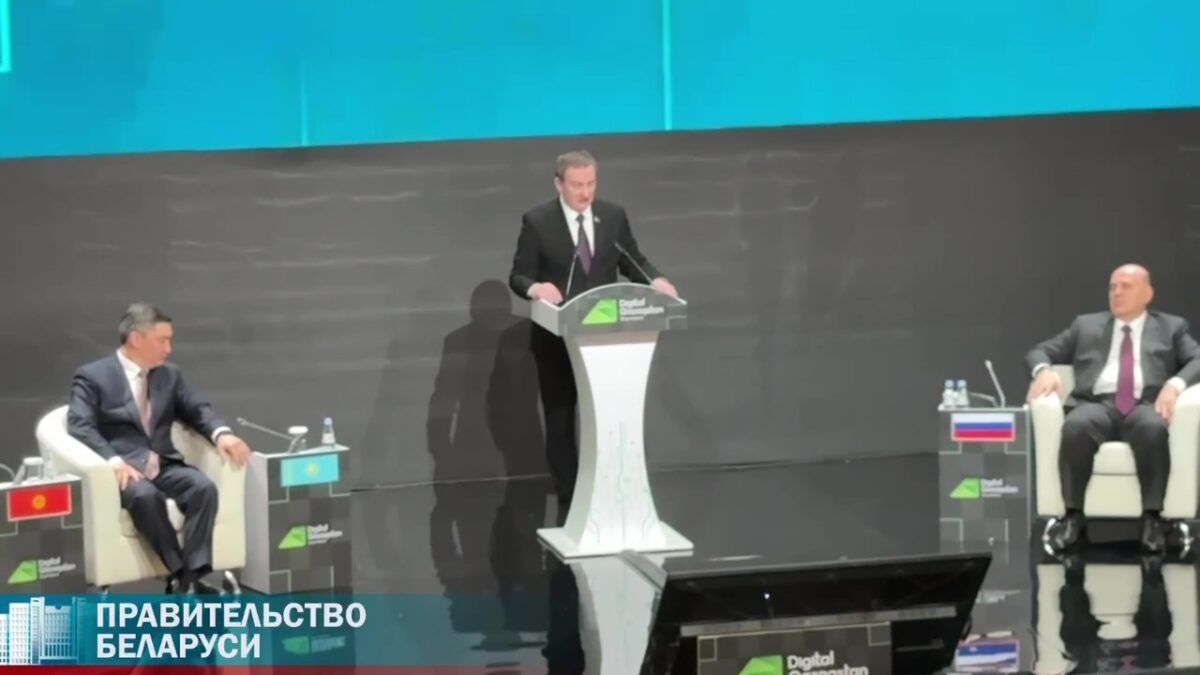
Prime Minister Alyaksandr Turchyn said that Belarus’s largest dairy company is introducing robots into production, speaking at the Digital Forum “Industry 5.0: Power of Interaction” in Kazakhstan, held alongside the Eurasian Intergovernmental Council.

“The Belarusian state and business are introducing new approaches to organizing production, moving from fragmented information systems to a unified digital management environment. One example is the well-known Belarusian dairy brand ‘Savushkin Product.’ About 80 robots have been integrated into the company’s production cycle. They are used to automate processes such as sorting, packaging, and labeling.
Robots are also used in the logistics segment, ensuring storage and movement of goods. At the same time, a robotics laboratory has been created at Savushkin Product, the potential of a regional technical university has been engaged to train specialists, and the company is producing its own robotic systems. In other words, this is not just a modern production facility, but a comprehensive industrial and social complex responding to the challenges of a new industrial era,” he said.
Turchyn also cited BelAZ as another example.
“Today we are testing capabilities and studying the prospects for using an intelligent mining dump truck. This is a Belarusian project both in terms of creating the machine itself and developing the software for it. Communication technologies are used here for connectivity, while artificial intelligence is used to plan the vehicle’s autonomous operation in a quarry,” he said.
According to Turchyn, the world is undergoing a fifth industrial revolution based on digital transformation and robotics, which for Belarus is a strategic priority rather than a trend.
“Industry 5.0 today is both a guarantee and a condition for increasing labor productivity and the competitiveness of Belarusian products. It is also the foundation for further development of human potential, preserving the socially oriented model of the Belarusian state, ensuring resilience to external factors, and strengthening technological sovereignty,” he added.
Turchyn named the Hi-Tech Park as a key driver of the digital ecosystem.
“Residents of the park are developing solutions based on artificial intelligence and computer vision that are already being used in industry — from product lifecycle management to autonomous warehouse logistics. Software systems are also widely used to train personnel for industrial facilities. This is particularly relevant for the energy sector, where so-called digital simulators allow core processes to be practiced and staff to be trained for emergency situations,” he said.
“The Republic of Belarus has a strong set of competencies that enable it to effectively develop technologies of the new industrial era. These include a strong industrial base, an engineering school, a high level of technical education, and a developed IT ecosystem capable of rapidly creating and implementing technological solutions. All of this we are ready to invest in joint work within the EAEU as we enter a new industrial era.
As the president of our country, Alyaksandr Lukashenka, always emphasizes, it is crucial to be among those shaping the rules of the game from the outset, rather than adapting to others’ standards. For any country, achieving this alone would be extremely difficult, if not impossible. But as an integration association, the Eurasian Union can fully participate in shaping the new industrial order,” he concluded.