
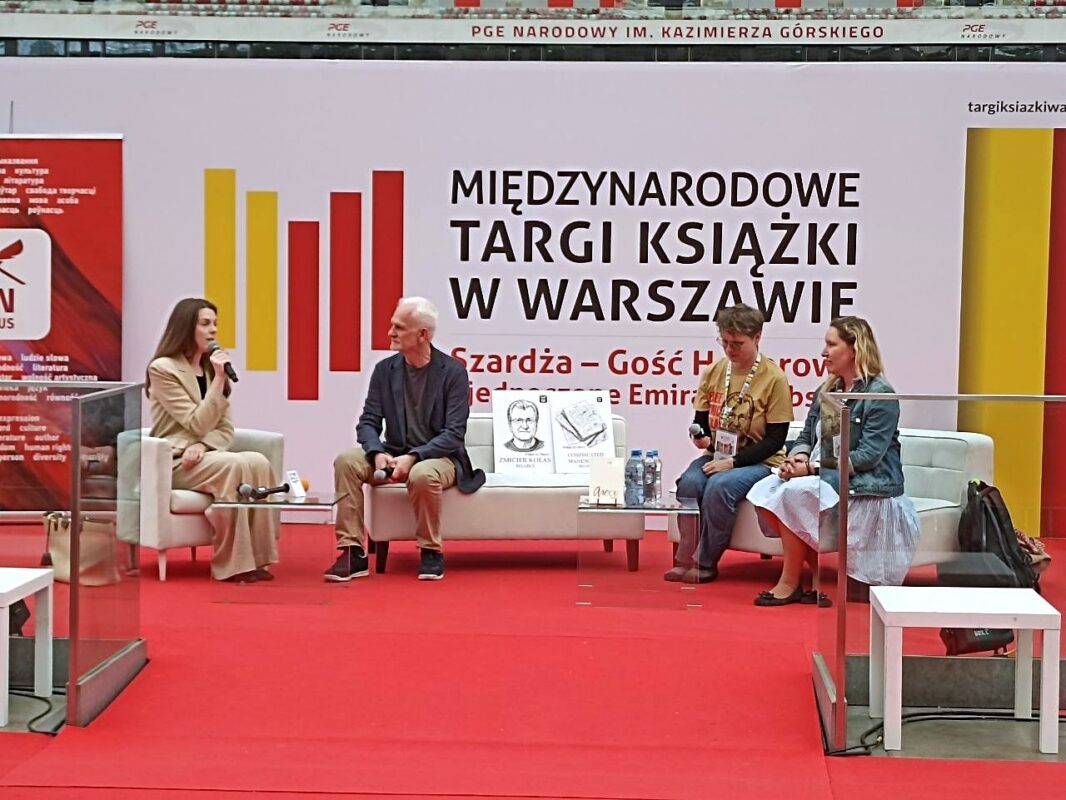
A meeting with Nobel Peace Prize laureate, human rights defender, writer, former political prisoner and member of Belarus PEN Ales Bialiatski was held in Warsaw during the International Book Fair, in which Belarusian publishers are also taking part.
The meeting, moderated by Gazeta Wyborcza journalist Wiktoria Bieliaszyn, was dedicated to the book “Ales,” published by Polatskiya Labirynty. It was presented by Belarus PEN Chair Taciana Niadbaj.
The discussion was primarily intended for a Polish audience. The moderator asked about Bialiatski’s prison experience, the fate of manuscripts left behind in prison, and the state of the Belarusian language. At the end, she asked about hope.
“They Need to Be Given Some Time to Recover”
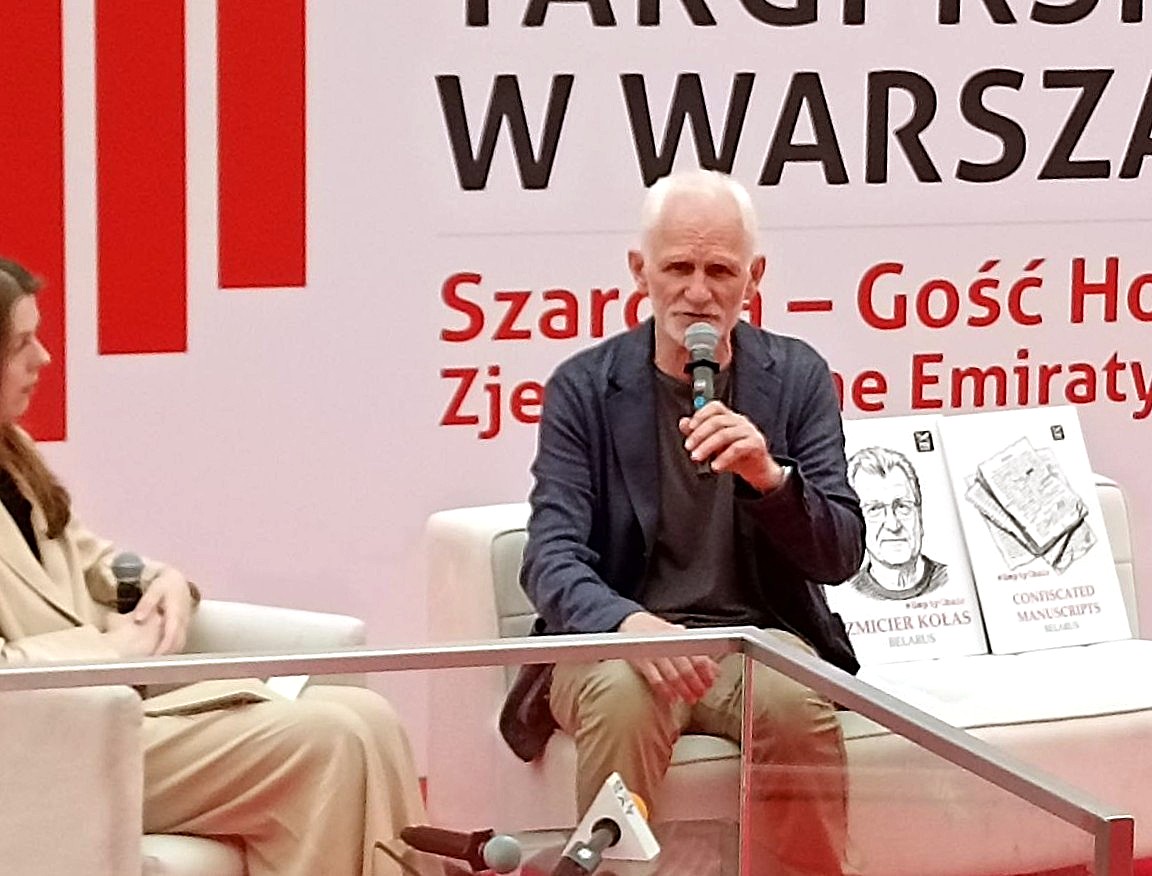
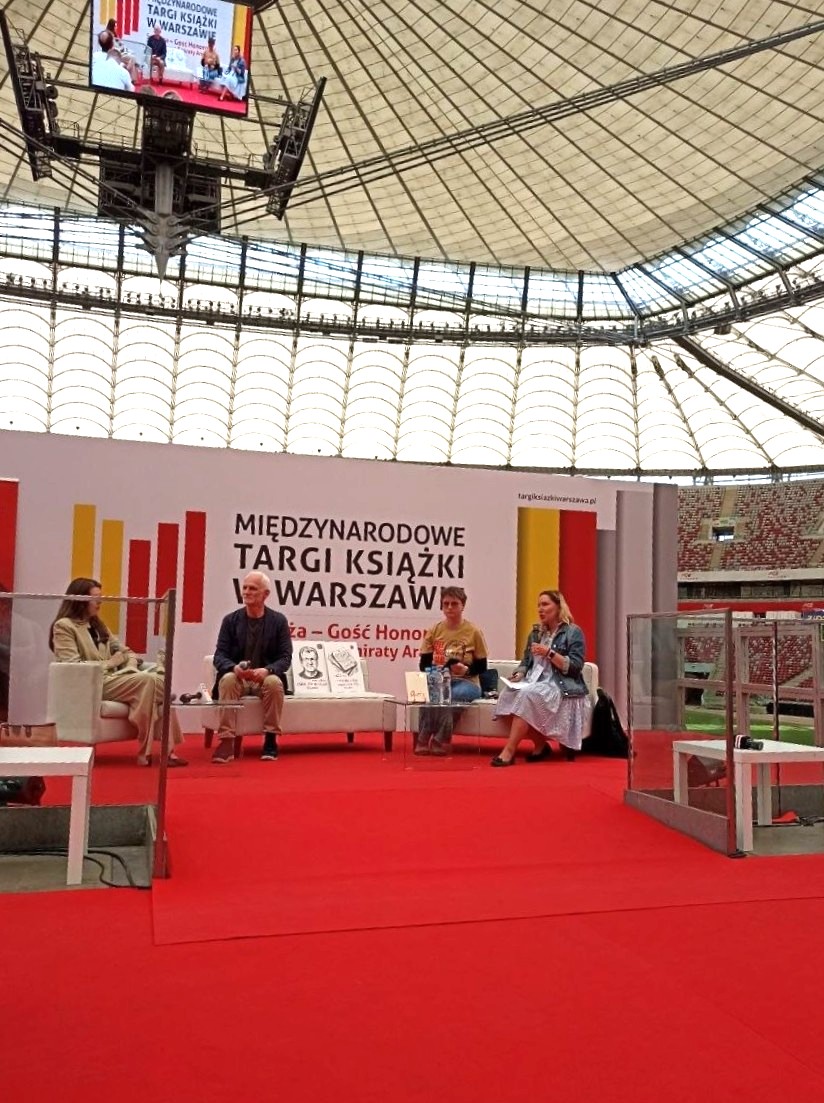
“This is the first time I’ve spoken in a stadium,” Ales Bialiatski joked (this year’s International Book Fair in Warsaw is being held at the National Stadium). The human rights defender said he still does not fully feel that he has left prison, “some part of me still remains there.” But this was not his first prison experience, and he understands that time is needed to recover. For example, immediately after his release he was even afraid to enter the metro.
That is why, when former political prisoners speak or make public statements, it is important to remember that they have emerged from conditions of complete information isolation and immense psychological pressure, and at times physical pressure as well. “They need to be given some time to recover,” the human rights defender believes.
“It Was Our Human Rights Mission”
Four and a half years is undoubtedly time “taken out of one’s life,” but Ales Bialiatski said he does not regret a single minute of those years in prison, even though “they were difficult and hard, but it was a conscious choice, and I explained why we made that choice. What could speak more clearly about the human rights situation than human rights defenders being imprisoned? Nothing more needs to be said. In fact, we continued our work there, although it was a strange form of activity. It was our human rights mission,” Bialiatski explained.
“Nine people from our organization went through prison, but the others continued working. I am very grateful that my colleagues who went through prison were not broken, did not give up, and did not become disillusioned with what they were doing. Of course, it is a huge part of your life that is taken away simply because of your beliefs and your work. But what can you do? If we want to see Belarus as a democratic, independent and European country, then this is the price to be paid. Because the struggle between the civilized world and the post-communist empire, of which Belarus is now a part, continues.”
“The Assimilation of Belarusians Continues”
The Gazeta Wyborcza journalist asked about the state of the Belarusian language.
“The Russification of Belarusians has been going on since the partitions of the Polish-Lithuanian Commonwealth. Poles also experienced what the Russian Empire was like in the 19th century,” Ales Bialiatski replied. “The assimilation of Belarusians continues even now, despite the fact that Belarus has been an independent state for more than 30 years. Belarusian-language education has practically been destroyed. The Belarusian language has become ornamental in nature. It is not represented in various spheres of public life because Lukashenka is deliberately destroying the Belarusian language and thereby destroying a significant part of Belarusian culture. One could say he is destroying the Belarusian soul.
I have fought for the Belarusian language and Belarusian culture all my life, since my youth. Our first underground groups were built around language and culture, and only after that did we arrive at anti-communism because we understood that there was no future for Belarusians in the Soviet Union.”
The human rights defender spoke about the revival of the Belarusian language in the early 1990s. However, when Lukashenka came to power, a rollback began that has continued for 30 years.
“This is the essence of the Soviet ideology in which he was raised. For them, the Belarusian language is decorative; they never saw value in it. Lukashenka did not even see Belarusians as a full-fledged nation. We understand perfectly well that without our culture and without our language, we will never have normal prospects for development.”
The human rights defender also said that political prisoners in the penal colony were beaten for speaking Belarusian, but he himself was left alone because of his Nobel Prize status.
Dialogue or Sanctions?
Who is right — Europe or America? the moderator asked. Should pressure on the regime continue, or should negotiations take place?
“Everyone is right,” the human rights defender replied, “both the American diplomats who are getting hostages out of prisons and the European Union and Poland when they continue sanctions against the regime.”
Sanctions should continue because nothing is changing in Belarus. The state has not stopped helping Russia in the war. For example, the penal colony where he was held had production facilities supporting Russia’s military machine.
Repression has not stopped either. Until repression ends in Belarus and dialogue begins, it is not time to lift sanctions. Pressure on the regime should continue, and the start of dialogue should be demanded.
At the same time, an important nuance is that sanctions should target the regime, not ordinary people. That is why visa support, assistance for students and people-to-people contacts remain important.
Light at the End of the Tunnel
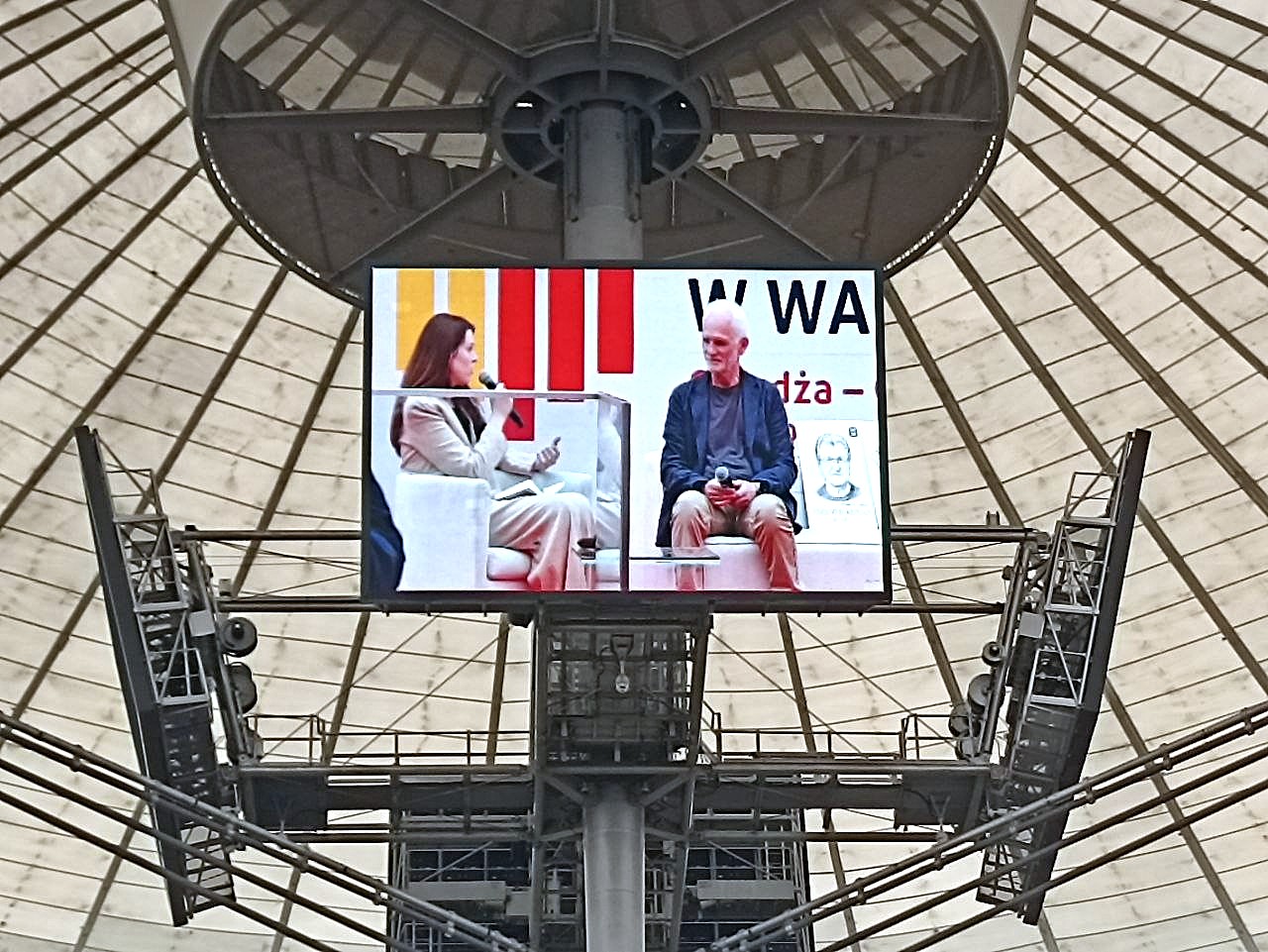
The moderator recalled that after his release, Ales Bialiatski had said: “We are walking through a tunnel and cannot see the light. But we must keep going because the light exists.” Has anything changed now?
“In fact, I can already see that light at the end of the tunnel because the situation itself is not that bad. One can compare it with what was happening in Poland during the 1980s until 1989, when there was harsh confrontation and nobody knew when it would end. The fact that the current Belarusian authorities do not have the support of Belarusian society gives great reason for optimism that change will come,” Ales Bialiatski said.
After the meeting, visitors were able to purchase and have copies of Ales Bialiatski’s books signed at the “Free Belarus” pavilion of Belarusian publishers, organized by the Belarusian Solidarity Centre and the Belarusian Book Institute.
The program of the “Free Belarus” pavilion, which will operate until May 31 at PGE Narodowy Stadium (stand 11/D5) in Warsaw, can be viewed here.