
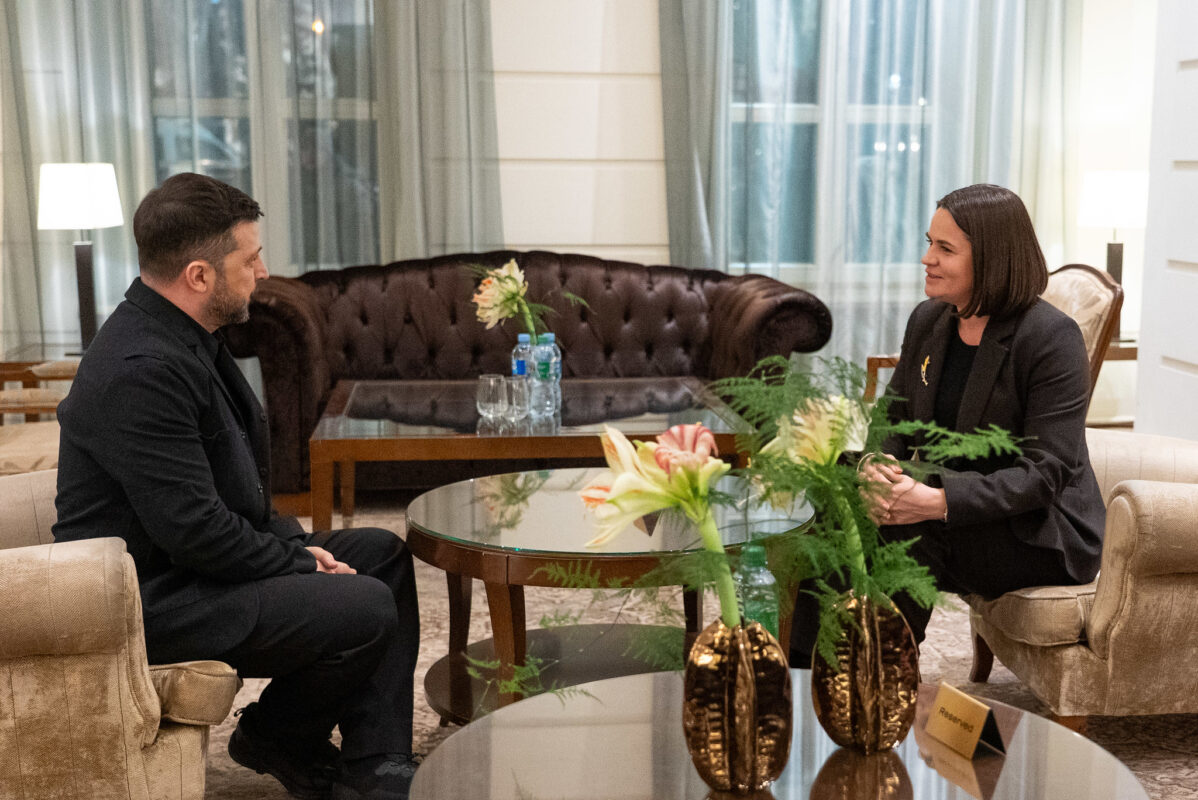
On Sunday in Vilnius, the first bilateral meeting since 2020 took place between Ukrainian President Volodymyr Zelenskyy and the head of Belarus’ United Transitional Cabinet, Sviatlana Tsikhanouskaya. What factors may have influenced Kyiv’s shift in strategy toward the Belarusian democratic forces?

Ukraine’s position toward Belarus, the regime of Alyaksandr Lukashenka, and the Belarusian democratic movement has been shaped by the ongoing war. For understandable reasons, Kyiv sought to prevent deeper involvement by the Belarusian regime in Russia’s aggression. Hence the approach based on a simple maxim: do not provoke official Minsk. Kyiv saw little benefit in close contacts with the Belarusian democratic movement, while assessing the risks as high. The result was limited mid-level contacts and the demonstrative ignoring of Tsikhanouskaya, the leader of the democratic forces.
So what has changed? One of the key factors appears to be talks between the administration of Donald Trump and the Lukashenka regime. This track is important for the Belarusian ruler, and a thaw in relations with Washington virtually rules out Belarus’s full-scale entry into the war. This likely gave the Ukrainian leader grounds to no longer fear the opening of a second front and the participation of the Belarusian army in hostilities. As a result, Kyiv’s room for maneuver toward its northern neighbor expanded.
The meeting between Zelenskyy and Tsikhanouskaya almost certainly received approval from Poland and Lithuania, whose leaders have for years taken a different approach from Ukraine and supported the Belarusian democratic movement. This too may have played a role in Zelenskyy’s decision: once the opportunity arose, he took into account the position of his closest allies and partners in the Lublin Triangle.
Personnel changes in the Office of the President of Ukraine may also have influenced the situation. Back in early December last year, when it became known that Andriy Yermak would step down, followed logically by the departure of several of his appointees, we noted the likelihood of changes in Ukraine’s approach toward the Belarusian democratic movement. The arrival of new figures in Zelenskyy’s administration may not have been the main factor, but it could have been an important milestone in revising the strategy toward Belarus.
Contacts between Tsikhanouskaya’s Office and the Trump administration may also have played a role. For Ukraine today, no voice of support on this track would be superfluous.
The combination of all these factors ultimately led to movement. The Belarusian democratic movement as a whole, and Tsikhanouskaya in particular, ceased to be perceived as a threat. At the same time, tangible advantages emerged for Ukraine. For example, an attempt to derail Lukashenka’s possible participation in talks on ending the war, or at least to make such participation as uncomfortable as possible for official Minsk.
One more point. At the event in Vilnius commemorating the participants of the 1863–1864 uprising, the Ukrainian president unexpectedly spoke at length about our country. In particular, he said that today Belarus is “forced to exist as a Russian governor-generalship.” This may be linked to a nuance important for Zelenskyy from the standpoint of domestic politics — a factor that could soon come to the forefront for the Ukrainian president.
If a peace agreement with Russia is concluded, the outcome of the war, regardless of how it ends, will be used by certain political forces both inside Ukraine and abroad to destabilize the situation in the country. This will especially concern the inevitable territorial losses. These will be presented as Ukraine’s defeat and, consequently, as Zelenskyy’s defeat.
The example of Belarus could become an important argument in the domestic political battle awaiting Ukraine and its president. Zelenskyy can and should tell both supporters and opponents that Russia had prepared for Ukraine the fate of our country — the loss of independence and transformation into a governor-generalship. Only the resistance and courage of the Ukrainian people prevented these plans from being realized. Ukraine managed to withstand the onslaught and preserve its independence. This is the most important result. It is a victory without any exaggeration. Unfortunately, modern Belarus can serve Ukraine in this way as well — as an antipode.
Undoubtedly, the meeting between Zelenskyy and Tsikhanouskaya is also a stop signal to official Minsk. It is a response to Lukashenka’s far-reaching plans and statements that “no one but us will help them (Ukraine — ed. Reform.news) in the post-war period.” Kyiv is clearly signaling that it has different reference points and fundamentally different plans for its post-war future. There is no place for Lukashenka in them. Unlike Tsikhanouskaya.
***
The author’s views and assessments may not coincide with those of the Reform.news editorial team