
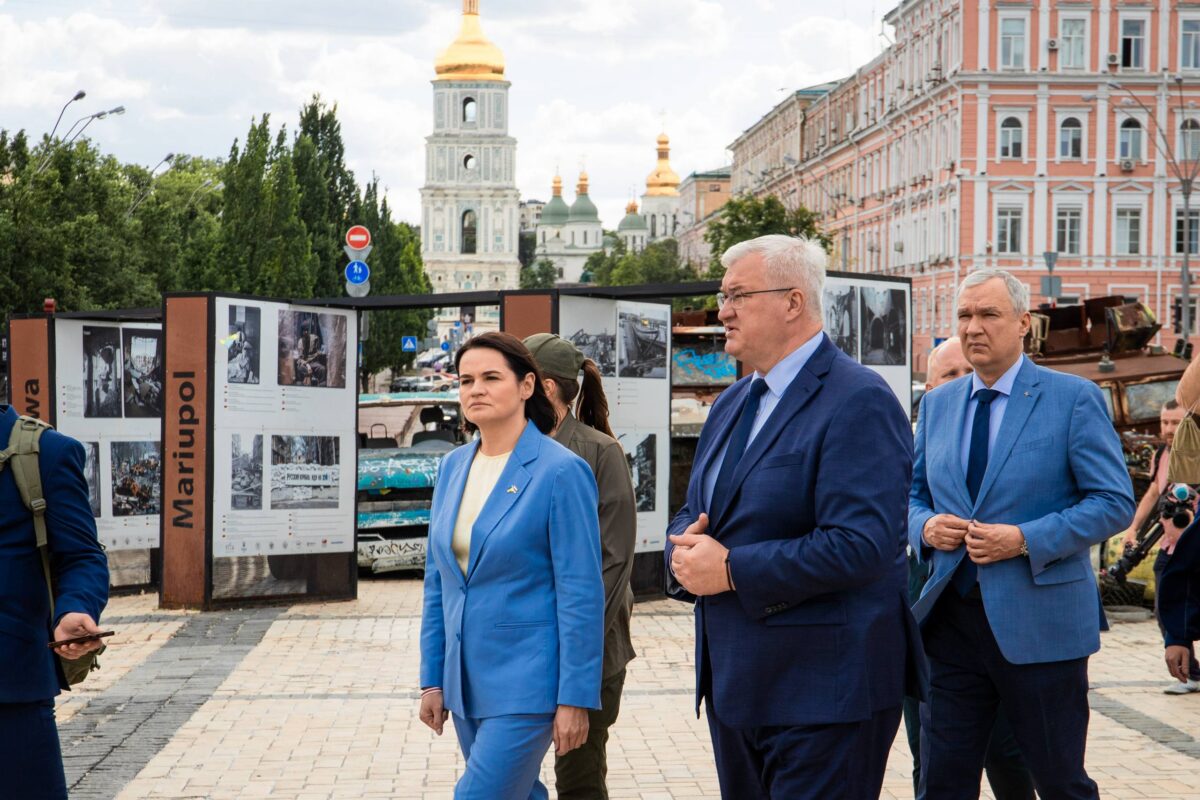
This morning, Sviatlana Tsikhanouskaya arrived in the Ukrainian capital on her first official visit. Why did this happen only now, and what goals might Kyiv be pursuing by inviting the leader of Belarusian democratic forces?

What Was Holding Kyiv Back?
From the very beginning of Russia’s full-scale war against Ukraine, the Ukrainian leadership appeared to follow a strategy toward Lukashenka and his regime that could be described as “not provoking the old man”. Kyiv likely understood the risks of opening a second front in the north of the country and therefore had no intention of provoking Minsk into more active participation in the war.
Perhaps this approach was also partly shaped by the position toward the Belarusian regime held by the close circle of President Volodymyr Zelenskyy. At least, some significant movement in relations with Belarusian democratic forces began shortly after the resignation of the head of the Office of the President of Ukraine — at the end of November last year, Zelenskyy dismissed Andrii Yermak, and already in January the Ukrainian leader met with Sviatlana Tsikhanouskaya in Vilnius. Until then, personal contact between the two politicians had been limited to handshakes during meetings held under EU auspices. At the same time, Zelenskyy invited Tsikhanouskaya to visit Kyiv — before that, the Ukrainian authorities had preferred to receive less prominent representatives of Belarusian democratic forces in their capital.
But were Yermak and his advisers the only reason for such an approach? What had prevented Kyiv from reconsidering its attitude toward Belarusian democratic forces and their leader earlier?
To look for an answer, it is worth paying attention to other dates. The Vilnius meeting between Zelenskyy and Tsikhanouskaya took place on January 25. Already in early February, the Ukrainian president told journalists that there was a risk of Belarus being drawn further into the war. Later, in an interview with the Belarusian outlet Zerkalo, Zelenskyy stated that Lukashenka was gradually drawing Belarusians into the war.
In other words, it was precisely then, in February 2026, shortly after the meeting with Sviatlana Tsikhanouskaya, that Ukraine launched an information campaign. Or, if one prefers, an information and psychological operation aimed at the Belarusian regime.
The campaign then intensified steadily, reaching its peak by mid-May. At that point, the Ukrainian president stated that Russia was planning operations against Ukraine or NATO countries from Belarusian territory, reported Moscow’s intention to “draw Belarus much deeper into the war”, and warned leaders of several EU countries about the Kremlin’s plans regarding Belarus.
And then Sviatlana Tsikhanouskaya arrived in Kyiv.
At the same time, the initially discussed dates for the visit of the leader of Belarusian democratic forces to Kyiv were February–March. At least, those were the dates mentioned by Tsikhanouskaya herself. However, the visit did not take place then. Why did the Ukrainians decide to move the event to May?
Perhaps because by March the client had not yet matured.
Lukashenka and Negotiations
What happened from March through May? Quite a lot of notable developments. Ukrainian drones are now reaching as far as the Urals. Oil refineries in Russian cities have been burning continuously. And not only in regional cities — Ukrainians are already striking Moscow itself. Meanwhile, the Russian army has still been unable to make any significant advances on the front this year. Judging by reports in Western media, divisions and instability are growing among Russian elites. Kyiv is no closer to Vladimir Putin than it was not after three days — but after four years. Any politician supporting Russia, even not especially closely, might reasonably begin to ask whether they backed the right horse.
It appears that Aliaksandr Lukashenka may be asking himself the same question.
For several months now, Kyiv has been deliberately “prodding” the Belarusian politician. At times promising consequences for assistance provided to Russia in carrying out strikes against Ukrainian territory, and at other times hinting at preventive measures “against the de facto leadership of Belarus” in the event of an attack on Ukraine.
And while President Zelenskyy still appears to restrain his language, the commander of Ukraine’s Unmanned Systems Forces Robert “Madyar” Brovdi has been less restrained. Addressing the Belarusian politician, he publicly referred to him as “Lukashescu”, alluding to the grim fate of Romanian leader Nicolae Ceaușescu. He also promised “retribution” for providing a “corridor for killers” — for Russian drones flying into Ukraine through Belarusian territory.
And what about Lukashenka? He preferred to remain silent, responding to Ukrainian rhetoric only minimally. Moreover, after observing an exercise involving the use of nuclear weapons, the Belarusian politician stated in conciliatory terms that he saw neither a civilian nor a military need to become involved in the war in Ukraine.
On the one hand, the value of Lukashenka’s words is well known. On the other hand, immediately after the exercise, the Belarusian politician proposed negotiations with Zelenskyy, saying he was ready to meet “at any point” in Ukraine or Belarus.
It seems the client is gradually becoming more receptive.
And may already be ready for dialogue.
Mutual Interest
Kyiv, however, wants to conduct this dialogue on its own terms. And it is demonstrating this to Lukashenka by using a range of instruments.
For Ukraine, the security of its northern borders is important. Regardless of attitudes toward Lukashenka in Kyiv, at present there is no one else who could guarantee neutrality from the Belarusian side. Moreover, in a way that would make breaking one’s word — as has happened before — no longer seem acceptable. That means Lukashenka needs to come to the negotiating table already prepared. His room for manoeuvre is being deliberately reduced, effectively forcing him to make the decision Ukraine considers necessary. This is the purpose of both the information campaign and the “warning signal” from French President Emmanuel Macron.
And also Tsikhanouskaya’s visit to Kyiv. To strengthen its position in negotiations with Lukashenka, Ukraine is using, among other tools, Belarusian democratic forces. The message directed at the Belarusian politician is simple — if you are still not ready to talk to us on our terms, we will find someone else to speak with. So act quickly while the offer remains on the table. And these negotiations are extremely important for Lukashenka. If Russia begins to collapse — whether on the battlefield or economically — his fate will, in essence, end up in Ukraine’s hands. Kyiv is already setting the rules. Lukashenka may, of course, resent the Ukrainians for inviting Tsikhanouskaya. But his resentment no longer seems to concern many people there.
At the same time, there is little reason to be upset by what may appear to be a somewhat transactional attitude by the Ukrainian leadership toward Belarusian democratic forces. High politics is not built on charity. Everyone has their own interests and their own stakes. Sviatlana Tsikhanouskaya in particular, and Belarusian democratic forces in general, did not lose from the visit to Kyiv. Quite the opposite. The same cannot necessarily be said about Aliaksandr Lukashenka, whose faith in miracles and room for manoeuvre appear to shrink with each new successful strike by the Ukrainian Armed Forces.
The author’s opinions and assessments may not coincide with the editorial position of Reform.news