
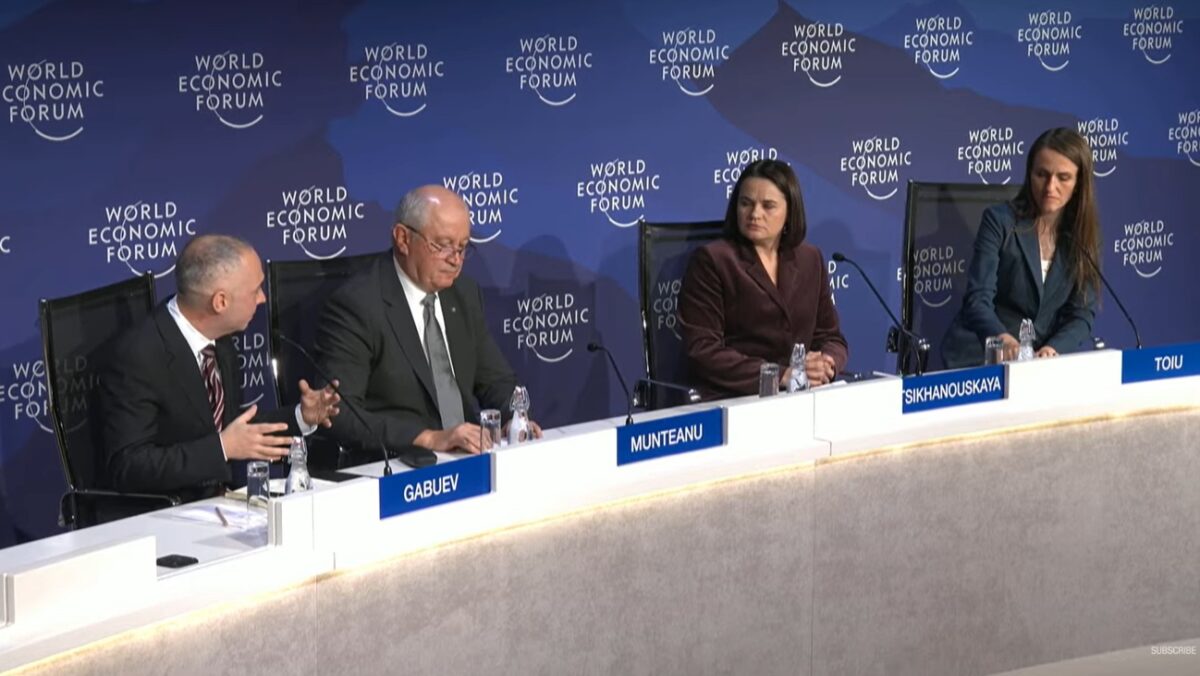
Sviatlana Tsikhanouskaya has welcomed U.S. efforts to secure the release of Belarusian political prisoners, including in exchange for easing sanctions against Alyaksandr Lukashenka. In her view, the European Union should adhere to a consistent sanctions policy. She made the remarks during a discussion titled “Can Russia Sustain a Wartime Economy?” at the World Economic Forum in Davos.
“The case of Belarus very clearly shows that sanctions work, because Lukashenka is releasing people not because he has suddenly become humane. I would not suspect Lukashenka of humanity at all. He is doing this because sanctions work, isolation is effective, and he is ready to release even his biggest enemies just to get rid of these sanctions. In our case, we have developed a formula: U.S. sanctions are for freeing people, European ones are for freeing the country,” she said.
According to her, European sanctions are far more serious than American ones. As an example, she cited the ban on the transit of potash fertilizers. Even if U.S. sanctions on the potash sector are eased, she said, revenues will not be significant without transit through Lithuania.
“Without transit through Europe, especially through Lithuania, Lukashenka will not gain much benefit. That is why European sanctions should serve irreversible, larger-scale changes in Belarus. And of course, you know, in the case of our country I am very grateful to John Coale, the U.S. special envoy for Belarus, for his truly intensive work on freeing people. But we are asking Europe not to copy the policy of President Donald Trump when it comes to sanctions,” she said.
Tsikhanouskaya stressed that when speaking about sanctions pressure on Russia, one must not forget about countries that support Moscow.
“Undoubtedly, Lukashenka’s economy works for Russia. Around 200 Belarusian enterprises produce military equipment for Russia’s war. Most Russian missile systems use Belarusian chassis. And Belarusian banks are used for military contracts. Therefore, it is very important to align sanctions against the Belarusian regime and Russia in order to avoid the use of these loopholes. Of course, now is not the time to lift sanctions against the Belarusian regime, because this would definitely strengthen Russia,” she said.