
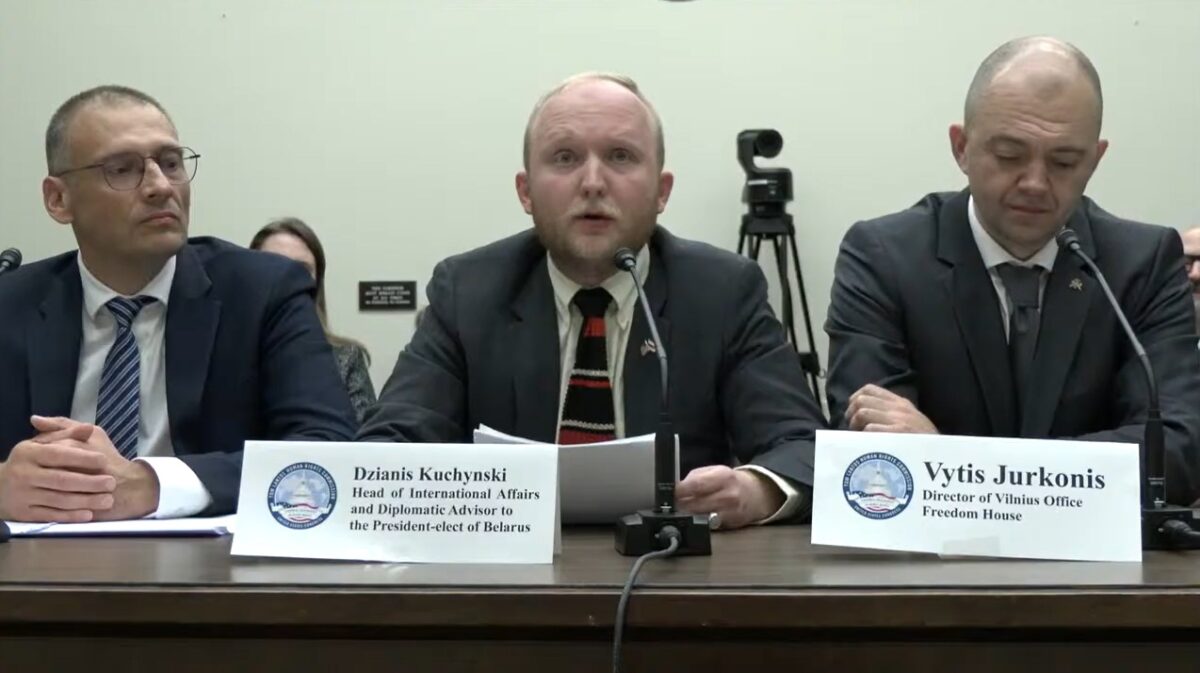
A hearing on human rights in Belarus was held in the U.S. Congress at the Tom Lantos Human Rights Commission. The hearing featured Siarhei Tsikhanouski, adviser to Sviatlana Tsikhanouskaya Dzianis Kuchynski, and Director of Freedom House in Lithuania Vytis Jurkonis.

Continuing Strategic Dialogue Between the United States and Belarusian Democratic Forces
In his remarks, Dzianis Kuchynski thanked the United States for its efforts to secure the release of Belarusian political prisoners. According to him, about 300 people have been released over the past 18 months. At the same time, repression in Belarus has not stopped, and conditions of detention for political prisoners are worsening, including placement in unheated punishment cells during freezing temperatures and the maintenance of an incommunicado regime for a number of political prisoners, including politician Mikalai Statkevich.
“Last year, I personally participated in all five release groups. I saw what freedom after torture means. And yet new arrests continue every week. Lukashenka releases some hostages and then takes new ones. We must continue working together to stop this,” Kuchynski said.
He urged the U.S. side to step up efforts to secure the release of all political prisoners and to end repression, including transnational repression. Kuchynski also proposed expanding humanitarian assistance for political prisoners and continuing support for democratic institutions, including the Office of Sviatlana Tsikhanouskaya, the United Transitional Cabinet, and the Coordination Council.
In his view, the United States should maintain pressure on official Minsk through sanctions, with any easing linked to real, verifiable improvements in Belarus.
“It is critically important that the United States continue the strategic dialogue between the United States and the democratic forces of Belarus,” he emphasized.
“Lukashenka wants the world to believe that the situation in Belarus is calming down. In reality, repression has only intensified. We must continue to act decisively to save lives whenever possible.
And the American approach truly saves lives. At the same time, the European approach with tough sanctions remains the most important guarantee of saving the country. This balance must remain coordinated,” he continued.
Kuchynski stressed that a free and sovereign Belarus is in the national interests of the United States. This would mean fewer risks to NATO’s eastern flank and less space for anti-American influence.
“We hope for continued partnership until every political prisoner is freed, repression ends, and Belarus returns to democracy,” he concluded.
Trump’s Coercive Diplomacy
Siarhei Tsikhanouski told the commission about conditions of detention in Belarusian prisons and penal colonies. He stressed that his story is not unique, but that other political prisoners must not be overlooked.
“More than a thousand political prisoners are still being held in Belarusian prisons. And among them are people whom Lukashenka deliberately hides from you. People whom he does not want to release under any circumstances. People whose prison terms are so long that they should never have been served to the end,” Tsikhanouski said.
He drew attention to former judges and investigators who have been recognized as political prisoners, received lengthy sentences, and whom Lukashenka is unwilling to release.
Tsikhanouski said that “coercive diplomacy under the leadership of President Donald Trump” is a real option.
“Lukashenka needs President Trump far more than President Trump needs Lukashenka. This gives the United States and the special envoy, Mr. Coale, enormous leverage.
We have already seen how this leverage works. Lukashenka was one of the first to sign an agreement with the newly formed Peace Council. Watching Belarusian propaganda try to explain this moment was almost surreal: a petty dictator who has falsified every election since 1996 suddenly trying to look like a global peacemaker.
Lukashenka is a very sensitive political creature. He understands who is in power today. He understands that the American concept of ‘peace through strength’ leaves little room for criminal regimes like his own. His conversations with his ‘friend’ Maduro are still fresh in his memory,” Tsikhanouski said.
He also noted that Lukashenka is trying to attract American business by offering potash fertilizers and data centers, and by seeking to present himself as a mediator between the United States and the Kremlin, as well as other authoritarian regimes. In Tsikhanouski’s view, this gives Washington enormous leverage that can be used wisely.
“I will not presume to give President Trump advice on how to use coercive diplomacy. We should all learn from him.
But I can say this: Mr. Coale holds all the cards.
If there is political will in Washington, it will be possible not only to free all remaining hostages, but also to insist on a complete end to political repression,” Tsikhanouski concluded, adding that he has additional recommendations that are better discussed in private.
U.S. Policy Should Not Be Limited to Calls for Unconditional Release
Vytis Jurkonis, Director of Freedom House in Lithuania, said that after releasing political prisoners last year, the Belarusian authorities detained at least 509 people who were subsequently recognized as political prisoners. He also drew attention to the fact that released political prisoners were expelled from the country without passports, limiting their ability to exercise their rights. In addition, Belarus has stopped providing a number of consular services to its citizens abroad, further restricting their rights. Political prisoners who are released in Belarus after completing their sentences continue to face pressure.
“In practice, political prisoners serve as bargaining chips for the Belarusian authorities. Arrests and selective releases are used to obtain concessions — as soon as the regime achieves its goals, it imprisons even more people, promising Belarus a bright future. As one group is released, even more people end up behind bars. Releases are a kind of deal designed to manage pressure without changing the existing system.
This approach is often combined with deliberate escalation in the security sphere through hybrid provocations, including migration pressure and border destabilization, followed by partial rollbacks that are then presented as concessions. The result is a cycle in which Belarus appears to offer cooperation while retaining full control over the timing and scope of any so-called goodwill measures. While international actors are occupied with resolving artificially created crises and seeking limited concessions from Belarus, Alyaksandr Lukashenka continues a large-scale campaign of internal repression against his own people, and Russia is able to continue its war against Ukraine, including constant attacks on civilian targets,” he said.
Jurkonis proposed reaffirming support for Sviatlana Tsikhanouskaya. He also said that the United States should treat the practice of political imprisonment in Belarus as a permanent phenomenon rather than isolated cases.
“This means sustained attention to arrests, conditions of detention, releases, and post-release treatment. The release of high-profile prisoners, while significant, does not absolve the regime of responsibility for the thousands of others who remain behind bars. Moreover, U.S. policy should not be limited to calls for unconditional release alone. It is necessary to ensure the release of all political prisoners, the dropping of all politically motivated charges, and guarantees that those released will be able to remain in the country rather than being forced into exile,” he said.
Jurkonis also said it is necessary to demand meaningful reforms in Belarus. In his view, lifting sanctions on Belarus should be conditioned on its refusal to support Russian aggression against Ukraine and on the withdrawal of Russian troops and nuclear weapons from Belarusian territory.