
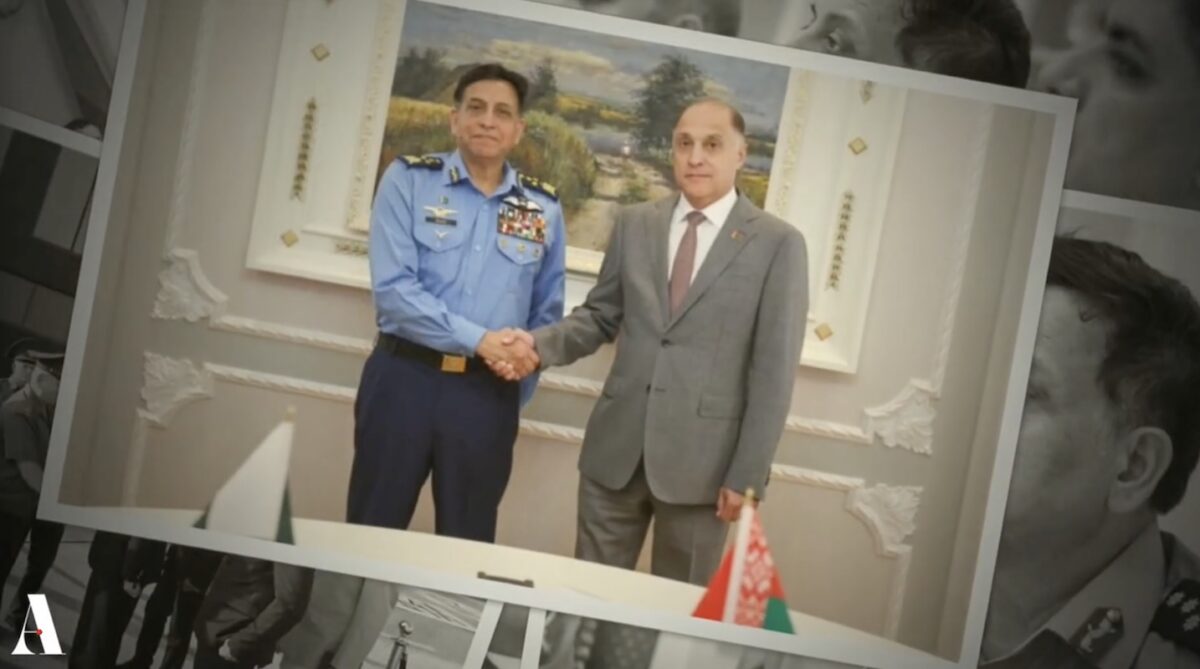
During his visit to Minsk, the Chief of the Pakistan Air Force held talks with the leadership of the Belarusian armed forces and the Security Council. According to the authors of the AXIS programme on India’s The Times of India, the visit points to the emergence of new defence cooperation between Pakistan, Belarus and Russia.

According to the programme, Islamabad views Belarus not only as a supplier of military equipment but also as a partner in technology transfer and joint production. The authors note that the bilateral roadmap for 2025-2027 envisages the development of joint manufacturing rather than merely the procurement of military hardware.
The programme says Belarus has a well-developed defence industry producing drones, microelectronics, electro-optical systems and heavy military chassis, while its close alliance with Russia gives Minsk access to Russian technologies.
“Also, there is another dimension to this that is often underreported. Belarus is one of the world’s most effective sanctions-busting corridors. Western restrictions on Russia have not stopped Moscow’s war machine, because Belarus acts as a transit hub. Technology that cannot go directly from Europe or Asia to Russia often goes through Minsk. That corridor is being opened for Pakistan as well, which means Pakistan could potentially access Russian and Chinese defence technology through Belarusian pipelines in ways that are harder to track, harder to sanction, and harder to counter,” the programme’s authors claim.
The Indian analysts argue that the cooperation could help Pakistan develop its own defence industrial base and reduce its dependence on Western arms suppliers. Particular attention is paid to drone technologies. Following the conflict between India and Pakistan in May 2025, Islamabad is seeking not only to purchase advanced drones but also to establish domestic production, according to the programme.
At the same time, the programme notes that India itself is also actively cooperating with Belarus in the defence sector. The authors refer to the participation of Indian military personnel in the Zapad-2025 exercises, India’s purchase of Belarusian Berkut-BM loitering munitions, and contacts with the Belarusian holding company BelOMO.
AXIS concludes that the system of military and political partnerships in Eurasia is becoming more flexible and that Pakistan is attempting to replicate the model of diversified defence cooperation previously pursued by India. At the same time, the authors stress that it is still too early to speak of a full-fledged strategic alliance between Pakistan, Belarus and Russia, as much will depend on the scale of technology transfers, financing and Moscow’s policy toward New Delhi and Islamabad.