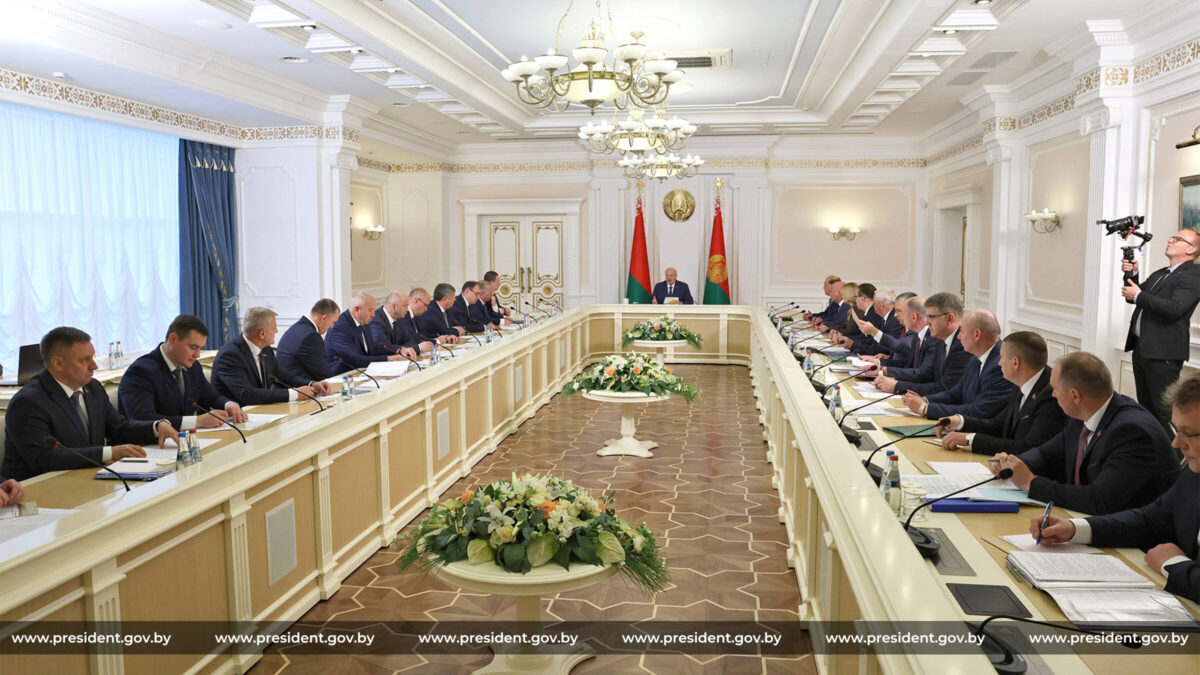
Aliaksandr Lukashenka is concerned that Belarusian farmers are not taking up their quotas of mineral fertilizers, which are sold to them on preferential terms. As a result, the products cannot be sold on the foreign market, where prices are currently high. Lukashenka raised this concern at a meeting that also addressed new mechanisms for supplying fertilizers to agricultural enterprises.

“Fertilizers are supplied to agricultural organizations — collective and state farms, as they were called in the old days — by producers every year, whether in the autumn for winter crops or in the spring for spring crops. This is financed accordingly. The state participates in this process and helps agricultural organizations purchase these fertilizers”, he said.
According to him, the practice will continue, but there is no extra money.
“There should be no excesses — there is no extra money in the budget either. The government draws up monthly schedules for fertilizer purchases by region and determines the sources of financing. These are the national and local budgets, the agricultural enterprises’ own funds and, above all, credit resources on preferential terms.
Overall, the picture is normal. As of August 1, 92% of the quotas for mineral fertilizers had been taken up. The remaining 8-10% were not taken up not because they did not want or did not need them — some simply cannot afford to pay. But more than 90% is a good level of mineral fertilizer uptake. At the same time, some regions do not fully purchase their quotas during the year. For winter sowing, in the nitrogen and phosphorus groups, only half of the regions have fully taken up their quotas. What is the reason if, as you claim, there are raw materials and sources of financing have been identified?” Lukashenka said.
According to him, in some cases fertilizers allocated under quotas are not taken up.
“The product is tied up. It has not been taken up by the domestic market, and they cannot sell it on the foreign market because they need to grow and cultivate their own grain. As I said earlier, given the current global situation, enterprises could easily sell on the foreign market, and at a higher price. For example, nitrogen fertilizers are one and a half times more expensive than what we supply to the domestic market”, he said.
Next year, he proposes increasing fertilizer purchases by another 18% to account for growth in agricultural production.
“Consequently, even more funds will be needed — about 3 billion rubles in total — as well as real sources of financing. To reduce the cost of mineral fertilizers for farmers and ensure that quotas are taken up, the government has developed new approaches”, he added.
According to him, the government proposes that half of the purchases be paid for directly from the budget, with the money sent to fertilizer producers. The other half will be purchased by farmers using their own funds, loans and local budgets. The producer will ship the fertilizers only after full payment. Oversight of implementation will be assigned to the chairmen of regional executive committees.
“What concerns us is that we are paying money and, above all, what efficiency we will get from this money, not the quotas. And another thing: will the new approach eliminate the practice of making unplanned appeals to the president for additional resources? Most importantly, will this motivate the hypothetical director to work harder and more efficiently, since we are all solving his problems?” Lukashenka concluded.