
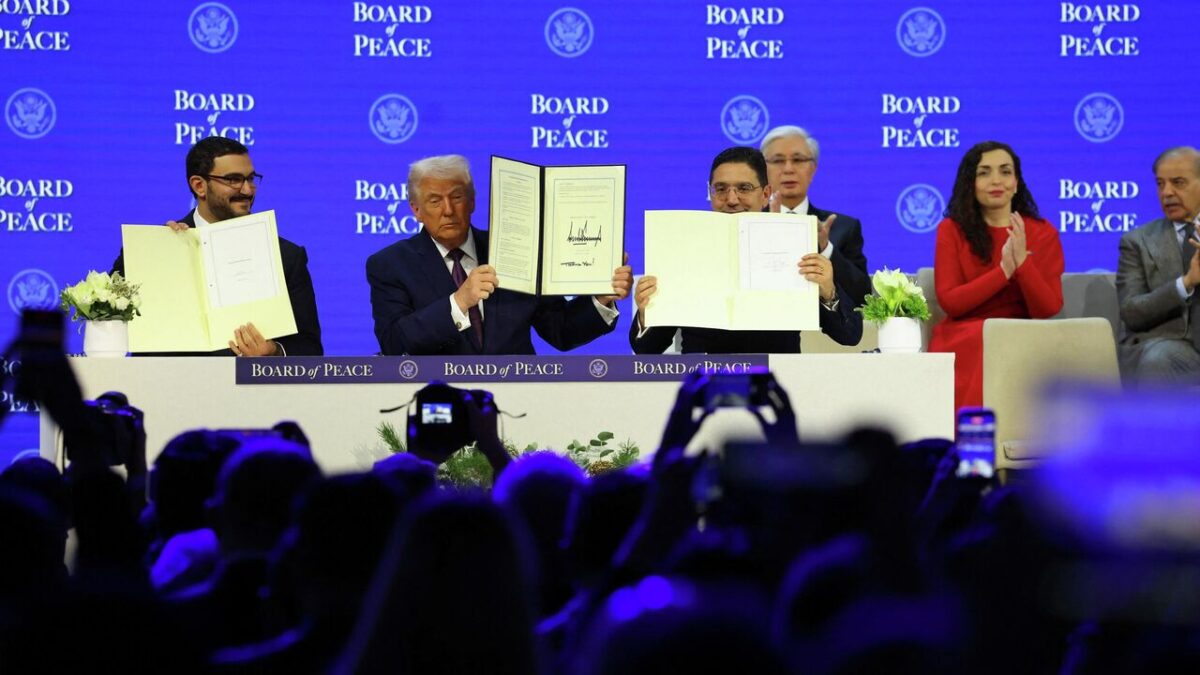
Today, at the World Economic Forum in Davos, a ceremony was held to sign the charter of the World Peace Council established by U.S. President Donald Trump. How does the invitation to Aliaksandr Lukashenka correspond to the aspirations of the Belarusian politician, and has he really obtained what he wanted?

Distant Gaza
The creation of a World Peace Council for Gaza was envisaged in the Comprehensive Plan published in September 2025 by Donald Trump to end the war in the enclave. The plan provided for the temporary transfer of Gaza under international administration, to be headed by the Council.
In November last year, the United Nations approved the U.S. president’s plan through a resolution and welcomed the creation of the World Peace Council. The task of this body, as the White House stated, is “to play a critical role” in implementing the 20 points of the plan “in transitioning the enclave from conflict to peace and development.” The Council was personally chaired by President Donald Trump.
In January, two structures were established within the Council: a “Founding Executive Council,” which will handle investments and high-level diplomatic contacts, and a “Gaza Executive Council,” which will oversee the work of the National Council for Coordination of Action in Gaza, a body responsible for the reconstruction of the enclave.
A Strange Invitation
As reported by Axios, Donald Trump invited the leaders of 58 states to join the World Peace Council he was creating. Among others, an invitation was extended to Aliaksandr Lukashenka. Minsk reacted with undisguised delight, and the Belarusian politician signed the accession document among the first — at that moment, only the leaders of a handful of states had announced their decision to support Trump’s initiative.
Today, at the ceremony in Davos, the charter of the Council was signed by the U.S. president himself and by the leaders of the countries present who accepted the invitation. Among them were Argentina, Armenia, Azerbaijan, Bahrain, Bulgaria, Hungary, Jordan, Indonesia, Kazakhstan, Kosovo, Pakistan, Paraguay, Qatar, Uzbekistan, Morocco, and Mongolia. Turkey, the United Arab Emirates, and Saudi Arabia were represented at the level of ministers and foreign ministry officials. Belarus was also among this group — by Lukashenka’s instruction, the ceremony was attended by the country’s ambassador to Switzerland, Aliaksandr Hanevich.
Franak Viačorka, an adviser to Sviatlana Tsikhanouskaya, who was participating in the World Economic Forum, said that Lukashenka wanted to be personally present at the signing of the World Peace Council documents today, “but it did not work out, and he tried in vain.”
Viačorka did not explain why it “did not work out,” but one can assume that the forum’s organizers did not want to see Lukashenka in Davos. If so, this is telling. In principle, at first glance, it appears that the Belarusian politician will end up as little more than a “ceremonial figure” in the newly established Council. He was invited purely for numbers — it is clear that the more states represented in the Council, the more impressive this organization will look. The “price of the issue” is also illustrated by the fact that, in the list of countries participating in the new association published by the White House, the Americans confused Belarus with Belgium.
It seems that Lukashenka himself understands perfectly well that he can offer little assistance in establishing peace on the shores of the Mediterranean. “What can we do there, really help Gaza much? If we help, it won’t be much,” the politician said frankly after receiving the invitation.
However, there is an important “but” that allows Lukashenka to watch the creation of the World Peace Council with optimism.
What Lukashenka Was Aiming For
The UN resolution approving the creation of the World Peace Council states that the mandate of this body runs until the end of December 2027 and is limited to the Gaza Strip. But it appears that Donald Trump has a different vision and different goals.
A senior U.S. official told Axios: “The World Peace Council will not be limited to Gaza. It will be a World Peace Council for the entire world.”
Several days ago, The Times of Israel published the text of the World Peace Council charter, which, it claims, was attached to the invitations sent out to join the organization. Here is an excerpt:
“The World Peace Council is an international organization that seeks to promote stability, restore credible and lawful governance, and ensure lasting peace in areas affected by or at risk of conflict.” There is no mention of the Gaza Strip in the charter text at all.
It appears that, according to Trump’s design, the World Peace Council he created is intended to deal not only with Gaza, but also with other conflicts — including, presumably, the war unleashed by Russia against Ukraine.
And this works in Lukashenka’s favor, as one of his most important goals is to find himself at the negotiating table on peace in Ukraine and on the postwar arrangement of our region. If this happens, it can be stated that the Belarusian politician will obtain what he has been striving for. That is precisely why the invitation to the Council is so important to him.
“What attracts me is that perhaps this World Peace Council, some of its actions and capabilities, will extend to other parts of the planet. First of all, maybe we can help with Ukraine in some way, discuss something and move peace forward, bring it closer, influence the Ukrainian leadership,” Lukashenka did not hide his hopes.
Higher Than Ever Before
The prospects of the World Peace Council are not yet entirely clear. At present, despite the invitations received, a number of important global players have not joined it — China, India, the overwhelming majority of EU countries, and U.S. allies in NATO. Neither Russia nor Ukraine has joined so far. And without the involvement of these states, it will be difficult for the Council to achieve peace in Ukraine.
We are closely watching Gaza, which will become the first test for Trump’s initiative. The future of this association will largely depend on how successful the World Peace Council is in this region. And unraveling the many years’ tangle of contradictions of the Middle Eastern conflict will be far from easy.
If the Council stalls, it risks repeating the fate of Joe Biden’s “Summit for Democracy” or the “European Political Community” created at the initiative of French President Emmanuel Macron, turning into a low-impact “club of interests” for right-wing politicians and autocrats.
But if things move forward in Gaza, if there are still no breakthroughs in the conflict between Moscow and Kyiv, and if the World Peace Council takes on the Russian-Ukrainian war, then Aliaksandr Lukashenka will come out on top. After receiving Trump’s invitation, his chances of ending up at the negotiating table have become higher than ever before.
***
The opinions and assessments of the author may not coincide with the opinion of the Reform.news editorial board