
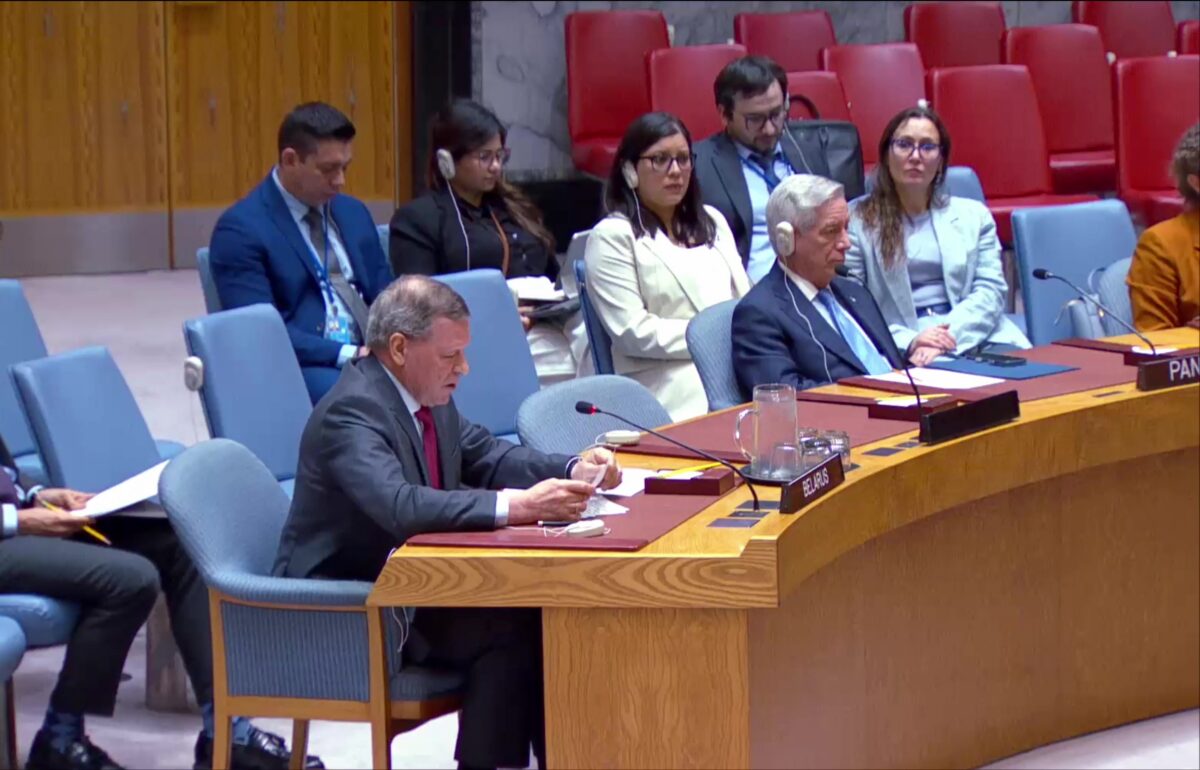
Belarus’ Permanent Representative to the United Nations Valiantsin Rybakau identified the type of drone used in the attack on a Belarusian bus in Russia’s Bryansk region during a UN Security Council meeting devoted to the incident. According to him, the UAV was manufactured in Ukraine.

“Today we have sufficient evidence to state responsibly that the attack on the Belarusian bus was carried out using a Ukrainian-made strike UAV. The drone belongs to the Darts type and is equipped with fragmentation elements. Its warhead contains approximately 1,200 grams of explosive in TNT equivalent,” he said.
Rybakau added that investigators recovered objects bearing Ukrainian-language markings at the scene.
“Such drones are a development of the Ukrainian engineering group Steel Hornets and use FPV control technology. During the inspection of the scene, investigators recovered objects bearing Ukrainian-language markings. Among them was a detonator control unit manufactured at a plant in Shostka, Sumy region. The detonator itself and the battery are also components manufactured in Ukraine. Drones of this type are produced at various Ukrainian enterprises, including makeshift production facilities. The manufacturing cost is about US$1,000. On the Ukrainian side, the principal operators of this system are units of the Main Intelligence Directorate, the Security Service of Ukraine, and various formations of the Armed Forces of Ukraine,” he said.
At the same time, the Belarusian envoy did not identify who had carried out the attack. He condemned the strike, calling it a provocation aimed at escalating the conflict and dragging Belarus into the armed conflict between Russia and Ukraine. Rybakau also stressed that the absence of an immediate and forceful response from Minsk should not be interpreted as weakness, indecision, or cowardice.
Rybakau also said that another drone had been discovered on Belarusian territory on the day of the attack.
“One recent example is the discovery on June 17, 2026, of a similar drone in the Lelchytsy district of Belarus’ Homiel region, identical to the UAV that attacked the Belarusian bus in Russia’s Bryansk region on the same day. The fuselage of the crashed drone was oriented toward the north and northeast, indicating a flight path from Ukraine to Russia through Belarus. I deliberately cite this specific example because investigators in the Republic of Belarus have established that the UAV found in the Homiel region and the drone used in the attack on the Belarusian bus carrying children in Russia’s Bryansk region were equipped with identical components and belong to the same type of drone. It has been established that both UAVs—the one in Russia’s Bryansk region and the one in Belarus’ Homiel region—were, as of June 17, 2026, within the signal range of four units of the Armed Forces of Ukraine stationed in the Chernihiv and Sumy regions.
If Belarus requested a UN Security Council meeting after every drone incident on its territory, there would be more such meetings than the Council’s regular monthly sessions on the agenda item ‘Maintenance of international peace and security of Ukraine,'” Rybakau said.