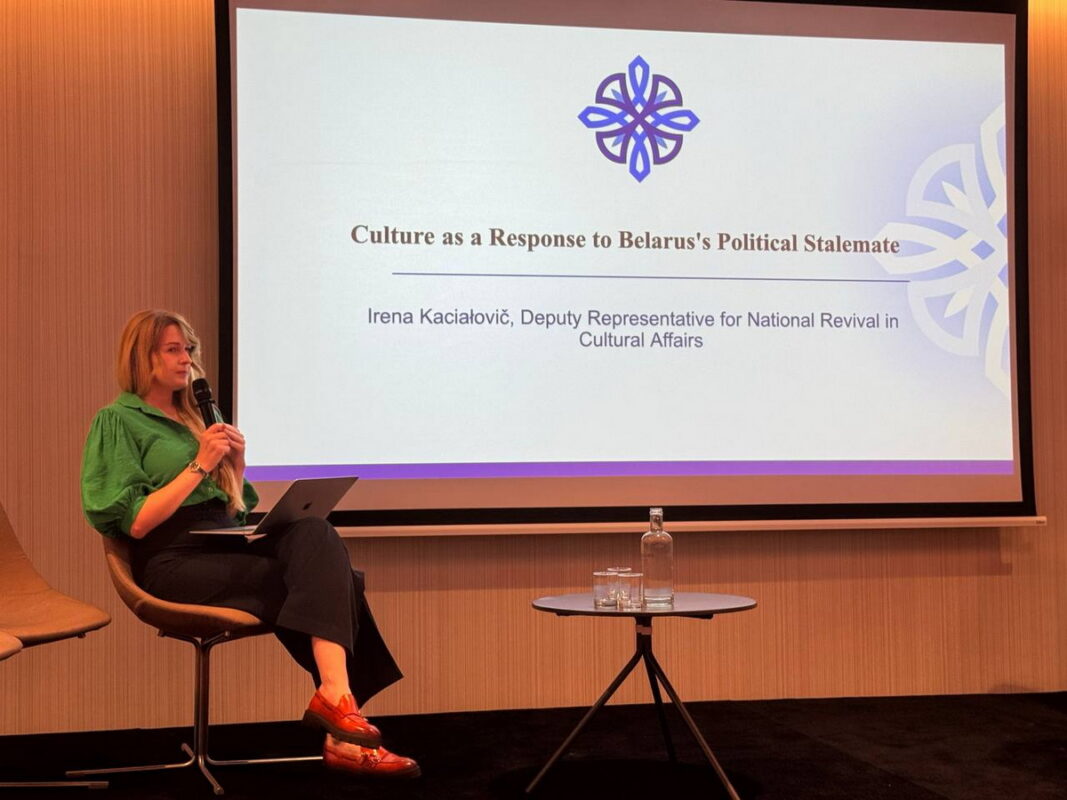
Participants at the side event “Language, Culture, Education and Media: The Invisible Front for Belarus,” held as part of the New Belarus Conference, discussed the importance of Belarusian culture and language for preserving national identity.

Representative for National Revival Pavel Barkouski said the new policy papers are not only an analysis of the current situation but also an attempt to influence it. In his view, the work should not end with the presentation of documents but should continue through coalition-building, finding partners and developing broad dialogue.
A policy paper on the strategic role of Belarusian culture was presented by Deputy Representative for National Revival for Culture Irena Katsialovich.
According to Katsialovich, one of the main threats facing Belarus is the deliberate reshaping of the country’s national identity by Russia and the regime of Aliaksandr Lukashenka. She said Russification is accompanied by repression, pressure on independent cultural figures and attempts to appropriate historical memory.
“A state may lose its borders. But it can restore them only if it has preserved its cultural identity,” Katsialovich said.
She stressed that culture should be viewed not only as a sphere in need of support but also as an element of democratic resilience, national security and a long-term strategy for Belarus.
According to her, independent Belarusian culture retains the capacity for self-organization and development, while the growing importance of the Belarusian language and culture for national identity creates opportunities to strengthen this area further.
“I believe Belarusian culture can become a success story. I even think that a new Belarusian wave could emerge in Belarusian culture and become a phenomenon not only in Belarus but across Europe,” she said.
Among the proposals outlined in the policy paper is a shift from humanitarian support for culture to its systematic development. Specifically, it proposes creating a Belarusian-European cooperation platform, identifying partner countries for specific cultural fields and developing a long-term strategy.