
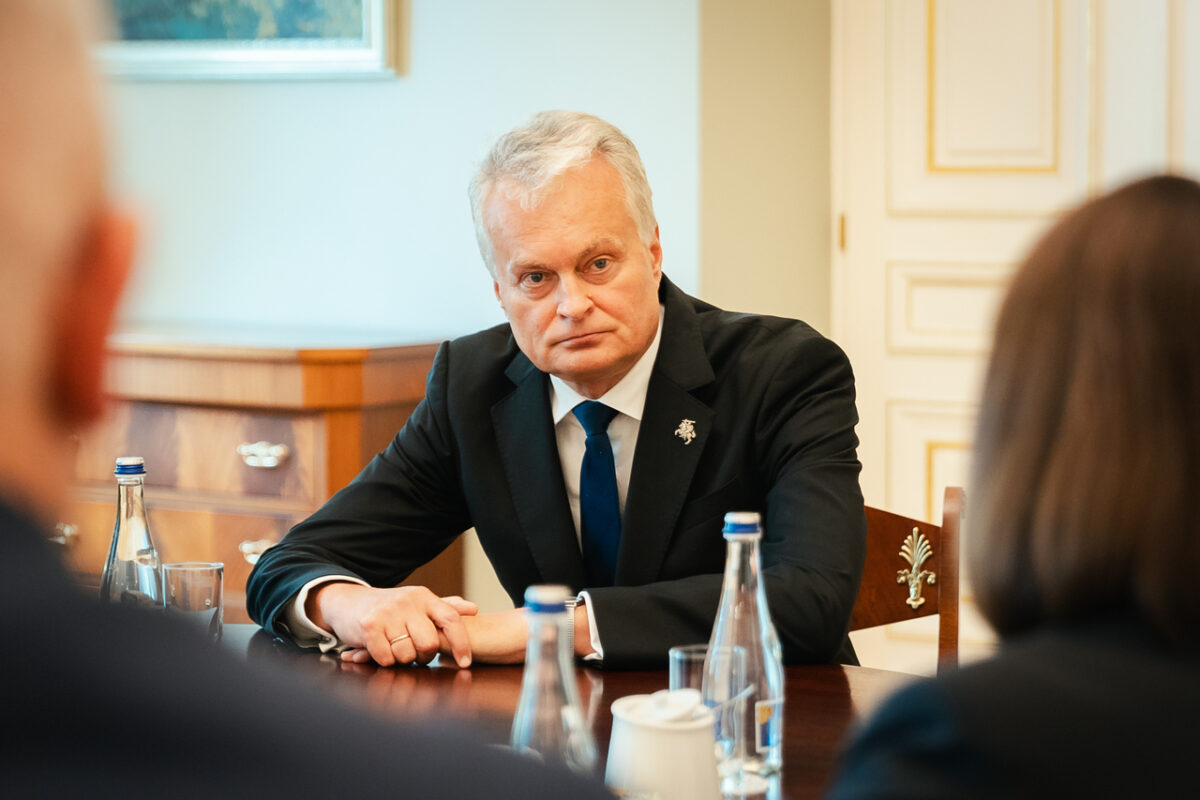
Lithuanian President Gitanas Nausėda said in an interview with BNS that he will continue to uphold a tough position on the transit of Belarusian fertilizers.
The Lithuanian president was asked whether he felt confident enough on this issue, given that during the election campaign he had been accused of having ties to businesses involved in the fertilizer trade.
“The issue of Belarusian fertilizers, I would say, evokes only a sad smile, because I was probably one of the most ardent supporters of sanctions against Belarusian fertilizers in all formats – in the European Council and beyond. That is why it really hurts me to hear these attacks. I am now discussing this with the leaders of neighboring countries – both with the Prime Minister of Poland and with the Prime Minister of Latvia. Yesterday we talked about this with the German Chancellor, Mr. Friedrich Merz. I asked his opinion on how events might develop further. In any case, Lithuania’s position remains very firm,” he said.
According to Nausėda, the German chancellor understands the “expediency of sanctions” against Belarus and supports them.
“In the course of these talks, I hope we will be able to form a very strong and clear coalition that will say that the export of Belarusian fertilizers through our ports is an unequivocal ‘no’,” Nausėda added.
The Lithuanian president was also asked to assess a situation in which the country might come under pressure from its partners to resume transit, as well as possible attempts to link such a decision to the deployment of U.S. troops.
“You know, for me values-based policy is not an empty concept or an empty word. Therefore, to take such actions as you mention – that is, to trade in values – is completely unacceptable to me. Consequently, any conclusions that we could sell something in exchange for a more flexible position on the issue of Belarusian fertilizers are, in principle, unacceptable. And this, by the way, is the policy of the European Union, because this is not a Lithuanian sanctions regime imposed on Belarus,” Nausėda said.