
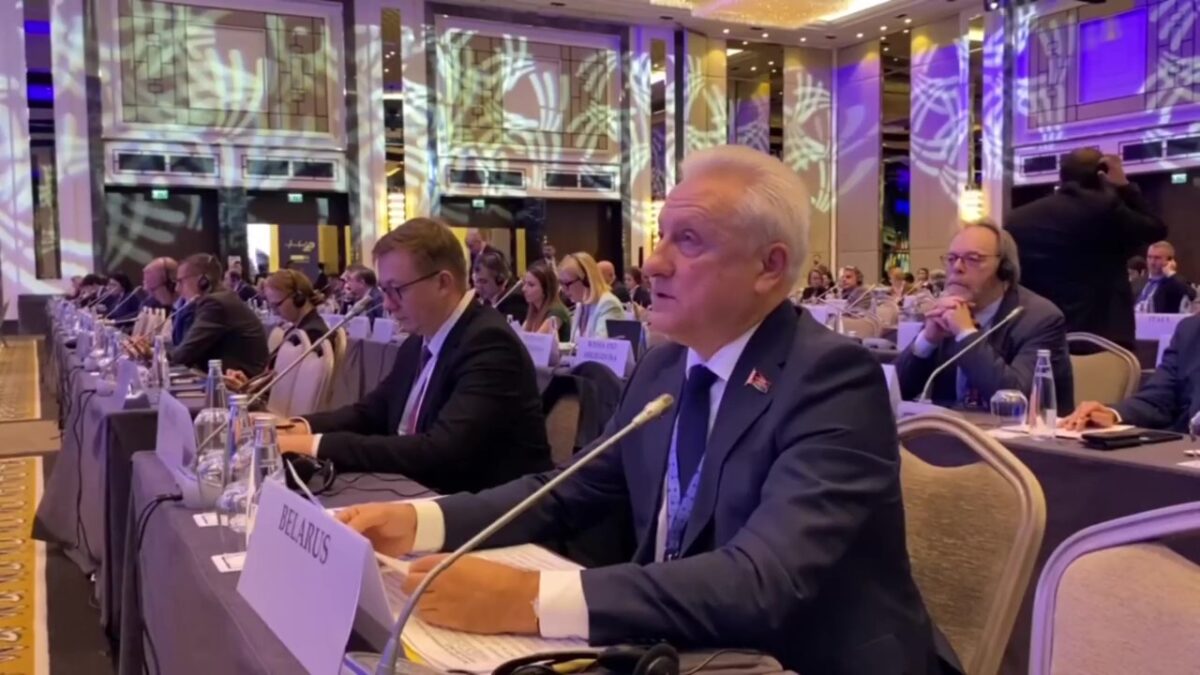
Minsk is proposing the creation of a Eurasian security architecture stretching from Vancouver to Vladivostok, as well as from Reykjavík to Shanghai. This was stated at a meeting of the OSCE Parliamentary Assembly’s Permanent Committee in Istanbul by Siarhei Rachkou, head of the Permanent Commission on International Affairs of the House of Representatives.

“Today the European continent is dominated by confrontation and mistrust. It resembles less an illusion of peace or a platform for dialogue, and more an arena of political accusations and mutual reproaches. Belarus is convinced that the future of the OSCE depends not on who takes the chairmanship, and not even on whether the organization’s budget is adopted.
The fate of the organization depends on the political will of participating states to restore respect, dialogue and trust — the very things for which Helsinki 1975 took place in the first place,” he said.
“Belarus advocates restoring the genuine principle of the Helsinki Final Act: equality, indivisible security and non-interference in internal affairs. Without this, neither genuine trust nor lasting peace is possible.
Located in the center of Europe, Belarus is more interested than anyone else in restoring peace, security and stability on the European continent. And it is doing everything possible. But it seems Europe does not need peace. Politicians have forgotten the losses already brought by the Second World War,” he noted.
According to Rachkou, European politicians believe that building up military potential can provide security.
“This is a road to nowhere,” he said.
“We propose beginning substantive work on forming a new Eurasian security architecture covering the entire shared geography from Vancouver to Vladivostok, from Reykjavík to Shanghai. Discussion of the future of the OSCE and Eurasian security must take place in a constructive, inclusive format.
Belarus is ready to host such meetings, including at the platform of the Minsk Conference on Eurasian Security, which has already become traditional,” Rachkou continued.
He presented several figures about the conference, emphasizing that representatives from more than 40 countries came to Minsk.
“Belarus invests in diplomacy, not in armaments. We invite all participating states to a dialogue without preconditions and political demands,” he said.
“Today we have a chance to restore the spirit of Helsinki — not in words, but in actions. And if not us, then who will preserve the OSCE as an organization for this dialogue?” Rachkou concluded.