
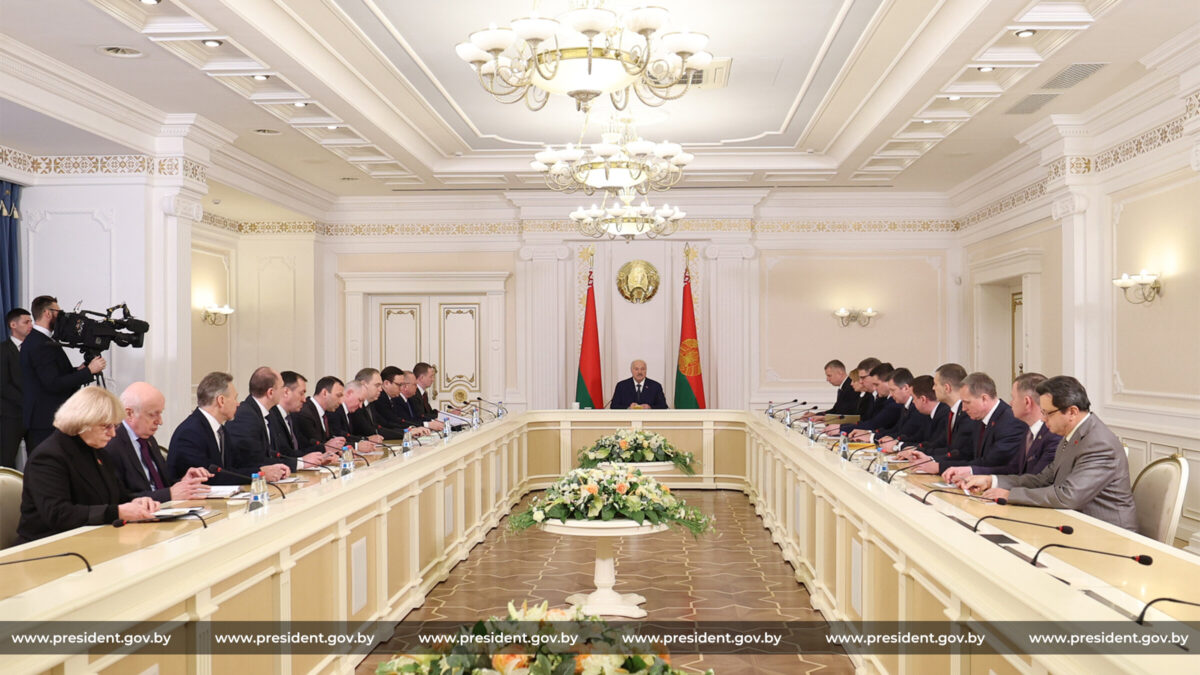
Alyaksandr Lukashenka was proposed to create an “intellectual special forces.” This is how future graduates of a center for training personnel in promising fields were described by Education Minister Andrei Ivanets. Representatives of the government, the Academy of Sciences, local authorities, and universities were invited to the meeting dedicated to the creation of the center.

Opening the meeting, Lukashenka stressed that the education system must be a priority. In his view, education and science are at a special stage of development.
“One of the most important tasks for the country today (perhaps the most important task) is the modernization of the economy on an innovative basis.
We have learned to do many things, but mostly we repeat what has already been done in the world: we copy, add something of our own, and sometimes add nothing at all. This is natural — all countries act this way,” he said.
He added that advanced countries can be called such only when they are able to produce something of their own from start to finish, and complained that Belarus cannot boast many such developments.
“As everywhere in the world, we are creating new industries (but far too few of them). They operate autonomously, with minimal human involvement or even without it. Scaling up such high-tech production is the key to our future well-being.
But for such a serious innovative transformation of the economy, we need specialists capable of competing in terms of knowledge with the world’s leading schools. And not just competing, but creating a high-quality and competitive Belarusian product. This is task number one for the higher education system,” he said.
Lukashenka proposed identifying promising areas.
“Today we need to determine what these promising areas are, without which no state can do,” he said.
In his report, Ivanets outlined these areas: aircraft manufacturing, digital technologies, biotechnology, and a number of other fields for training personnel in engineering specialties. According to him, experimental training programs are already being implemented at several universities, but not all students are able to master them.
“This does not mean that we are training them poorly. We are training them for absolutely all sectors of our economy. But we need a kind of special forces. And in this case, it will in fact be a continuation of the trajectory of the National Children’s Technopark, where we see that concentrating such young people was absolutely justified,” he said.
As usual, Lukashenka questioned the idea proposed to him.
“Why is it proposed to transfer part of the experimental programs being implemented (eight out of 18 are already being implemented at universities) from our leading universities to the center? Are they not coping?” he asked.
“I want everyone to understand this. We cannot afford to strip the leading higher education institutions of the country of their staff (to some extent this could happen), of the scientific schools that exist there, and even more so to weaken regional universities. A decline in the quality of education is unacceptable. The international prestige of our higher education and the export of educational services depend on this,” he continued.
Lukashenka asked what prevents organizing training on university platforms, what the uniqueness of the selection and training of specialists would be, and how they would later be retained. According to him, it is proposed to recruit to the center those who have already completed university studies and are ready to delve deeper into a specific field and create “miracle products.” Others propose recruiting graduates straight after school.
“Naturally, the very best, the most progressive and talented people will be drawn there for both study and teaching. This must be clearly understood. But a finished product must come out of there. That means that strong specialists must come there. Will people who come today to study after secondary school be able to do this?” he asked.
The issue of using the Biology Center under construction at Belarusian State University was also raised. Lukashenka was interested in the prospects of the facility if various models of educating talented youth were implemented.
“And whether it is necessary to create a separate center at all to develop these areas. We have the capacity to create a separate center, but it seems to me that we also have the capacity to develop them within our traditional centers of science and education. I mean universities, institutes, the Academy of Sciences. There is enough space — if only there were people who could move this forward,” he said.