
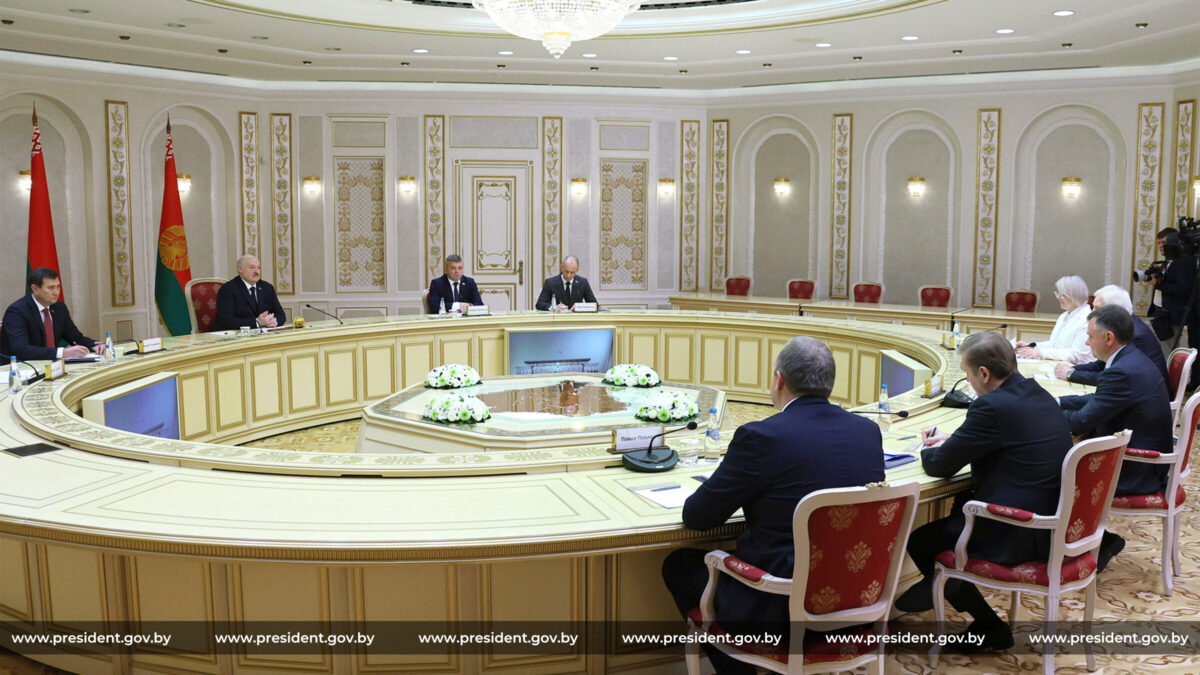
Alyaksandr Lukashenka told Rostov Region governor Yury Slyusar during their meeting today that nothing and no one will break his alliance with Russia. He also spoke about the prospects of building another nuclear power plant in Belarus, saying he hopes to convince Russian officials to build it so that he can earn money by selling electricity to southwest Russia.

“The external pressure is colossal. I won’t name addresses, passwords, or details. You know this well. That’s why we must hold on to what’s ours. Belarus and Russia have been together and will remain together. No one will be able to tear apart our unity, no matter how much someone may want it. The people, the nations, will not allow it. We must endure it, we must keep it. That is the main thing,” Lukashenka said.
He held a meeting last week on the construction of a second nuclear plant. Following the discussions, a decision was made to build a third power unit at the Astravets plant, while also continuing research for another nuclear plant in the Mahilyow region.
“We decided that we will build the third unit and will conduct a dialogue on building the second nuclear plant — again in the east,” Lukashenka said.
“If we build a second nuclear plant in the southeast of Belarus… Who knows? Maybe southwest Russia will need it. Anything is possible,” he added.
According to him, he had already discussed this with Russian President Vladimir Putin on Saturday.
“We discussed this issue the day before yesterday with Vladimir Vladimirovich, and agreed to continue the discussion,” Lukashenka said, noting that the Russian president supported the construction of the third power unit.
“We are ready to build the third unit. The President has no objections at all — I sense and know his support. The head of Rosatom fully supports it. Of course, they are interested. Especially since we are ready to build about 85–90 percent of this plant ourselves. As for engineering and the reactor — that will be the Russians. We will take the main elements from Russia; we can handle everything else. The Russians taught us during the construction of the first plant,” he said.
This is not the first time Lukashenka has voiced such an idea. In March this year, addressing the Russian Federation Council, he said that if a second nuclear plant were built, he would be able to supply electricity to Russia’s Bryansk region and the “new regions of Russia.” On 26 September, during talks with Putin, Lukashenka said that a plant in eastern Belarus could be built to “supply electricity to the areas liberated by Russia — Kherson, Zaporizhzhia, Luhansk, Donetsk.”
The meeting also touched on proposals for cooperation in other areas, including machinery and machine-tool production.
“We are ready to go there and offer conditions better than foreign companies. It depends on you. The decision has been made, and we will act in this direction,” Lukashenka said.
He recalled meeting Yury Slyusar when the latter headed the United Aircraft Corporation. According to Lukashenka, Slyusar once said that without machine tools, one cannot speak of mechanical engineering or aircraft manufacturing. Lukashenka today tried to assure him that Belarus does produce machine tools, even if not the most advanced ones.
“We have preserved all the enterprises that existed in the Soviet Union. And we have even advanced, as far as possible,” he said.
“In the media they increasingly say: oh, CNC machines, oh, some ‘space-age’ machines that we have only seen and cannot produce, while only one and a half or two countries can. Maybe so. But not many of those machines are needed. Everything else we know how to make — both in Russia and especially here. I know this for sure,” he added.
Lukashenka also raised the issue of building a multibrand center for Belarusian equipment in the Rostov region.
“We need to think about organizing everything in one center and as close as possible. So that we can sell our machinery and spare parts at a favourable, competitive price,” he said.