
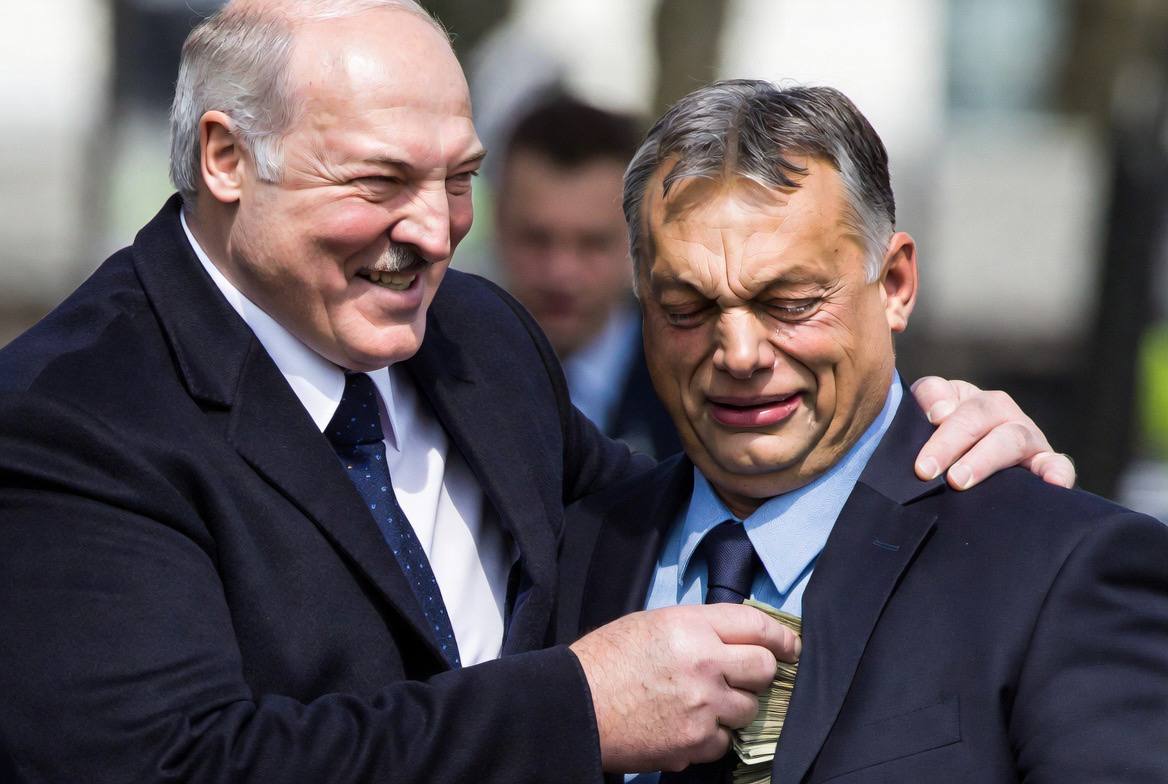
While the TISZA party and its leader Péter Magyar celebrate victory, leading global media outlets are identifying the winners and losers of Hungary’s election campaign. Among the winners are the EU and its leaders Ursula von der Leyen and António Costa. With reservations, Ukraine is also included. Among the losers are the Kremlin, Donald Trump and the far-right wing of European politics in general. But what about Alyaksandr Lukashenka? Should the Belarusian politician be pleased or disappointed by the defeat of Viktor Orbán and his Fidesz party?
Congratulatory Latitude
Today, Lukashenka congratulated Péter Magyar on his victory, expressing hope that “the traditions of friendship and mutually beneficial cooperation that have developed over many years between Minsk and Budapest should continue.”
It is noteworthy that the congratulatory message was published by the politician’s press service after Kremlin spokesman Dmitry Peskov commented on the results of the parliamentary election in Hungary at a briefing. He said that Russia respects the choice of the Hungarian people and expects pragmatic contacts with the country’s new leadership to continue.
However, Lukashenka still allowed himself some latitude in offering congratulations, since the Kremlin refused to congratulate Magyar and his party on their victory, explaining its position by saying that Russia does not send congratulations to “unfriendly countries.” “And Hungary is an unfriendly country: it supports sanctions against us,” Peskov explained.
Most likely, this is not so much an attempt to distinguish himself from his senior ally and demonstrate a slightly different position, but rather Lukashenka’s traditional approach of trying to extract everything possible from the moment. Congratulating someone costs nothing, but the recipient will remember it. And at some point, that may prove useful.
The Costs of Magyar
Lukashenka is probably sorry for Orbán. At least because the collapse of any politician inclined toward authoritarianism is painful for autocrats. Such an event evokes unpleasant associations for them. After all, Orbán spent years reshaping the electoral system to suit himself and squeezing independent media. But in the end, the people — whom autocrats do not regard as political actors — had their say and chose another force.
On the other hand, Orbán’s example is further proof of Lukashenka’s own view that the reins must not be loosened even slightly. Give people a chance to run a campaign and count the votes honestly, and you will have problems. The other screws, too, must be kept tightly fastened.
There are other costs as well. It is unfortunate to lose a “Trojan horse” in the EU. Although this is more of a headache for Moscow than for Minsk. Still, by torpedoing sanctions, Orbán was helping Lukashenka too. Now, the new Hungarian government is likely to abandon that practice. This is probably the biggest problem for Russia and, consequently, for Lukashenka.
However, according to Orbán government Foreign Minister Péter Szijjártó, “80% of oil enters Hungary through Belarus”, and “without the Druzhba pipeline, Hungary’s secure oil supply is impossible.” The new Hungarian government will not be able to change this situation overnight, so contacts with Minsk will remain at some level. Magyar promised that if his party won the election, Budapest would maintain “pragmatic relations” with Moscow. Lukashenka’s regime is also unlikely to become an exception to this approach for a renewed Hungary. That is why the congratulatory message was sent to Budapest.
But the foreign minister in Magyar’s future government, unlike predecessor Szijjártó, may no longer visit Belarus. And it is also unlikely that anyone from Budapest can be persuaded to attend another Minsk international conference on Eurasian security. Minsk may have to make do with Russia, North Korea and Myanmar. Likewise, Magyar is unlikely to follow in Orbán’s footsteps and fly to Minsk before an election to support Lukashenka. For a Belarusian politician not spoiled by attention from Europeans, all of this is, of course, not very pleasant. But it is survivable.
One Less
At the same time, if desired, Lukashenka can find some advantages in Orbán’s defeat. At the very least, he now has one less competitor. He wanted negotiations on the Russian-Ukrainian war to take place in Minsk. But last autumn, Donald Trump announced a meeting with Vladimir Putin in Budapest. Those talks never took place, but Hungary’s capital had long been seen as an acceptable venue for both Moscow and Washington. Now, having lost their friend Orbán, Putin and Trump will have to reconsider a possible meeting place, at least for image reasons. Yes, there is still their friend Recep Tayyip Erdoğan, but Lukashenka’s chances of hosting such talks in Minsk have increased significantly.
The number of Moscow’s friends in power has also declined. That only increases the value of those allies who remain. And this allows Lukashenka to hope for more, including loans, subsidies and other material assistance. Russia, having once again invested significant resources in a failed campaign in a democratic country, may also begin to wonder whether it is more profitable to invest in allies who face no risk of re-election by definition.
Trump has also lost his European protégé. The Trump administration sought out and supported leaders close to it ideologically, and in this respect Lukashenka resembles Orbán. So, in order to strengthen its position in Eastern Europe, the current U.S. administration may decide to pay a little more attention to Minsk than before.
So, for the moment, things are working out well for Lukashenka. As the number of competitors decreases, his own value as an asset increases. And the Belarusian politician will certainly not miss the opportunity that has presented itself.
The author’s opinions and assessments may not coincide with the position of the Reform.news editorial team