
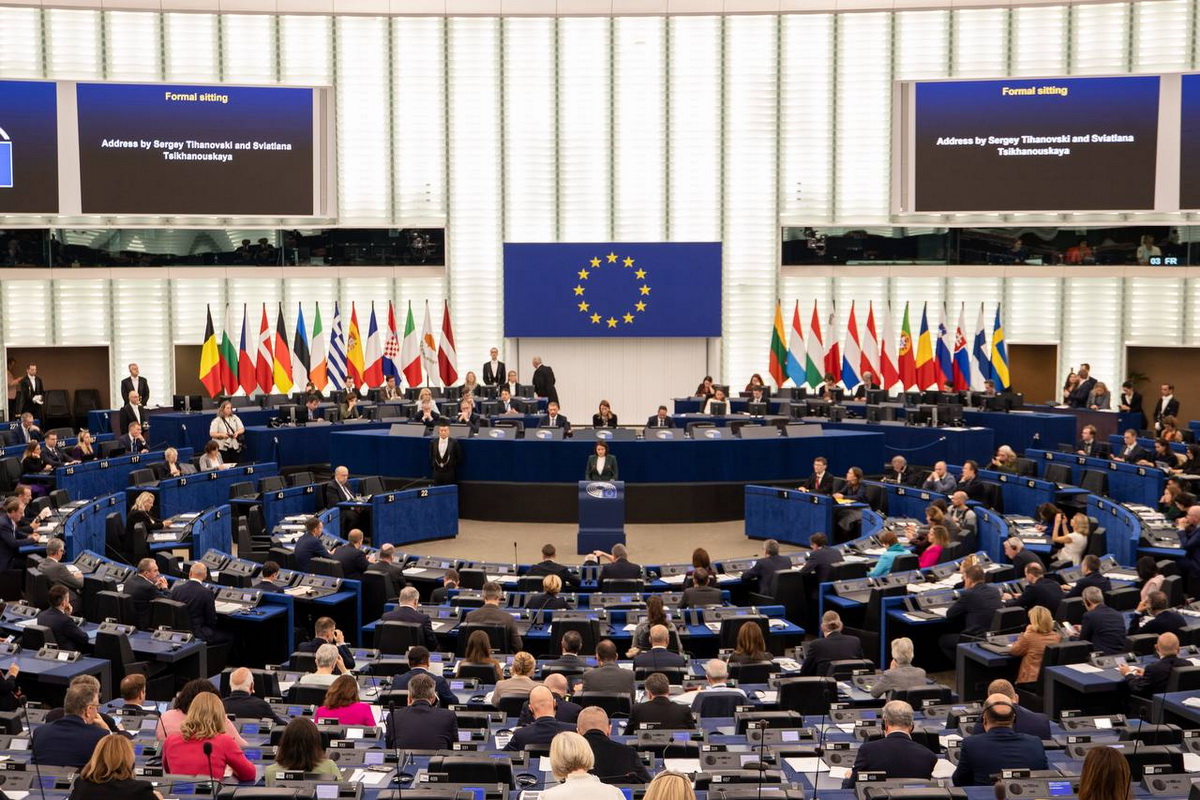
The European Parliament has adopted a resolution strongly condemning repression in Belarus and calling for increased support for the country’s democratic forces. The document was approved by 458 votes in favor, 18 against, and 84 abstentions.

Members of the European Parliament demanded the immediate release of all political prisoners, emphasizing that Alexander Lukashenko is not the legitimate president of Belarus.
In the resolution, the European Parliament expressed solidarity with opponents of Lukashenko’s regime and called for compensation and restoration of rights for all victims of repression. Lawmakers condemned the use of the judicial and law enforcement systems to violate human rights and reaffirmed their support for the Belarusian democratic forces led by Sviatlana Tsikhanouskaya. They noted that there is abundant evidence indicating that she was the legitimate winner of the 2020 presidential election, while Lukashenko’s regime unlawfully retained power.
The European Parliament urged the EU to provide political, financial, and security support to the opposition and to cooperate with other countries on a policy of non-recognition of Lukashenko’s regime. MEPs also called for the EU and international organizations to formally represent Belarusian democratic forces at international forums such as the Parliamentary Assemblies of the Council of Europe, the OSCE, and NATO.
The resolution calls for new, free, and fair elections under international supervision, warning that any vote held under conditions of repression cannot meet democratic standards. Particular attention was given to the use of political prisoners as leverage in negotiations with the West. The authors stressed that each time prisoners were released, others were subsequently detained.
MEPs advocated support for Belarusian civil society, independent media, students, and professionals in exile by providing visas, scholarships, grants, and protective measures. They condemned attacks on independent media, restrictions on internet access, and the arrest of journalists, urging the EU to offer systematic and long-term assistance to independent outlets.
The resolution calls for urgent action to counter transnational repression by the Belarusian regime, including abuse of Interpol mechanisms and the protection of Belarusians in exile. The EU and its member states should continue investigating human rights violations and crimes against humanity in Belarus, and support efforts to bring those responsible to justice, including through international courts.
The European Parliament also strongly condemned the Lukashenko regime’s involvement in Russia’s war against Ukraine and expressed concern over the growing Russian military presence in Belarus. Lawmakers urged the EU to tighten sanctions on those responsible for repression, complicity in the war, and sanctions evasion.
The Parliament called for thorough investigations and the dismantling of Belarusian and Russian spy networks within the EU and candidate countries, while emphasizing the need for restrictions on Russian and Belarusian diplomats in the Schengen area.
Sviatlana Tsikhanouskaya thanked the European Parliament for adopting the resolution, calling it a demonstration of solidarity with the Belarusian people.
“This is an important step in our struggle for freedom. But it is vital that it becomes a guide to action — concrete steps that European governments can take to truly support Belarus. That is exactly what I called for today in Strasbourg,” the politician stressed.