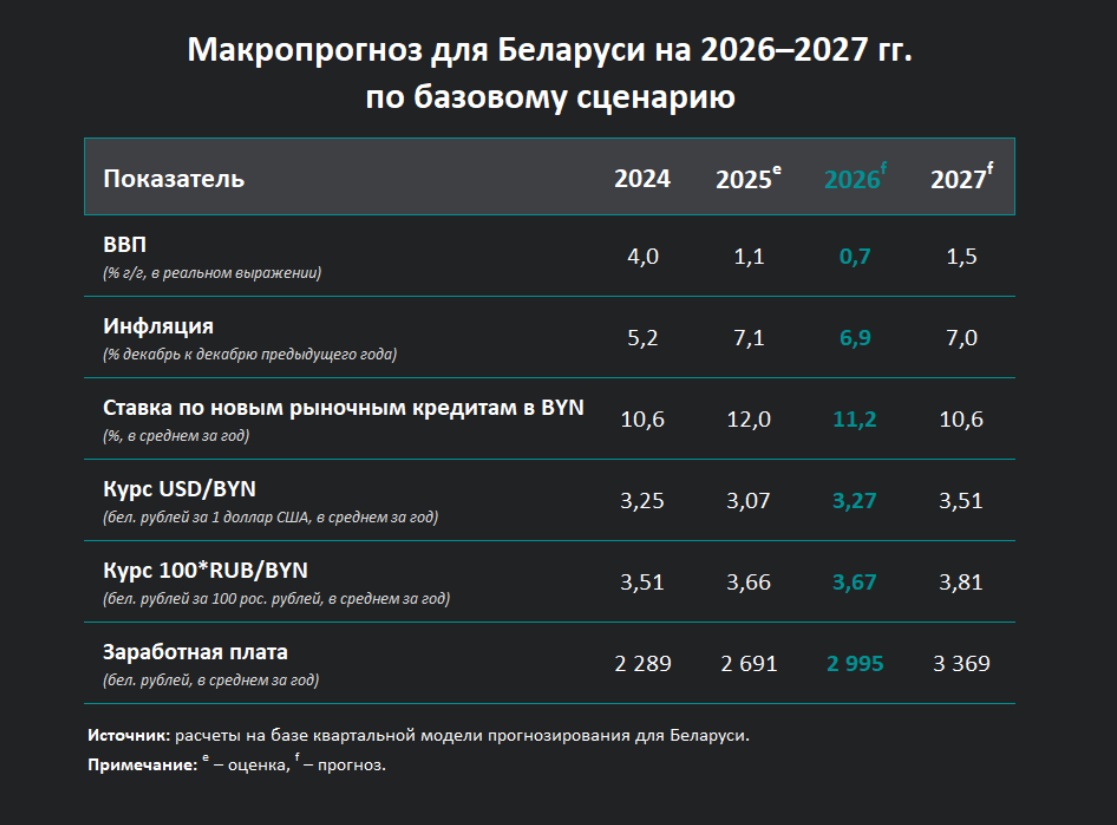
Growth rates of the Belarusian economy will continue to slow in 2026. GDP growth is expected at 0.5–1.5%. This is stated in a macroeconomic forecast for Belarus for next year published by the project “Monitoring the Belarusian Economy.”

“GDP growth will slow from around 4% in 2023–2024 to about 1.1% in 2025 and 0.5–1.5% in 2026. The slowdown of the Russian economy and the lack of room for a significant strengthening of domestic stimulus will limit the growth of economic activity in Belarus on the demand side. The exhaustion of the potential for involving idle labor resources in production and the low return on investment will act as constraining factors on the supply side.
The contribution of aggregate demand and a tight labor market to price growth will decline in 2026, but this decrease will be offset by the partial realization of accumulated inflationary pressure and an increase in regulated prices and tariffs. As a result, inflation will remain close to 7% year-on-year in 2026. The deficit in foreign trade in goods and services is projected at around 2% of GDP in 2026, corresponding to a moderate weakening of the Belarusian ruble by 3–7% over the year in terms of the currency basket,” the forecast says.
Risks to the forecast remain high, both from domestic economic policy and external conditions. The authors believe that the scope for large-scale fiscal stimulus in Belarus is being exhausted. The likelihood of a further contraction in demand in Russia poses the risk of a stronger weakening of economic activity in Belarus. The development of military and political activity in the region may present both positive and negative risks for the Belarusian economy.
The document notes that overheating of the Belarusian economy in the second half of 2025 declined amid weakening domestic consumer activity and reduced exports. At the same time, domestic demand remained excessive. As a result, in the fourth quarter the scale of economic overheating amounted to about 1%.
In 2026, economic growth rates are expected to be close to potential, estimated at 1.5–2% per year, based on assumptions of neutral economic policy and Russia’s GDP growth of around 1.5%. Aggregate demand is expected to gradually return to a balanced state next year after the period of overheating. The baseline scenario assumes that nominal dollar GDP could reach $100 billion in 2027.
Wages will continue to grow next year, although the labor shortage problem will ease. Wage growth is expected to slow from 10% in 2025 to 3–6% per year over the following two years. The average wage next year may approach 3,000 rubles.
As a reminder, the official socio-economic development forecast for 2026 approved by Alyaksandr Lukashenka envisages GDP growth of 2.8%. In recent days, the Eurasian Development Bank has also presented its macroeconomic forecast for member countries, estimating growth of the Belarusian economy next year at 1.8%.