
Warnings about new attempts by the insidious West to destabilize the situation in Belarus by 2030 are being actively amplified by domestic propaganda, Russia’s Foreign Intelligence Service (SVR) and the Russian Foreign Ministry. The question is why they have all suddenly moved in unison to raise a wave of apocalyptic forecasts.

An Unfulfilled Promise
Let us briefly return to 2020. On August 28, when protests in the country had not yet subsided, the Belarusian regime presented its plan for resolving the domestic political crisis at a special meeting of the OSCE Permanent Council in Vienna. The plan envisaged constitutional reform in Belarus that would weaken presidential powers and strengthen those of parliament and the government. The Constitution was to be amended by 2022, after which early parliamentary and presidential elections were to be held.
In early September, in an interview with Russian propagandists, Aliaksandr Lukashenka подробно outlined his plan for constitutional changes and stabilization of the situation in the country. “If we amend the Constitution, then we must прописать presidential elections in the Constitution separately, separately, and I am inclined to do this in order to hold early presidential elections. I do not rule this out,” the politician said.
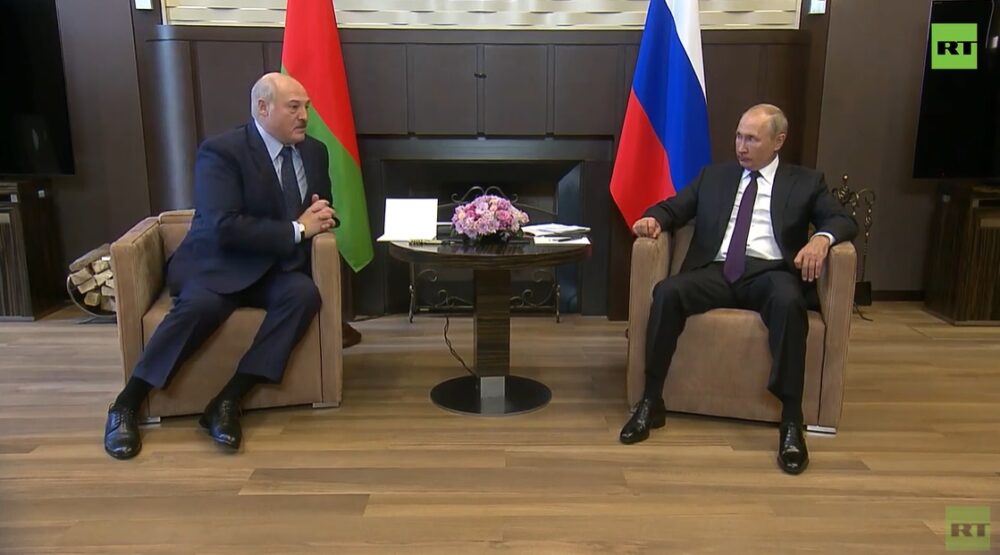
Lukashenka was compelled to state this before Russian television cameras for a reason — at that time, he promised the Kremlin and personally President Vladimir Putin that he would step down within the next two years, after the adoption of a new Constitution in 2022. He was to leave after preparing Belarus for a transition.
Lukashenka, of course, had no intention of stepping down. In the end, the promise remained unfulfilled. In 2022, war began, and Moscow had other priorities. Lukashenka became a co-aggressor, carried out an entirely different constitutional reform and remained in power. At this stage, this may even suit the Kremlin. Amid the war with Ukraine, Russia allowed Lukashenka to hold “elections” in 2025 and remain in office for another term.
An Important Date
The year 2030 is not far off, when Lukashenka will again need to hold “elections.” And precisely now, as serious people think about the future in advance, plans for the long term are being drafted in Kremlin offices. These include scenarios taking into account a possible end to hostilities in Ukraine, as well as potential and much-needed Russian “victories” and “achievements” in the coming years.
Some of the scenarios under preparation may prove far from favorable for Lukashenka personally and for his regime. It is not certain that they will ultimately be adopted as the basis for policy, but such a possibility cannot be ruled out. The Kremlin could recall the long-standing promise made by Lukashenka. The Belarusian politician needs to take preventive measures to demonstrate to the Kremlin that he remains indispensable.
Russian Allies
Domestic propaganda has begun loudly warning of a “regrouping of forces” and of a “planning horizon” allegedly being set by the hostile West and Belarusian democratic forces. They are, it is claimed, preparing for a “political diversion at a key moment” — in 2030. Everything will allegedly be used, from “diplomatic cover” — as propaganda describes proposals to return EU ambassadors to Belarus — to the “recruitment of officials.”
Then the “heavy artillery” was brought in. First, the press bureau of Russia’s Foreign Intelligence Service, which closely cooperates with the Belarusian KGB, issued a warning about Western plans regarding Belarus. It claimed that “NGOs of Western countries, including ‘democratizing’ structures, agencies and foundations of the United States, the United Kingdom, Germany, Poland and other European states, are accumulating forces and resources to once again attempt to rock the situation and achieve a change in the constitutional order in Belarus.”
In essence, the SVR press release mirrors the messaging of Belarusian state propaganda. It may even have been drafted by the Belarusian partners of the Russian intelligence service.
The Russian Foreign Ministry soon joined the campaign through its spokeswoman Maria Zakharova. The tone was the same: “Westerners have not abandoned their aspirations to tear away, including by any means, our brotherly republic from Russia; they are preparing for revenge,” and are “waiting for the right moment.”
The spokeswoman for the Russian Foreign Ministry promised that Russia and Belarus “do not intend to sit idly by and watch all this.”
Of the influential Russian allies of Lukashenka, only Federation Council Chair Valentina Matviyenko has so far remained silent. It can be assumed, however, that her remarks on this issue will also be heard soon.
The Starting Whistle — 2030
Why have they all suddenly spoken out at once? There appears to be nothing happening either around Belarus or inside the country that would justify a ninth wave of apocalyptic forecasts and heightened rhetoric.
The answer may be quite simple — through this PR project involving friendly external stakeholders, Aliaksandr Lukashenka has launched his own 2030 election campaign. At present, it is directed at Moscow — at those drafting and approving Russia’s long-term plans. The goal is to prove his indispensability.
To convince them that the insidious West, as well as domestic “fugitives,” are not idle. And that without Lukashenka everything will collapse. As Zakharova laments, “all the achievements of the integration construction of our Union State with Belarus” would be crossed out. Another “hotbed of instability” would emerge on Russia’s western borders. In short, the Kremlin’s worst fears would come true. From this perspective, the conclusion in Moscow should be that Lukashenka must not be touched and should continue to rule Belarus.
The Belarusian politician has begun his campaign by cushioning his position. So that the Kremlin reflects and, of all possible evils, chooses the lesser — him.
***
The author’s opinions and assessments may not coincide with the position of the Reform.news editorial board.