
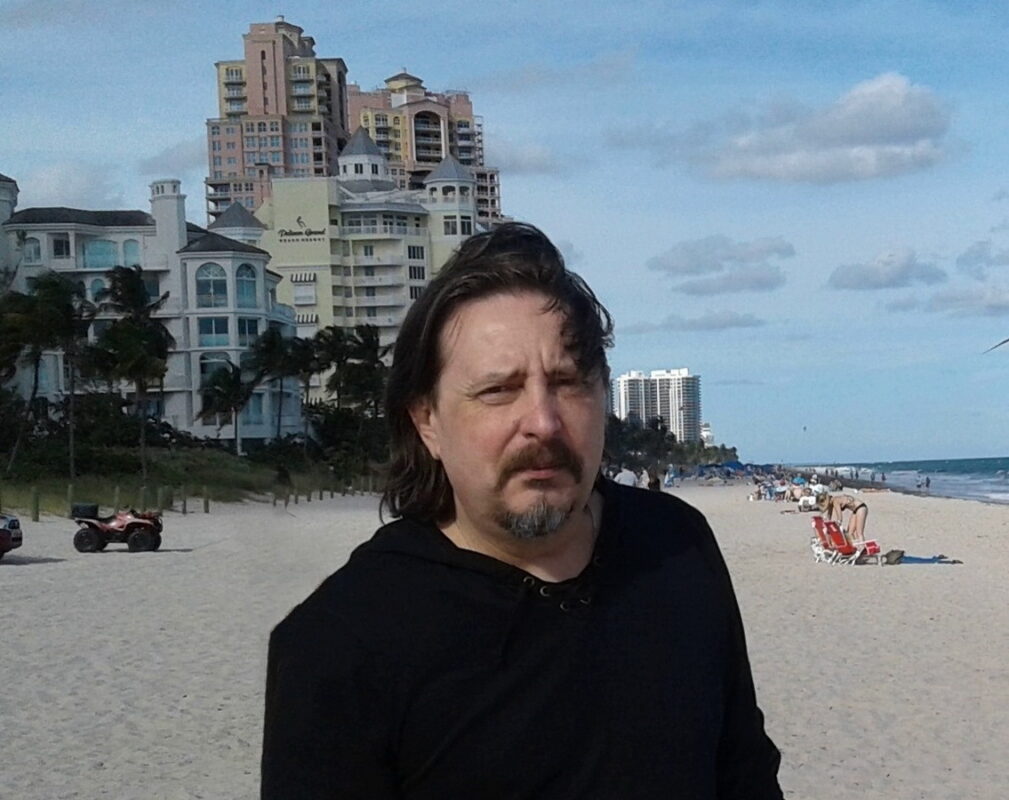
The Interior Ministry has added another 19 people to its “List of Citizens of the Republic of Belarus, Foreign Citizens and Stateless Persons Involved in Extremist Activities.” Among them is musician and radio host Aleh Khamenka.
Khamenka was detained in Minsk on June 17, 2025, following a search of his apartment. He was initially placed in the Akrestsina detention centre on administrative charges. In early July, it became known that a criminal case had been opened against him, after which he was transferred to Detention Centre No. 1 in Kaliadzichy.
On March 4, the Minsk City Court sentenced Khamenka to three years in prison and imposed a fine of 20,000 Belarusian rubles on charges of facilitating “extremist activity.” According to case materials, the charges were based on his long-term cooperation with the editorial team of Belarusian Radio Racyja.
Khamenka is widely known as a promoter of Belarusian music on radio. In the 2000s, he created and hosted the programme “Brama Isnasci” (Gate of Existence) on Autoradio. From the late 2000s, he worked regularly with Belarusian Radio Racyja. His programmes “Tuzin Hitoŭ” (Dozen Hits) and “Folk-brama” (Folk-gate) were broadcast for many years until his detention.
Belarusian Radio Racyja is a radio station broadcasting around the clock in the Belarusian language across Belarus, Poland and Lithuania via FM frequencies and the internet. The editorial office has operated since 1999 and is based in Białystok. The station covers social, political, economic and cultural developments in Belarus and around the world.
In September 2021, access to the station’s website from Belarus was blocked by decision of the Information Ministry. On January 16, 2024, the KGB designated Belarusian Radio Racyja an extremist formation.
Also added to the Interior Ministry list were four women convicted in the case of the “Russian Orthodox Church – Tsarist Empire”. These are Hanna Stryukava, Halina Fralova and Volha Baikouskaya, who were sentenced to five years and three months in prison, as well as Volha Voshchanka, who received a five-year sentence.
The “extremist list” now contains 6,650 names.
Belarusian authorities regularly use extremism-related charges to target political opponents and dissent more broadly.