
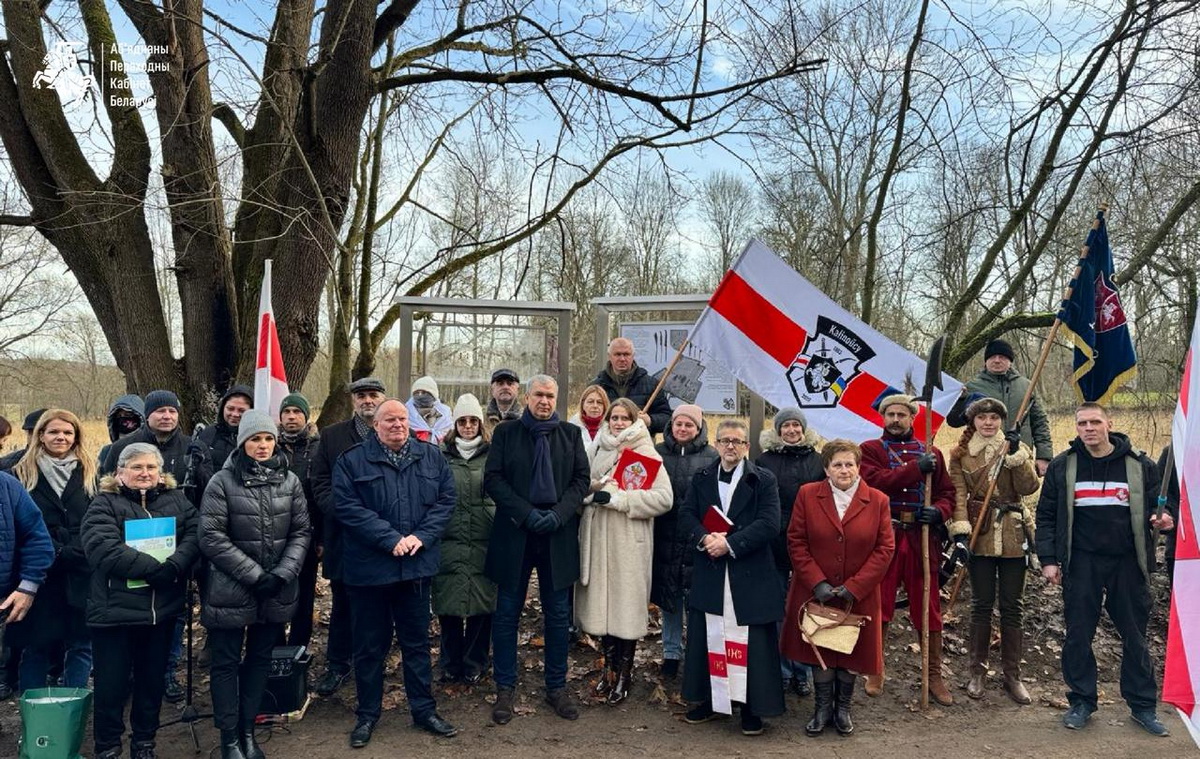
A ceremonial unveiling of an information plaque installed at the birthplace of Kastuś Kalinoŭski took place in the Polish village of Mostowlany (Michałowo Commune, Białystok County). The event was attended by Pavel Latushka, deputy head of the United Transitional Cabinet and head of the National Anti-Crisis Management.
In his remarks, the politician thanked the authorities of Białystok County, the communes of Michałowo and Gródek — whose representatives were present — as well as all participants in the initiative to memorialize the Kalinoŭski estate and park complex in Mostowlany for their work in preserving the memory of the national hero of Belarus, who brings together Belarusians, Poles, and Lithuanians.
In his speech, he emphasized the symbolic meaning of Kalinoŭski’s well-known words: “– Whom do you love? – I love Belarus. – Then it is mutual.” According to him, these lines embody patriotism and the belief that Belarusians will be able to reclaim their country.
“These are the words of a hero who showed us that Belarusians are strong and powerful, that in our history there were, are, and will be heroes. For me, as a Belarusian, such heroes are the volunteers of the Kalinoŭski Regiment, who took this name as a symbol of the struggle for the independence and freedom of our Homeland, our Fatherland,” his statement was quoted by the press service of the United Transitional Cabinet.
“I also recall that when I served as minister of culture, I asked the director of the National Art Museum to place in the minister’s office a work of art — it was a piece depicting Kastuś Kalinoŭski addressing insurgents. It hung in the minister’s office until the last day of my tenure. The next day, when the new minister entered the office, he ordered it removed. Officials who are now trying to destroy the memory of Kastuś Kalinoŭski, think again. Do you want Russia to dominate Belarusian soil? Do you want Belarus to become a subject of the Russian Federation? And no matter how difficult things are for us today, we must continue to believe and fight, and carry these words in our hearts: ‘– Whom do you love? – I love Belarus. – Then it is mutual,’” the head of the National Anti-Crisis Management said.
Kastuś Kalinoŭski was born at the Mostowlany estate on 21 January (2 February) 1838. In 1863–1864, a national liberation uprising took place in the lands of Belarus, Lithuania, Poland, and Ukraine, which were then part of the Russian Empire. Kalinoŭski led the uprising in the Belarusian territories. He was arrested in late January 1864 in Vilnius and sentenced to death, and ten days later he was hanged. The burial places of Kalinoŭski and his executed comrades were unknown until recently, when their graves were discovered after a ground collapse on Gediminas’ Hill in Vilnius. A ceremonial reburial of the remains of Kalinoŭski and other insurgents took place on 22 November 2019.

