
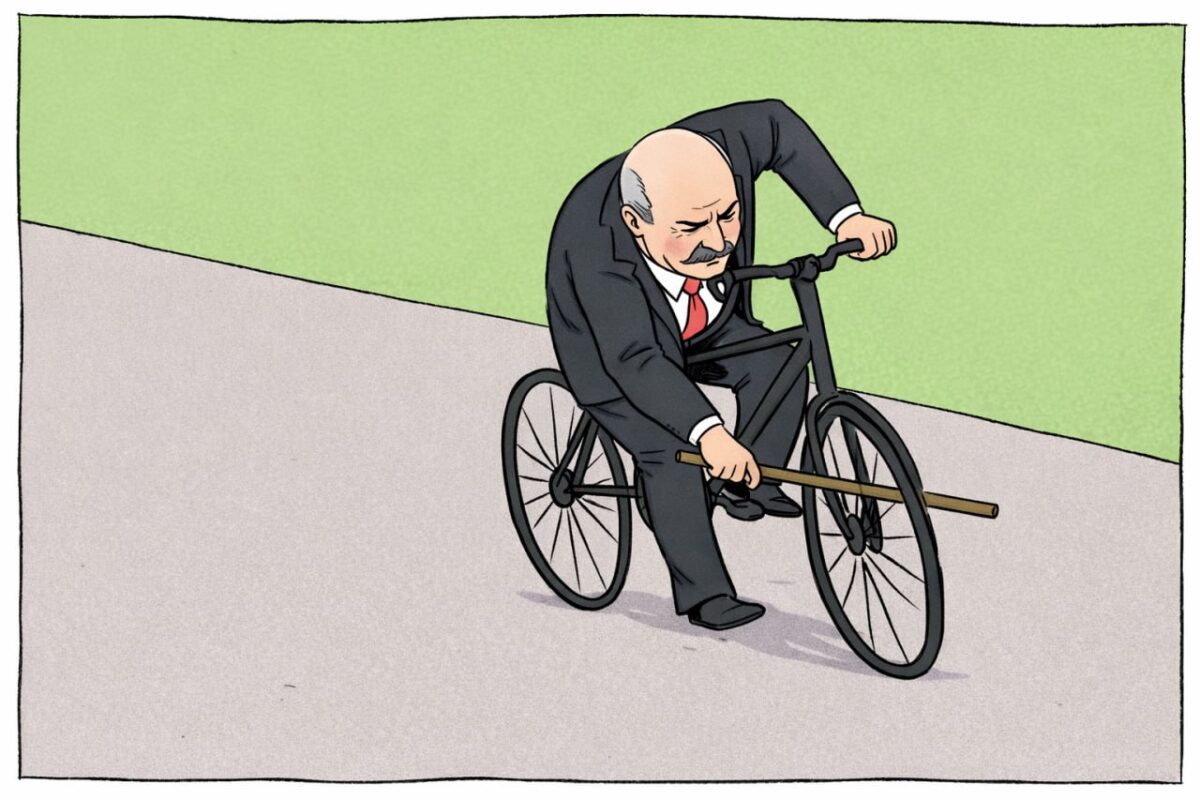
Yesterday, Belarus was plunged into darkness. One can invent many factors that might have caused the evening blackout. But only one of them appears the most plausible.

The Rationaliser-Inventor
Over the years of his rule, Alyaksandr Lukashenka has come up with all manner of rationalisation initiatives. At one point, he disliked cars driving during the day with dipped headlights on — no need to waste light bulbs. At another, the politician concerned himself with the temperature of the heat carrier, deciding that 20 degrees Celsius in apartments in winter was enough for citizens. Then minibuses displeased him, and he ordered them to be replaced with buses. Then he was outraged by drivers buying coffee at petrol stations, thereby creating queues.
It is amusing that many of these valuable instructions were later either quietly shelved or gradually reduced to nothing. Dipped headlights in Belarus remain mandatory during certain periods. Police patrol groups meant to control coffee drinking at petrol stations have virtually curtailed their activities. Minibuses have continued to ply the country’s roads as before. The innovative idea concerning street lighting will most likely end the same way.
The Road to War
At a meeting the day before yesterday devoted to the Viciebsk Region, Lukashenka expressed outrage at how street lighting is switched on and off in the country. According to him, in the mornings the lamps are still lit when it is already bright outside. In the evenings, they are switched on earlier than necessary. This policy, he said, “annoys and amazes” him. And such mismanagement, he added, could even lead to war.
No one dared to argue with Lukashenka. Too risky. The very next day, under the leadership of the Ministry of Energy, a meeting was held in Belarus to adjust street lighting operating schedules. It decided that, together with local authorities, a unified approach to these schedules should be developed.
But why deliberate and develop anything if a concrete directive from Lukashenka had already been issued — “so that it switches off at 7 a.m. And the lights come on not at six in the evening, but at eight.” The timing was nevertheless adjusted — in Minsk, street lighting, as reported, was switched on at around 7 p.m.
That brought little joy either. People went out onto the streets after work at six, and it was dark. They had to make their way home, as many Belarusians wrote on social media, almost by touch.
The Belarusian Nuclear Power Plant, Heating, Exports
Almost immediately, like mushrooms after rain, various theories began to multiply — what really caused Lukashenka’s such a strong reaction to lit street lamps?
The most obvious was problems with generation caused by cold weather. Shortly before the politician’s order, at the end of January, the Ministry of Energy reported that amid severe frosts the Belarusian energy system had set new records. The ministry said that, “according to operational data, during the period of severe frosts a new maximum instantaneous peak load of 7,325 MW was recorded. This is the highest figure in our entire history.”
Peak electricity consumption in the residential sector also falls on morning and evening hours, when people return home from work. In addition, back in 2023 Lukashenka instructed that conditions be more actively created for using electricity to heat homes, which also increased the load on capacity. Moreover, since 15 January the first power unit of the Belarusian Nuclear Power Plant has been shut down for scheduled preventive maintenance. All of this taken together could have affected the capabilities of the Belarusian energy system.
But in order not to alarm the public, it was decided to explain the need for savings by a fight against mismanagement. Just as with coffee and queues at petrol stations, which Lukashenka took on precisely at the moment when, due to regular Ukrainian attacks on Russian oil refineries, Moscow asked to increase fuel supplies to Russia. Fearing panic over petrol shortages among the domestic population, they decided to fight queues at petrol stations.
Versions were also put forward that today Belarus is forced to supply electricity to Russian regions bordering Ukraine that are experiencing a shortage. And almost even to Ukraine itself, in order to placate Kyiv.
Theoretically, anything is possible, but there is one “but”. After mass public outrage and angry appeals to various authorities, the Minsk City Executive Committee reported that yesterday’s blackout was a one-off action. And already today lighting in the capital would be switched on as before. Probably, other cities will act similarly — the Ministry of Energy promised to sort everything out “based on local conditions”. But if this had been a real shortage caused by the above-described or some other reasons, it would hardly have been possible to reverse course so quickly. Although the frosts in Belarus are gradually easing.
Even if a shortage had in fact arisen, the authorities should have addressed citizens. Asked them to save electricity. Or at least simply explained in human terms — frosts, load, please endure temporary inconveniences. But the regime does not know how to act humanely. And does not want to learn.
A Capricious Old Man
Therefore, with a high degree of probability, the issue is not about the energy system’s capacity. It is about banal peasant logic — one must save on everything, regardless of inconvenience. With age, miserliness progresses. Especially when savings can be achieved at the expense of someone else’s discomfort. Thus, in Lukashenka’s view, the waters of the Dnipro River are needlessly flowing into the sea, and the lights in cities are burning in vain.
And the people — the people will endure. Why should everything be glowing and shimmering here? Before, in the village there were two street lamps — at the village council and at the club. And nothing. As Azaronak says — this is not Las Vegas. We did not live well, so there is no point in starting.
So it is most likely about a simple whim of Lukashenka. About a desire to save money at the expense of Belarusians. He drives home in the evening, and there are lights everywhere. But when you leave a room, you should turn the light off behind you. He left Minsk for his residence, and ordered the lights in the city switched off. Who needs them on if he is not there? And that is that.
And what about the officials? The tsar spoke, the boyars snapped to attention. Then let him answer himself for his initiatives.
It is not excluded that now the tsar will say that he was misunderstood, that the clumsy boyars messed everything up again. The lights will be switched back on. But at some point the same story will repeat itself. Not with coffee at petrol stations, not with lighting, but with something else. The COVID-19 epidemic and society’s reaction to Lukashenka’s voluntarism taught the politician nothing. He is still convinced that he was right about everything back then. And the talent of a rationaliser-inventor is not something you can just suppress.
***
The opinions and assessments of the author may not coincide with the opinion of the Reform.news editorial board