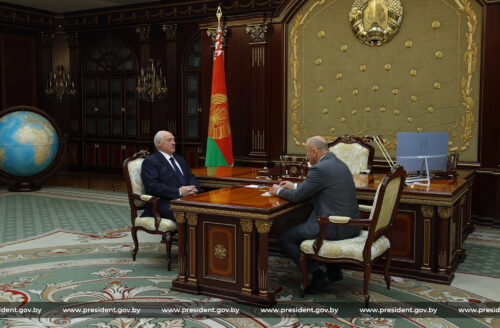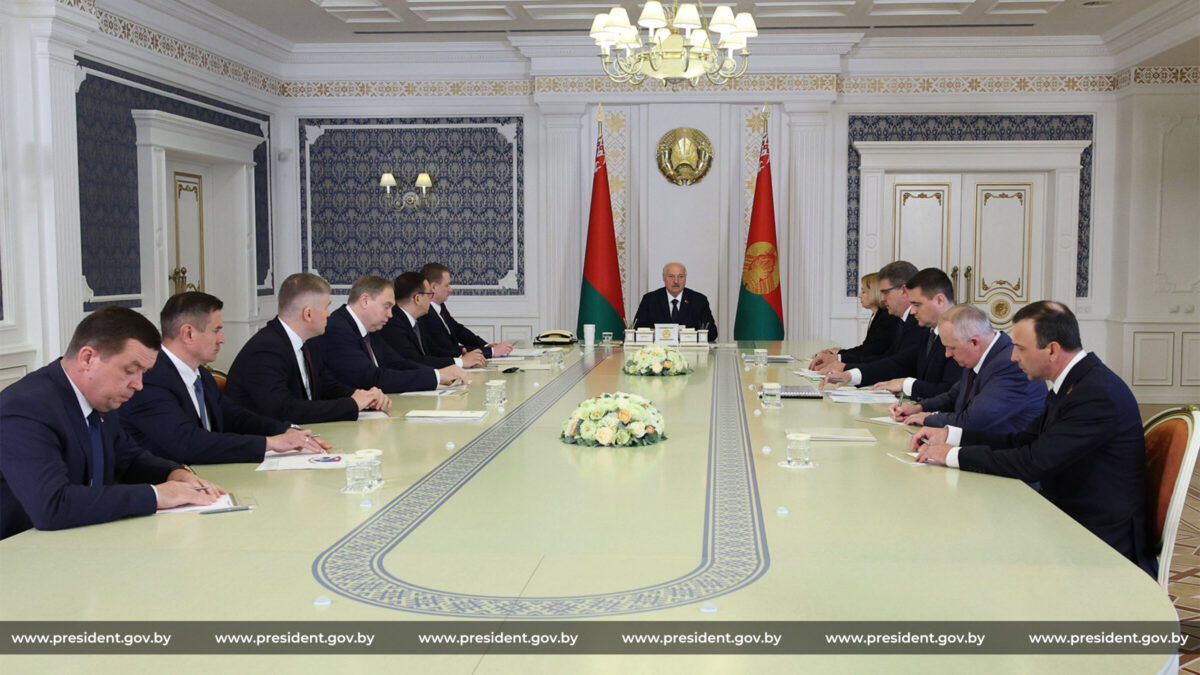
Belarus plans to establish an Academy of Intellectual Technologies. It would be an educational institution for gifted people combining research and educational functions. Aliaksandr Lukashenka had previously floated the idea and raised it at a meeting today, while, as usual, questioning whether such a university should be created.

“At the beginning of the year, we agreed that the government and the relevant authorities would work out an option for creating a new area of education and science. I don’t know what else to call it. I think that after today’s meeting we will decide whether it should be a Center of the Future or, as you propose, an Academy of Intellectual Technologies.
I want to say right away that I do not need a second fundamental research track in Belarus. After I am gone, you can create one and pursue fundamental sciences if you want to conquer the whole world. I do not rule out that this research center will include a fair amount of fundamental science or elements of it. But its focus must be applied. Above all, it must be useful in real life, perhaps with an eye to the future, but preferably not the distant future.
It would be good if we, Uladzimir Karanik, could create something in our lifetime. This applies not only to you; it applies above all to our education minister and the government. We need to create something that will be needed tomorrow and the day after tomorrow. What we have today is clear. But if this is a new academy that we create, where the best minds will be concentrated…
What kind of minds — young people, the very young, mature adults or pensioners — that is something we also have to decide. The person’s age does not matter to me. The main thing is that they have something in their head. Well, that is my opinion. I want to hear yours.
So take your seats. Once again, I want to emphasize to you, Aliaksandr Turchyn, and above all to you, that we need this tomorrow, not the day after tomorrow or whenever the fundamentalists promise it. They keep studying and studying, saying that there can be no applied science without fundamental science, and so on. There is no fundamental science, while our applied sciences at least do something. They do something, although not enough. I understand that you have grasped my idea and can probably agree with me,” he said.
He added that the higher education system needed to develop ahead of emerging needs.
“By focusing on introducing the latest educational technologies in our work with talented children, we have begun shaping the future of our country, its intellectual elite.
But time does not stand still, and we need to make a qualitative leap in our work with gifted young people, and not only young people.
I have repeatedly said that building the economy of the future is impossible without the advanced development of the higher education system,” he said.
According to Lukashenka, the aim is to create a fundamentally new educational environment that is flexible, interdisciplinary, results-oriented and integrated into real economic processes to meet the country’s needs. This, he said, is why the time has come to establish a new university — a university of the future.
Lukashenka said the new institution could be open to people of all ages.
“Young people, the very young, mature adults or pensioners — that is something we have to decide. A person’s age does not matter. The main thing is that they have something in their head. That is my opinion, and I want to hear yours,” he said.
According to Lukashenka, the establishment of the academy would not relieve existing universities of their responsibility to train specialists for high-tech industries.
“We must not make a mistake under any circumstances. This is costly, and Belarus already has more than enough educational, scientific and other centers. My goal was to preserve everything good that remained after the Soviet Union. After all, our science and education were among the best in the Soviet Union,” he said.
“We cannot allow this center, academy or university to become an ordinary higher education institution that simply hands out diplomas. It must train specialists capable of developing their own solutions in the most promising fields — as it is fashionable to say now, artificial intelligence, new materials, digital industry and quantum technologies.
It is not necessarily about what we can do — we can do anything — but whether we need it. That is the question. Should we spend money on this today? That is the main issue.
In addition to its educational track, the Academy must become one of the key instruments for ensuring technological sovereignty. By generating new technologies and engineering solutions, it should work to increase enterprise productivity, boost exports and strengthen the country’s competitiveness. I hope you understand that,” Lukashenka continued.
He stressed that the new institution should become a driving force not only for the education system but also for science as a whole.
“Without abundant natural resources or other resources, we need to invest in intellectual resources — human potential, in people, especially young people, because they are the future. We need to give them an opportunity to fulfill their potential at home, in Belarus,” he added.
He reiterated that the institution should be open to people of all ages. Lukashenka expressed hope that the academy would make breakthroughs, for example by inventing a fundamentally new and powerful means of countering drones, which are currently a major focus of attention, with such a development effectively eliminating the significance and role of UAVs.
“It must be focused on the future. Every year, we must demonstrate that this center was not created in vain, that our smartest and most advanced people — and we have plenty of smart and advanced people — can receive an education there in the broadest sense and fulfill their potential at this center,” he concluded.