
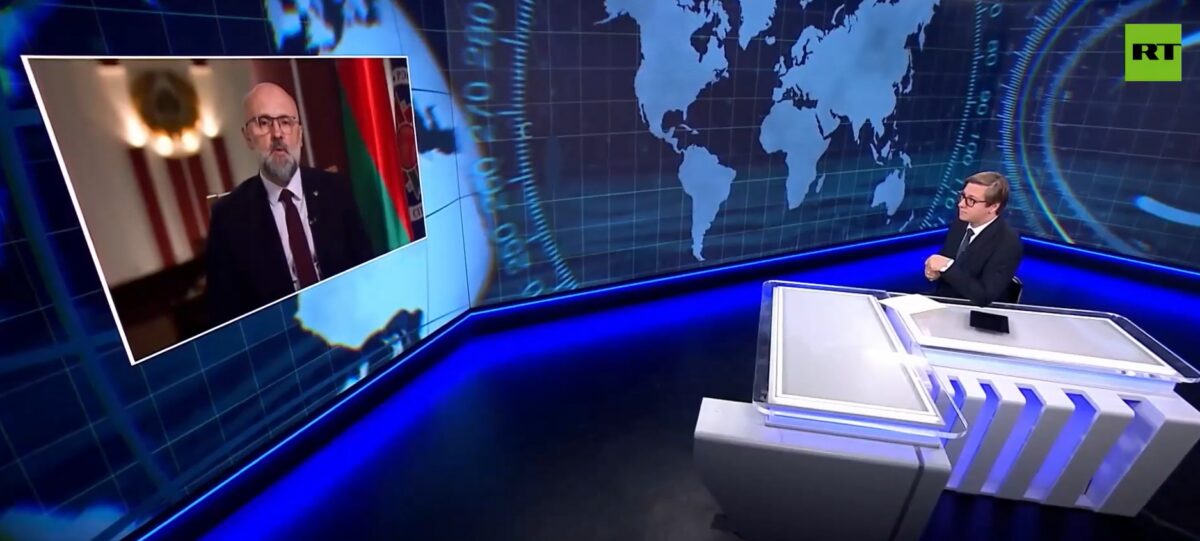
(Updated: expanded with additional quotes) Belarusian Deputy Foreign Minister Ihar Sakreta said he expects negotiations with the United States to move to a new level in the near future. He made the remarks in an interview with RT.

“The contacts between U.S. President Donald Trump, our President Aliaksandr Lukashenka, and our government demonstrate that there is enormous potential for improving relations, not only between the United States and Belarus, but also across a broad range of security and economic issues, as well as diplomatic representation in Washington and here in the East. I assure you that the release of prisoners is a pretext and a tool for a broader discussion of issues on the bilateral agenda,” he said.
“We very much hope that in the near future these negotiations will move to a new level that will allow us to return to what we at the Foreign Ministry call day-to-day work, to the routine bilateral contacts that existed before 2019 and were very productive for both the United States and Belarus. We hope for greater common sense and for the regular use of the same negotiation format with Western European capitals,” Sakreta added.
The deputy foreign minister also stressed that Minsk is trying to persuade its Western partners to engage in dialogue without military rhetoric.
“We are saying that on the other side of the Bug River, to the west of Belarus, people and weapons are being deployed. Increasingly larger military budgets are being allocated to new tank brigades, and more infantry divisions are stationed along our borders. They are closer than ever before, and this poses a real threat to our country. Therefore, we have to respond somehow. Of course, we cannot spend the same amount of money for these purposes. We are trying to persuade our Western European and American partners to enter into dialogue and restore the confidence-building measures and mechanisms that functioned for decades and were developed in the 1970s and 1980s. We are trying to convince them not to use military rhetoric because even I find it provocative. Military incidents could lead to a much larger conflict that would be far worse than the one we are currently witnessing in Ukraine,” Sakreta said.
According to him, Western partners are fully aware of the consequences of any aggression.
“They know perfectly well that we have signed a treaty stipulating that if any country attacks the Union State, there will be an immediate response under that treaty and, importantly, that even the use of conventional weapons could have serious consequences. As for nuclear weapons, the potential use of such weapons could even lead to the depopulation of Europe. This is a dangerous—very dangerous—consequence that they would have to face. Therefore, I believe this bravado and rhetoric are mainly intended to strengthen the positions of the political elites in Western European capitals. At the same time, we see that alongside what is being said in those capitals, there are political parties and many reasonable voices among the public who are alert to the situation, deeply concerned about this military rhetoric, and are urging their elites and governments to resume negotiations with Belarus, with Minsk, and with Russia,” he said.
Sakreta also said that several rounds of negotiations had recently taken place.
“I must admit that we have recently held several rounds of talks with our Western European colleagues. We do this regularly, currently under the Chatham House Rule. The questions they ask me concern not only sanctions and opportunities for trade and logistics, but primarily security issues. This means they are very concerned about their own security. They want to take steps that will reduce the threat, but they also need to save face because someone among their elites has to respond to the mistakes made several years ago, when Ukraine was flooded with weapons, and take effective steps to bring this conflict to an end,” he said.
Sakreta also commented on statements made by Ukrainian President Volodymyr Zelenskyy.
“If Belarus’ border is crossed with aggressive intentions, we will respond using all the means at our disposal. I do not think this is entirely serious. Rather, it is bravado and rhetoric from Zelenskyy, most likely aimed at boosting his approval ratings, which are declining,” he said.
“We are monitoring the situation along our border with Ukraine, and we do not see active military preparations that would indicate an impending attack. At the same time, I must acknowledge that we see the so-called opposition leaders and their fighters, for example the Kalinouski Regiment, being regularly used and trained on Ukrainian territory for the future, for a more likely attack on Belarus. But I believe that, once again, these are merely statements, and we do not see any real military or political potential for such an attack. The aim is to intimidate the government in Minsk, the president, and the Belarusian people by portraying themselves as ready to fight for a democratic and independent Belarus.
But I believe that with each passing day, more and more people, even in the West and in the United States, understand that the only legitimate government in Minsk is the government and President Lukashenka. That is why they are increasingly seeking contacts with him. The recent conversations and telephone calls with President Emmanuel Macron, as well as contacts with representatives of Ukraine in Minsk and representatives of other European countries, clearly confirm this,” the deputy foreign minister added.