
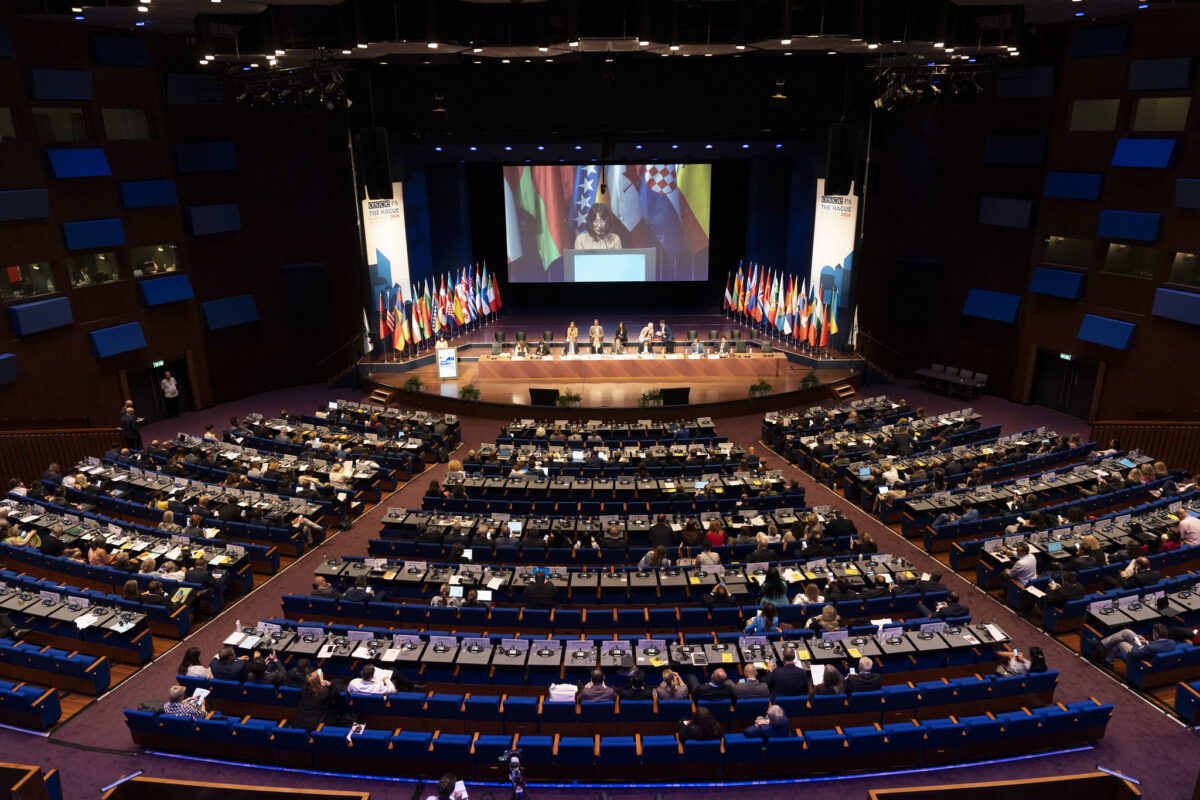
The OSCE Parliamentary Assembly on Tuesday adopted the Hague Declaration at the conclusion of its 33rd annual session, which ends today. The declaration includes a reference to Belarus. In addition, the Assembly adopted a separate resolution on the situation in the country.

“Noting recent releases of some political prisoners in Belarus, and recognizing the significant diplomatic efforts contributing to these developments while expressing concern that politically motivated charges and detentions persist, underscoring the imperative to end all arbitrary detentions and ensure full respect for the human rights and fundamental freedoms of the Belarusian people, and reiterating the call for Belarus to fully implement the recommendations set forth in the OSCE Moscow Mechanism reports of recent years,” paragraph 159 of the declaration states.
The Parliamentary Assembly also called on OSCE participating States to increase economic, political and diplomatic pressure on Russia, Belarus and other states supporting Russia’s armed aggression against Ukraine, with the aim of deepening the aggressor state’s isolation and preventing sanctions circumvention, including through the use of secondary sanctions.
The declaration also calls on Belarus to end its support for Russia’s aggression and to stop persecuting activists, journalists, human rights defenders and young people involved in pro-democracy activities.
The resolution dedicated to Belarus is entitled “The Situation in Belarus in the Context of Regional Security, Transnational Repression and Human Rights.”
The document states that Belarus under the Lukashenka regime is no longer a factor of stability in the region but instead constitutes a source of threats to regional security across the OSCE area.
It also states that Lukashenka continues to use hybrid instruments of pressure against OSCE participating States, including the forced landing of a Ryanair civilian aircraft, the artificially orchestrated migration crisis on the borders with Poland, Lithuania and Latvia, the launch of aerial objects violating the airspace of OSCE participating States, as well as activities related to cyberattacks and other forms of destabilisation.
The resolution further states that Belarus poses a direct military threat in the region after abandoning its non-nuclear status and hosting Russian troops on its territory. It also highlights Belarus’s involvement in supporting Russia’s aggression against Ukraine.
The document refers to transnational repression carried out by the Belarusian authorities, including the persecution, intimidation and harassment of Belarusians abroad, as well as the abuse of international mechanisms.
“Warning that the Lukashenka regime’s innovative approaches to transnational repression serve as a powerful model for the Russian Federation and other authoritarian States to imitate as they attempt to silence opponents abroad,” the resolution says.
It further states that “a sustainable resolution of the crisis in Belarus is only possible through the cessation of repression, the holding of free and fair elections and ensuring accountability for violations of international law.”
The OSCE Parliamentary Assembly welcomed the work of the Belarusian democratic forces, including the Coordination Council, the United Transitional Cabinet and the Office of Tsikhanouskaya.
It also states that sanctions remain a necessary instrument of international pressure and should be maintained and, where necessary, strengthened until genuine and verifiable changes are achieved, including an end to repression and Belarus’s involvement in the aggression against Ukraine.
The Assembly also welcomed the launch of the International Criminal Court’s investigation into Lukashenka.
Against this backdrop, the Parliamentary Assembly condemned the use of Belarusian territory as a platform for hybrid threats against OSCE participating States. It called for the immediate end to the Lukashenka regime’s use of migration as an instrument of political pressure and condemned actions undermining the security of the borders and airspace of OSCE participating States, including the launch of aerial objects and other forms of hybrid interference.
The OSCE Parliamentary Assembly called on participating States to maintain and, where necessary, strengthen sanctions.
The resolution emphasises the “need for the full and unconditional release of all detainees without them being forcibly deported abroad and without using this process as an instrument of political pressure or bargaining.”
The OSCE participating States were also urged to strengthen measures against transnational repression, including preventing the abuse of international mechanisms, and to ensure appropriate protection for Belarusians abroad.
The Parliamentary Assembly further called for the development of concrete legal and administrative solutions for Belarusians in exile, including access to identity documents, legal status and fundamental rights.
The OSCE participating States also called for support for the International Criminal Court’s investigation into Lukashenka.
The Parliamentary Assembly also expressed support for expanding cooperation with the Belarusian democratic forces, including their continued participation in the work of the OSCE Parliamentary Assembly.
“For the first time in a long time, Belarus is mentioned in the main outcome document — the resolution. There is an entire paragraph devoted to Belarus, focusing on the most pressing issue — political prisoners. It welcomes the release of people, while at the same time recognising that new victims of the Belarusian regime continue to emerge,” said Tsikhanouskaya’s adviser on parliamentary cooperation, Anatol Liabedzka.