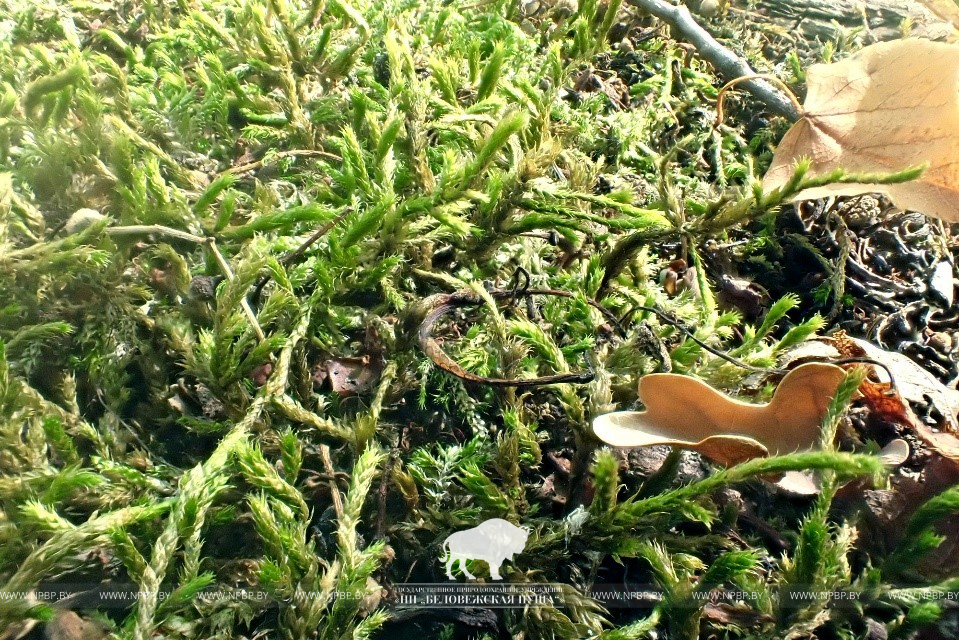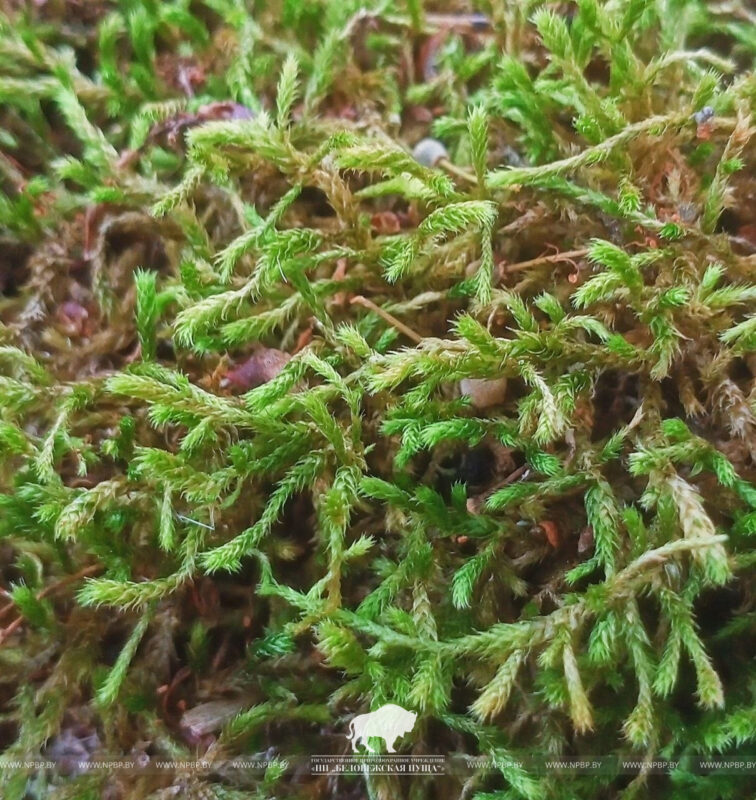
A unique relict moss, Antitrichia curtipendula, has been discovered in the Belavezhskaya Pushcha. According to the national park’s scientific department, it was found by Aliaksei Astrelin, a researcher at the Institute of Experimental Botany of the National Academy of Sciences of Belarus.

“For the territory of present-day Belarus, this is effectively the first confirmed record of the species in history. Scientific archives contained only two references from the late 19th and early 20th centuries. These were the 1888 studies by Blonsky, Eismond and Drimmer, as well as Fleischer’s 1919 study. Blonsky found it ‘only once, on a felled oak in the Hajnówka forest guard post near the Lyutownia stream.’
However, the territory of that forest guard post is now located entirely in the Polish part of the Białowieża Forest. The moss was not found in the region again after 1919. A century after it was last recorded, a new site where it grows has also been identified on an oak, in a thermophilous oak forest on the grounds of the former European bison nursery,” the scientific department said.
The rare moss was found growing on the trunk of an oak tree that had fallen at least 20 years ago.
“The advanced stage of decomposition of the dead wood created the specific physicochemical matrix and stable microclimate without which this demanding species could not survive.
This fact clearly demonstrates the crucial habitat-forming role of large woody debris in forests, the removal of which from an ecosystem leads to irreversible biodiversity loss,” the scientific department explained.
Recently, the website of Belavezhskaya Pushcha National Park has begun publishing reports about rare and unique species that depend on the presence of old deadwood.
It is worth noting that recently Aliaksandr Lukashenka, during a visit to the Brest region, demanded that “order be restored” in the Belavezhskaya Pushcha, although he ultimately agreed that the protected part of the forest should not be touched.