
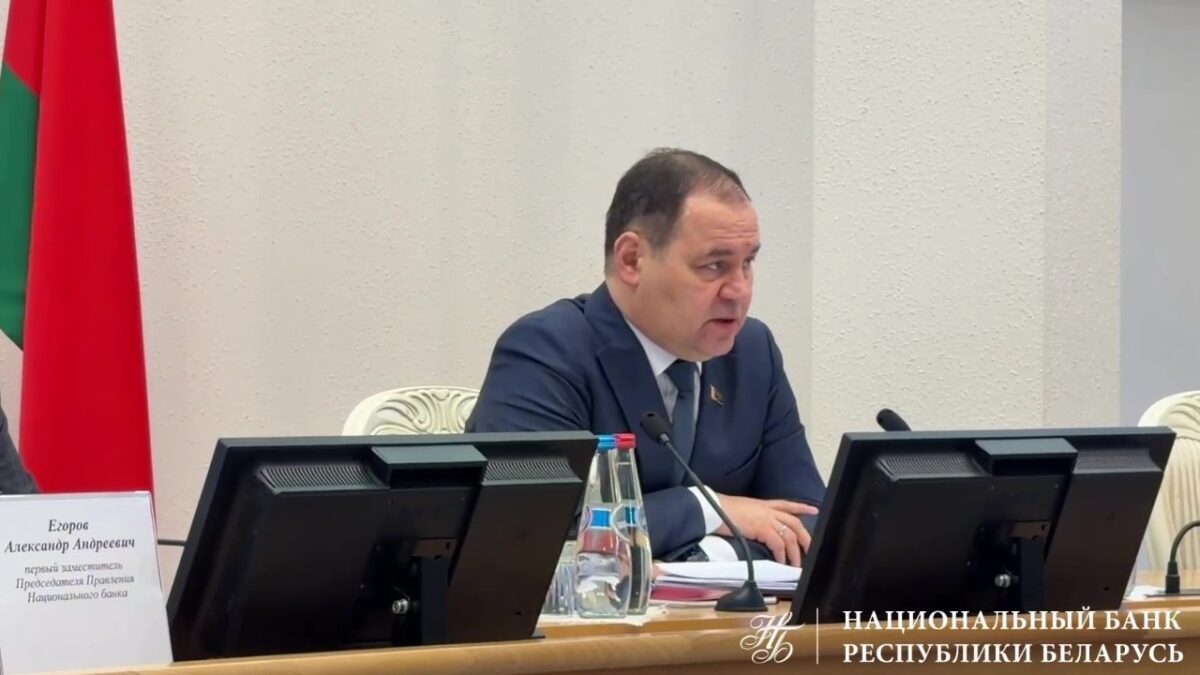
Lending growth last year exceeded forecast levels, National Bank Chairman Raman Halouchanka said at an expanded meeting of the regulator’s board dedicated to the results of 2025.

“The growth of the resource base allowed banks to meet the economy’s needs for financial resources. Lending growth exceeded forecast levels. With a target indicator of at least 16%, investment financing last year actually increased by 1.5 times. Consumer lending grew by almost one-third, to 1.5 billion rubles,” he said.
Last year, banks’ claims on the economy increased by 11.3%, which corresponds to the target indicator.
“Although not all banks coped with this task. In total, six banks are lagging behind the target; of these, two came quite close and fell just short,” Halouchanka said.
Last year also saw an increase in term deposits by the population. At the beginning of this year, the volume of such deposits exceeded 15 billion rubles, with long-term non-revocable deposits accounting for 11 billion rubles. Average market interest rates on ruble loans to legal entities in December 2025 amounted to 11.7% per annum, which is lower than in December 2024. Rates on investment loans were lower by 2–2.5 percentage points.
The head of the National Bank also noted that last year all monetary policy targets were met except for inflation.
“Inflation amounted, as is known, to 6.8%, which goes beyond the 5% forecast. At the same time, we note that the pricing process is manageable and is under constant control by the National Bank and the government. By the end of 2025, it was possible to slow the intensity of inflationary processes. Given the significant influence of external factors, the result obtained can generally be considered acceptable,” he said.
This year, the National Bank intends to keep inflation at no more than 7%. Core inflation has been placed under operational control, with the aim of keeping it within 5%.
“To maintain core inflation at the level of 5% in 2026, an approximate trajectory for this indicator has been formed and calculated. The issue has been placed under operational control in order to apply response measures in a timely manner and, together with the government, ensure this parameter remains within the level set by the program of socio-economic development. Low inflation rates are necessary for us, first of all, to allow organizations to plan long-term investments, taking into account the availability of funds attracted by the economy for its development. In essence, these are the basic conditions for economic growth and improving living standards,” Halouchanka added.
He also noted that the country’s banking system is demonstrating resilience. The share of non-performing assets in banks’ assets exposed to credit risk stands at 2.2%. The capital adequacy ratio significantly exceeded the established minimum, at 19.3% versus 12.5%, respectively. Net foreign currency supply on the domestic market last year amounted to about $1.1 billion.