
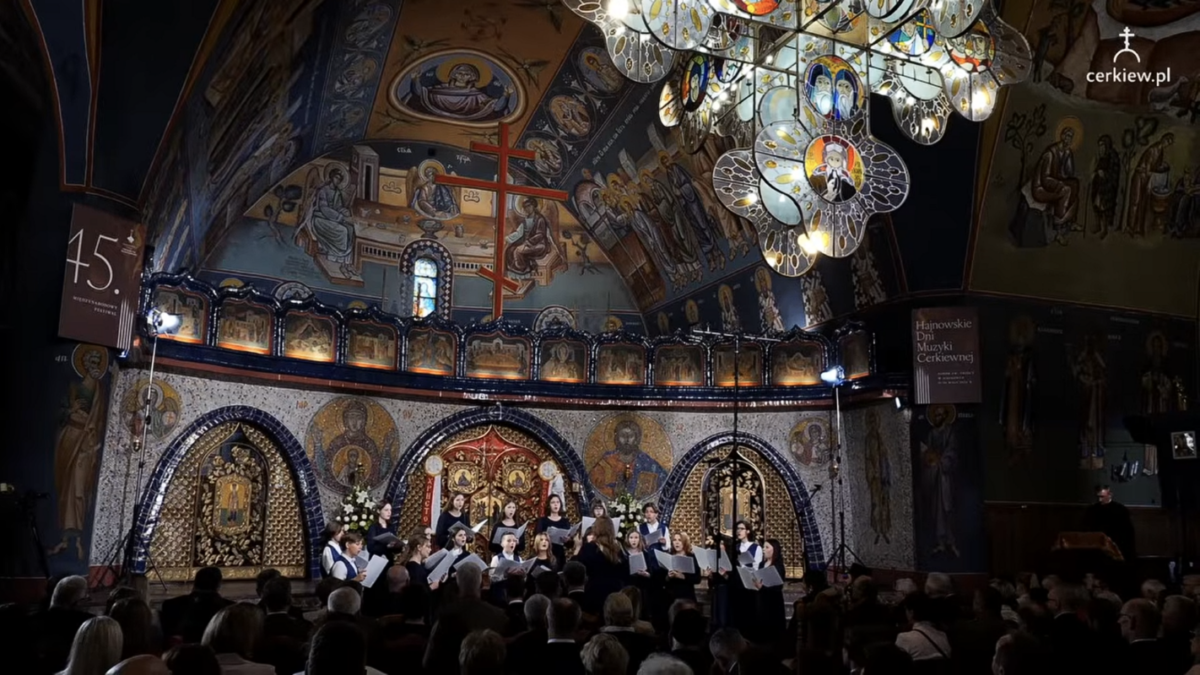
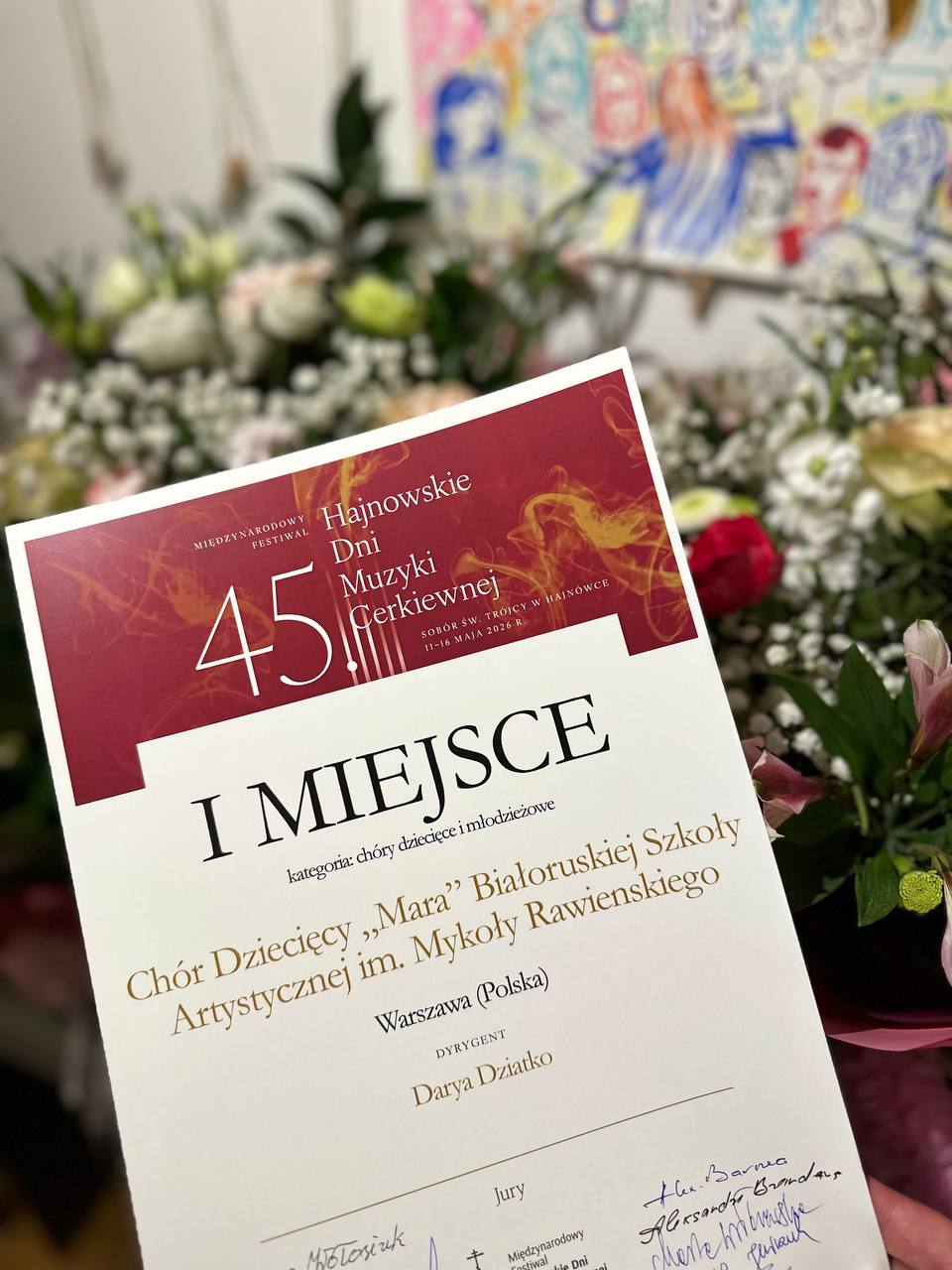
The children’s choir “Mara” of the Belarusian School of Arts named after Mikola Ravenski, located in the center of Warsaw, won first place among children’s and youth choirs at the International Festival “Hajnówka Days of Church Music.”

We spoke with teacher and conductor Darya Dziatko about how the choir was created in exile, how the performance went, and how important this award is for the ensemble.
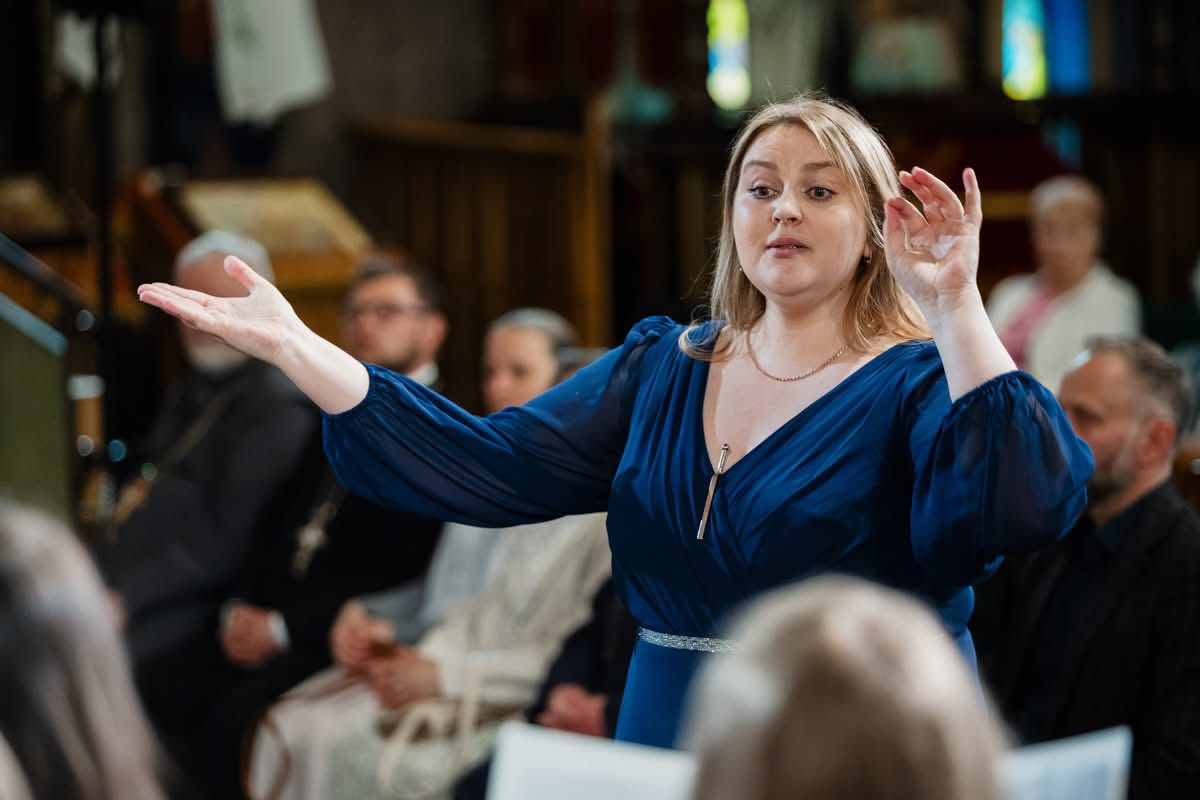
Birth of “Mara”
– Many Belarusians come to sing at the Warsaw School of Arts named after Mikola Ravenski. Who joins “Mara,” and what makes this choir special?
– The choir was born at the Belarusian School of Arts named after Mikola Ravenski in Warsaw, directed by Halina Kazimiroŭskaya. It was one of the school’s first directions. The choir consists of three groups: a younger group of children aged 6–10, an older group from 11 years old (it was this group that won the competition), and now there is also a male group consisting only of boys aged 13 and older.
They rehearse separately, but under one name, with one conductor, and perform together at concerts. Together, there are more than 40 children.
The choir emerged not out of ambition and not from the idea of “creating a collective,” but from a very human need. Emigration is difficult for children and teenagers: a new language, school, country. Their friends remained in Belarus. As a result, some children faced loneliness and difficulties adapting.
At first, our main goal was not even singing, but the desire to bring children together. To give them a place where they could be themselves, where they could speak Belarusian and be understood, where there is safety, support and community.
That is why our choir is not only about music: we grew together, learned to listen to one another, became friends, celebrated holidays, supported one another in difficult moments. Probably that is why children now come to choir willingly. Because it has already become their place.
We started with simple unison songs. And today the children sing in four-part harmony, a cappella, learn musical notation and perform a serious academic repertoire. And for me, this is a real miracle.
We very often hear discussions about preserving Belarusian culture. But if we are truly talking about its future — here it is. These are our children, who sing in Belarusian, who know their composers, who know that their culture is alive. I think it is very important to support such projects already today. Because culture does not exist on its own, but lives only when there is someone to pass it on to.
Performance
– Why specifically a church music festival? It is quite a difficult format, in my opinion…
– In fact, everything here is very simple. The development of a choir largely takes place precisely through sacred music.
Sacred works and the choral sacred tradition in general are extremely helpful in shaping a true choral sound. Such music teaches you to listen to one another, sustain a long musical line, build a shared breath within the choir, and seek a soft ensemble sound. It is precisely through sacred music that children begin to truly understand what a choir is as a single organism.
In addition, the acoustics of churches themselves have a strong influence on the choir’s development. In church spaces, children begin to hear sound differently; they learn to sing not loudly, but expansively, attentively, “through the breath.” This strongly shapes musical thinking and sound quality.
While still living in Belarus, I knew well the sacred music competitions in Hajnówka and Białystok. Many Belarusian ensembles went there, including myself. So there was almost no question about where to take the children in order to show what we had learned and mastered.
The only question was how to get there. And here I want to express great gratitude to the parents, who took on the financial side of the trip. Without their support, this story simply would not have happened.
– How did the performance go? In the video, you can see that the children feel both excitement and a clear sense of the solemnity of the moment in the incredibly beautiful Holy Trinity Cathedral.
– Yes, the performance itself was very emotional for us. Especially because the children truly understood how much work had gone into this program. We worked a lot, rehearsed, worried — you could say we grew together with this music.
And I would also like to note separately that all the works we performed were by Belarusian composers. This is very important for us.
And the announcement of the results will forever hold a special place in our memory. I do not think I have ever experienced such emotional swings before. But we will probably keep the details of that story within the choir itself.
Victory
– What does this victory mean for your choir?
– It is definitely something greater than just a diploma or first place. It is confirmation that a children’s academic choir in the Belarusian diaspora is possible. That Belarusian children far from home can not only preserve their language and culture, but also develop them at a fairly high level.
Honestly, I do not know of any Belarusian children’s academic choirs in exile throughout all this time. If such choirs do or did exist, I apologize — and please get in touch, we would love to become friends.
That is why I think this victory is not only ours; it belongs to the whole Belarusian culture in exile.
And we continue to invite children from the age of six to join our choir. You can join at any time. The school is located at the Old Town Cultural Center, directed by Marcin Jasiński.
Subscribe to Reform.news cultural news on Telegram