
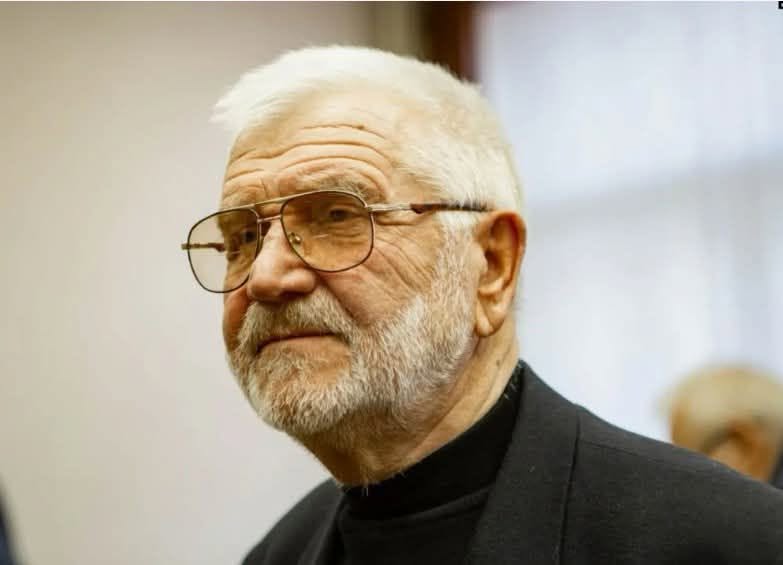
The passing of Belarusian linguist and diplomat Piotra Sadouski has prompted an outpouring of farewell messages and tributes from colleagues, associates, and public figures. The first ambassador of independent Belarus to Germany, a member of the 12th Supreme Soviet, and a brilliant linguist, he left an indelible mark on the history of Belarusian diplomacy and culture. We look back at what made Piotra Sadouski such an exceptional person and professional.

“He Combined Faithfulness to His Roots with a Vision of the Future”
Belarusian linguist Vintsuk Viachorka wrote about him.
“To me, Piotra Sadouski embodied Belarusian vitality, resilience, and joy for life. That is why it is difficult to write the brief word ‘was’…
Few people combined such faithfulness to their roots with such a clear vision of the future. He was a model Belarusian—specifically one shaped by Polatsk and Vetryna—yet at the same time open to the world. He viewed the world through a Belarusian lens, felt at home and influential within European civilization, and through his actions disproved the rotten stereotype of supposed Belarusian ‘provincialism.’
Sadouski was hardworking, creative, and persistent in everything, whether exploring the depths of linguistics or carrying out the mission of serving as the first ambassador in the modern history of Belarus…
He became an outstanding linguist not because of the sheer volume of his scholarly work, but because of the depth of his approach and his unwavering point of reference. He was never a compliant conformist, even in academia. He challenged Soviet-style routine and inertia for the sake of scholarly truth and the good of the Belarusian language.
Brave and principled, Sadouski was always on the right side of history. More than that, he himself was that right side. The principal song of his life—Yanka Kupala’s ‘And in the Pine Forest,’ about the little path leading back to one’s native land—will surely be heard by those who have not yet heard it.
My condolences to all his loved ones and friends. May he rest in peace, and may your memory be eternal, dear Piotra.”
“A Paradoxical Thinker”
Literary scholar and educator Hanna Siavyrynets also shared her farewell on Facebook.
“Piotra Sadouski has died. Besides everything else significant and remarkable that this fascinating man and, at times, paradoxical thinker accomplished in his life, he was one of the three local friends dearest to my heart who carefully watched my Belarusian and corrected both my small and major mistakes, always tactfully and with excursions into history and geography.
It was a good, full, meaningful life. Farewell, Uncle Piotra. May your journey be peaceful. You will remain within me, in every Belarusian word I write, as eternal gratitude.”
“It Was Thanks to People Like Him That Belarus Restored Its Independence”
Dzianis Martinovich, historian and theatre scholar:
“It was thanks to people like Piotra Sadouski, a member of parliament in the early 1990s, that Belarus restored its independence and exists today as a state. Eternal memory.”
“I Still Hear Him Singing on the Square”
Siarhei Navumchyk, politician and journalist:
“Piotra Sadouski has died. A defender of the Belarusian language, a member of the Belarusian Popular Front parliamentary faction, the first ambassador to Germany, a participant in the hunger strike against the humiliation of national dignity, and a man whose voice always stood out in the political and intellectual chorus. Through the years, I still hear him singing Yanka Kupala’s ‘Three Little Roads’ on the Square on the victorious evening of August 25, 1991. Eternal memory.”
Piotra Sadouski (1941–2026) was one of the key figures of the Belarusian national revival, an outstanding linguist, politician, and diplomat. He held a Candidate of Sciences degree in Philology. For many years, he taught German studies and translation theory at the Minsk Institute of Foreign Languages (now the Minsk State Linguistic University) and was fluent in several languages.
In 1990, he was elected to the 12th Supreme Soviet of Belarus as a representative of the Belarusian Popular Front. He was among those who directly adopted the Declaration of State Sovereignty of Belarus, fought for the restoration of the Pahonia coat of arms and the white-red-white flag, and chaired the parliamentary Committee on Foreign Affairs.
In 1992, he became the first Ambassador Extraordinary and Plenipotentiary of independent Belarus to Germany. He resigned in 1994 in protest against the policies of the country’s new leadership.
In April 1995, he was among the members of the Belarusian Popular Front parliamentary opposition who went on a hunger strike inside the parliament building to protest the referendum initiated by Aliaksandr Lukashenka. During the protest, he was brutally beaten by security forces.
After completing his diplomatic mission, he remained active in public and cultural life and was a member of the Belarusian Popular Front Council (Soim). He authored numerous opinion articles, essays, and the memoir My Shibboleth (2008), devoted to language issues, diplomacy, and the Belarusian national revival.
Sadouski’s daughter, Alina Sadouskaya, announced his death earlier today.
He was 87.
The farewell ceremony for Piotra Sadouski will take place tomorrow, Tuesday, from 9:00 a.m. to 9:45 a.m. at 8/8 Siamashki Street.
Subscribe to Reform.news cultural news on Telegram