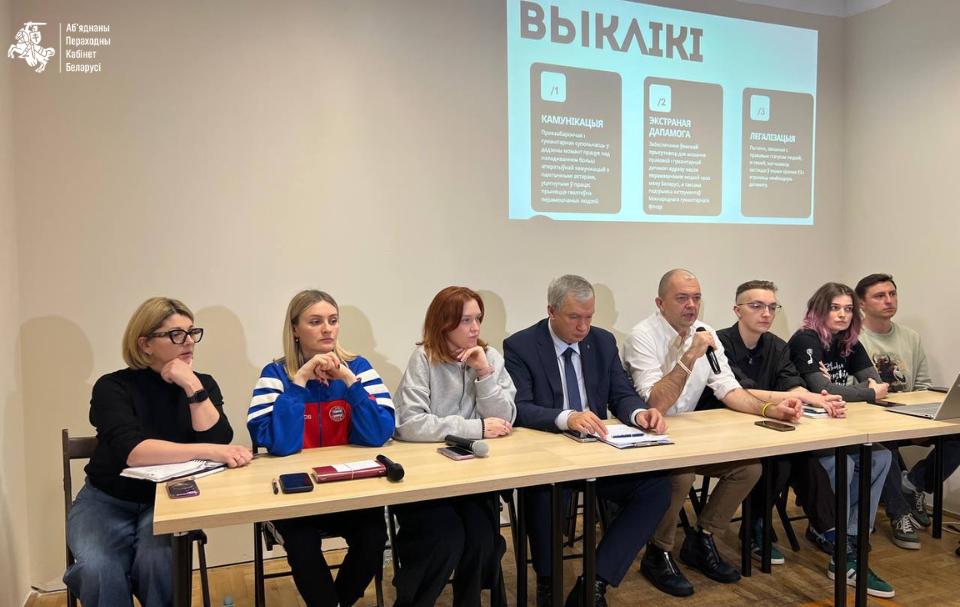
Representatives of democratic forces, human rights organisations and volunteer groups at a press conference in Warsaw described what has happened one month after the release and deportation of 123 Belarusian political prisoners who were taken out of Belarus in December. The former prisoners received initial assistance and were able to find temporary accommodation in host countries. They now need to resolve legalisation issues, reunite with their families, restore their health and begin resocialisation in a new country.

Maryna Kasinerava (DissidentBY) stressed that by removing the released prisoners from the country, Alyaksandr Lukashenka violated their basic rights.
“People cannot exercise their basic rights, for example, to food, to healthcare, to simply remain in their own country. And secondly, people were taken to the territory of Ukraine, where fighting is taking place. This strongly affects their physical and psychological health. All these actions and rights violations can be called a crime against humanity by the Lukashenka regime, because, as we know, many people had no intention of leaving the country, many had their documents taken away, and both social and family ties were broken. It is still a big question how people will reunite with their families in the future,” she said.
Initial Assistance
Belarusian political prisoners were taken to Ukraine in December and then moved to Poland and Lithuania. Upon arrival, they received initial assistance including clothing, hygiene items, and temporary accommodation.
According to the International Humanitarian Fund, 211,615 euros have already been spent on the reception of more than one hundred political prisoners. Spending included 66,199 euros on food, 60,862 euros on accommodation, 37,619 euros on clothing, 13,867 euros on equipment, 10,470 euros on hygiene supplies, 5,625 euros on vitamins and basic medicines, 8,070 euros on financial aid, and 8,903 euros on other expenses.
Volha Zazulinskaya, representative for social policy of the UTC, underlined that this amount does not include support from Freedom House, personal contributions from Pavel Latushka, or resources from volunteers, BYSOL, the Belarusian Human Rights House, Viasna and Libereco.
Legalisation in Poland
According to UTC Deputy Head and NAU leader Pavel Latushka, 83 former political prisoners have already applied for international protection in Poland. He thanked Polish authorities for their assistance. Democratic forces and human rights organisations are now asking Poland to accelerate the legalisation process, as relevant institutions are overloaded with applications.
“We know that a large number of Ukrainian and Belarusian citizens — the main groups — submit documents for legalisation in Poland, and the relevant institutions are under a heavy workload. But we appeal to the Polish authorities to speed up the legalisation of the freed political prisoners in Poland. This is vital for their socialisation and access to the labour market. It is also important given the financial burden placed on our human rights organisations and ordinary Belarusians, who must provide accommodation, food and support in daily matters,” he explained.
Visa issues for family members are also being addressed. There is an agreement with the Polish Foreign Ministry to provide lists of relatives. This includes national visas for family reunification and Schengen visas for relatives wishing to visit those who were forced abroad.
Legalisation in Lithuania
Most political prisoners who arrived in Lithuania chose legalisation pathways not linked to international protection, said Freedom House programme director Vytis Jurkonis.
“Most political prisoners who came to Lithuania applied for national visas or humanitarian residence permits, not for political asylum or international protection,” he noted.
Many have already received legal status. Those without passports are able to obtain foreigner’s passports, and humanitarian residence permits are usually issued within three to four months. Family reunification is also underway: some relatives have already received Schengen visas on humanitarian grounds.
What Comes Next?
Coordinator of Volnyja Veranika Stankevich said that the next stage is securing long-term housing.
“The entire group is now staying in a hotel, except for those who have already left to stay with relatives — they adapted better and found housing on their own. Some of those who remained in Warsaw are already living in shelters. By 20 January the entire group will be moved to individual accommodation, which will also be covered by the International Humanitarian Fund,” she said.
Each person has a mentor assisting with adaptation and socialisation. Work is conducted in groups. A medical support and rehabilitation programme is starting. Some have already received dental services, and further examinations and treatment are now being organised. Language courses are already being arranged, and employment support will follow.
Participants of the press conference emphasised that the problem is broader: in addition to those evacuated from Belarus, there are former political prisoners who completed their sentences but were forced to leave the country on their own. Around 300 such people have arrived in Lithuania. They also require support.
Many organisations have been involved in assisting Belarusian political prisoners: Volnyja, Country for Life Foundation, DissidentBY, INeedHelp.by, BYSOL, Freedom House, BCB, the UTC Social Policy Office, Valancer_ki, NAU, Viasna volunteers, the UTC Kyiv office, the United Transitional Cabinet, Sviatlana Tsikhanouskaya’s Office, the Belarusian Solidarity Centre, the Belarusian Human Rights House, Partyzanka, Dapamoga, the Kastus Kalinouski Regiment, the Association of Former Political Prisoners “Da Voli”, the Association of Political Prisoners of Belarus, Białoruski Związek Solidarności, Belarusian PEN and the Lithuanian Red Cross.