
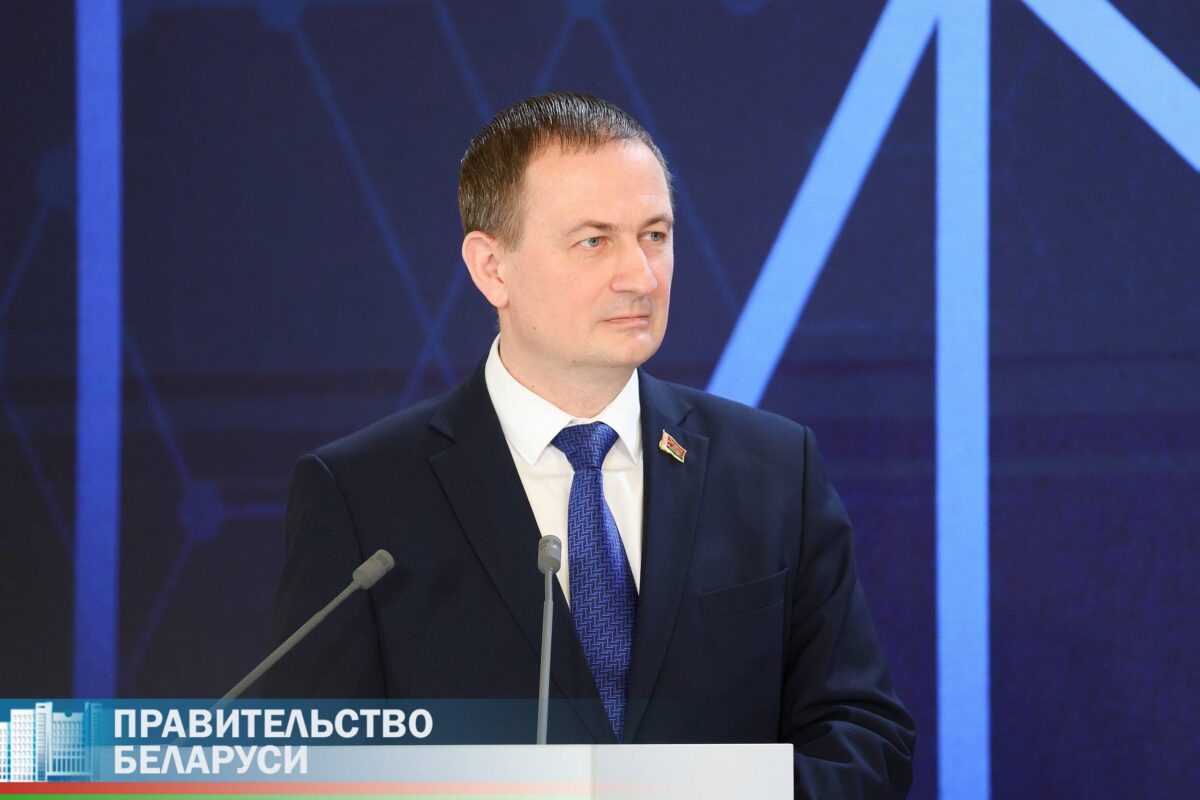
Belarus’ creative economy exports already generate $1 billion a year, Prime Minister Aliaksandr Turchyn said at a plenary session of the International Conference on Strengthening Cultural Ties and Developing Creative and Cultural Industries in St. Petersburg.

“It has become fashionable to talk about the creative economy lately. But the topic is far from new. There is a common joke: painting Malevich’s ‘Black Square’ was not difficult, but selling it was the real art. Today it has become obvious that the creative industry is a full-fledged sector of the economy, capable of generating high added value, creating new jobs and strengthening international competitiveness at the state level.
In this economic system, the main commodity is not raw materials but the product of human capital and intellect — an idea that has been monetized and scaled, creative content. And here we return to the simplest truths. As the president of our country always emphasizes, we do not have vast natural resources. The main wealth of Belarus is its people,” he said.
Turchyn also assessed the contribution of the creative industry to the Belarusian economy. It has already reached 5%.
“The world has entered an era in which control over intellectual property is becoming more important than control over traditional resources and even more profitable. According to United Nations estimates, creative goods and services already account for more than 3% of global GDP, while their annual volume exceeds $2 trillion. At the same time, the growth rate of the creative economy consistently outpaces the global average for other sectors.
The contribution of creative industries to our country’s GDP reached 5% in 2025. This is above the global average and indicates a shift in the structure of the Belarusian economy toward a knowledge-based economy, innovation and intangible assets. According to UNCTAD data for 2025, Belarus’ exports of creative services are estimated at $1 billion. In relative terms, Belarus ranks among the top three CIS countries, with creative services accounting for more than 10% of total services exports. Services exports constitute the dominant share — more than 65% — of the country’s total creative exports.
It is particularly important that this sector employs the highest proportion of young people aged 15 to 29 compared with other industries. Overall, it should be noted that creative industries help address a range of priority state objectives. They create flexible forms of employment, which is particularly relevant for women with children, people with disabilities and residents of small towns. Incidentally, it is in the creative sectors that we see the greatest contribution from women,” he continued.
The prime minister described the IT sector as the locomotive of Belarus’ creative economy. He noted that the Hi-Tech Park accounts for nearly 3% of Belarusian GDP.
The country’s second driver of the creative economy is the tourism and hospitality industry. The goal is to increase its contribution to GDP to 4.5%.
“We are developing systemic support instruments for micro, small and medium-sized enterprises, which on average account for 80% of all creative businesses. An important element of state support in this regard is tax and financial incentives, including benefits for cultural organizations, support for crafts and subsidies for the film industry.
The draft guidelines for implementing the Treaty on the Creation of the Union State for 2027-2029 provide for three key areas.
The first is the alignment of approaches to classifying creative industries and assessing their contribution to the economy. At the beginning of 2026, Belarus approved a list of aggregate categories for creative industries. Russian and Belarusian methodologies are generally similar and are based on UNCTAD approaches. Their further harmonization will improve the effectiveness of public policy.
The second is the exchange of experience in regulating the creative economy.
The third is the implementation of joint cultural and tourism projects.
Significant initiatives are also being implemented within the CIS to strengthen cultural ties. These include an agreement on joint film production, making it possible to create film projects without relying on the Western industry, and the operation of the Nesvizh National Historical and Cultural Museum-Reserve as a base organization for museum affairs,” Turchyn said.