
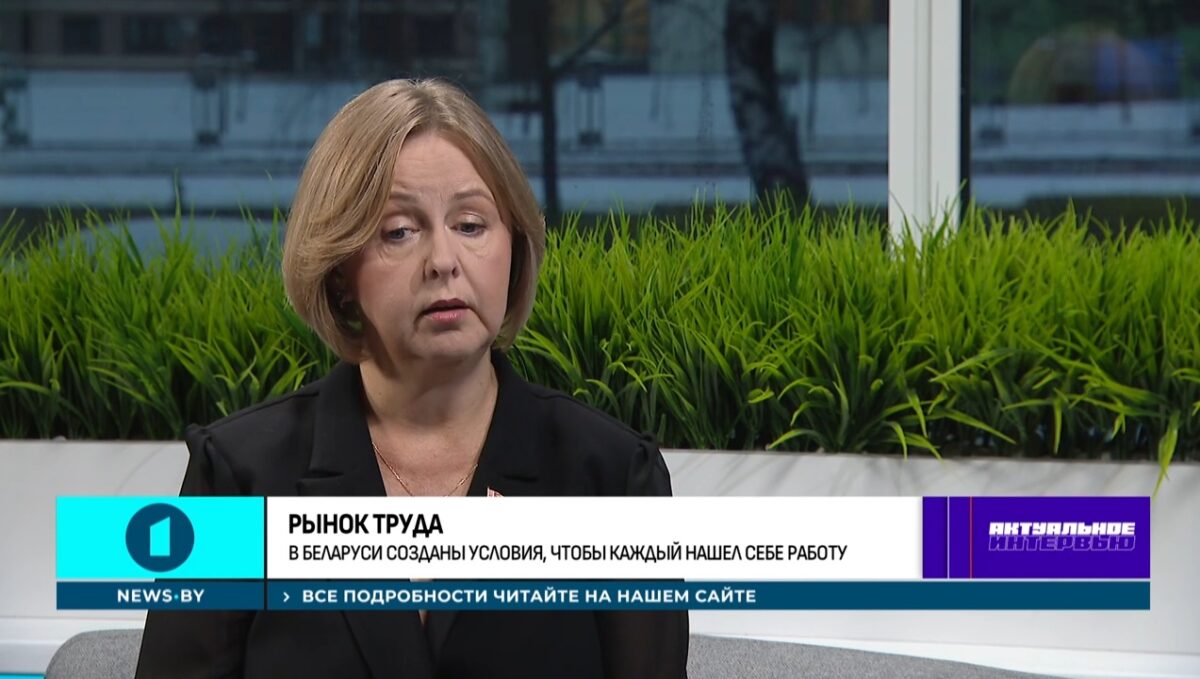
Belarus’s Ministry of Labor and Social Protection expects high demand for labor to persist in the country. Deputy Labor Minister Tatsiana Astreyka said this in an interview with Belarusian television.

“Today, every fifth worker is either of retirement age or already retired. Therefore, on the one hand, this is continuity of experience, knowledge, and competencies — a huge chance and opportunity for young people to enter the profession faster and more smoothly. I will say again that young people and older workers, so to speak, do not compete with each other in the labor market, because they occupy different professional niches and are both complementary and useful. On the other hand, this is economic growth. Economic growth creates a need for additional personnel. If we look at who is declaring these 160,000 vacancies, it is precisely industry, trade, and agriculture. These sectors — the drivers of GDP — as they develop, generate demand for additional labor. But these personnel are also needed at new high-productivity jobs. Therefore, the requirements for them are, of course, different — different knowledge, skills, and competencies are required. And here it is very important that the vocational education system works, that personnel training is carried out specifically in response to the needs of the economy, what is required. We cannot afford wastefulness, when we train people who are not needed by the economy, especially in conditions of a labor shortage. That is why the Ministry of Labor and Social Protection is changing its approaches to forming a forecast of the economy’s personnel needs. And this forecast will then form the basis for the state order for personnel training and will be used by the education system,” she said.
According to her, 70% of vacancies are for production workers. There is also a need for truck drivers, salespeople, cooks, and construction workers.
“We have prepared a forecast for the period up to 2030 of who will be needed by the economy. Probably unsurprisingly, based on the current situation, we understand that there will again be demand for workers, primarily with secondary specialized and vocational-technical education — on the one hand. This, of course, does not diminish the need for engineering personnel; this will definitely remain.
In addition, the IT sector. We are observing a revival in the number of people employed in the information and communications sector. This sector leads the salary rankings in our country. We see that transformation is taking place in this sector. These are not only programmers. These are people who are connected with artificial intelligence, who train artificial intelligence. What is very important for this sector is that IT permeates absolutely all areas of the economy. These specialists in this field are needed everywhere, so we forecast that demand will remain.
On the other hand, we see that a fairly large replacement demand for specialists in education and healthcare remains. That is precisely where the largest number of older, so to speak, workers are employed. Therefore, in the future we must think about this — and we are already doing so — in order to prepare replacement personnel. This is mandatory; it is our professional and labor, so to speak, security in this regard.
In addition, the growth in the number of people over the age of 75 naturally implies an increase in demand for social services. Therefore, services for caring for elderly people will definitely also be among the top needs. And I actively encourage young people to join our team and provide social services,” she said.
It should be noted that workers in the social sector have some of the lowest average wages in the country.