Belarus and North Korea are preparing to mutually abolish visa requirements. Foreign Minister Maksim Ryzhankou said this. And just days ago, Aliaksandr Lukashenka let slip plans to bring workers from North Korea to Belarus. It appears that an ideal workforce from the regime’s perspective is already ready to be sent to our country.

“One-Sided Visa-Free Travel”
According to Ryzhankou, a draft bilateral agreement with Pyongyang on mutual visa abolition is already ready. Only some technical matters remain to be settled.
“We will sign it in the very near future. I had a meeting with the foreign minister of North Korea. We discussed the whole range of bilateral relations, including agreeing on upcoming contacts through the foreign ministries and precisely on the signing of a number of agreements, including this important agreement on visa-free travel for citizens,” the foreign minister said.
An interesting fact: the countries that have visa-free arrangements with North Korea can be counted on one hand. Among the post-Soviet states, according to VisaBorders, such an arrangement exists only with Kyrgyzstan. Other countries include the Dominican Republic, Seychelles, Guyana and Micronesia, although in their cases visa-free stays are limited to periods ranging from 21 to 90 days, as well as several others. In addition, visa-free travel with North Korea is provided for the so-called Palestinian territories — the West Bank and the Gaza Strip. Belarus will apparently soon be added to this list.
At the same time, it appears that this is a kind of “one-sided visa-free arrangement.” As Amnesty International reports, North Korean citizens are prohibited from making international trips without official permission. They have virtually no opportunity to leave the country legally. But North Korean authorities do allow their citizens to work abroad. For Pyongyang, this is an important source of foreign currency. And this practice has repeatedly come under criticism because of the slave-like conditions in which North Korean migrant workers are forced to work and live. The Belarusian regime presumably intends to take advantage of this situation.
On August 11, at a meeting with the leadership of the Council of Ministers to discuss Belarus’ demographic crisis and measures of state support for families with children, Lukashenka made an interesting remark. Unlike Belarusian propaganda outlets, which edited the politician’s words, we quote them in full:
“So that we do not disappear as a nation and there is someone to work, [we] should not invite people here from Uzbekistan, from North Korea, and so on, everything is as simple as two plus two: two parents — two children. This is the basis, as young people say,” he said.
Video by the Telegram channel “Pool of the First”
Migrant workers from Uzbekistan have already begun arriving in our country in small numbers, although initially there were incidents and complaints from them. Judging by Lukashenka’s remarks, Minsk is also placing hopes on labor migration from North Korea. Especially since it will be many times harder for workers from North Korea to complain about anything. And a visa-free regime would significantly facilitate their arrival in our country.
Conditions Close To Slavery
Back in 2015, UN Special Rapporteur Marzuki Darusman said that North Koreans “are sent to work in many countries around the world and labor under conditions of forced labor organized both by their own government and by the governments of host countries.”
According to him, Pyongyang exports its workers to circumvent sanctions and earn foreign currency. North Korean authorities receive “black” wages for their workers. The migrant workers themselves are kept unaware of the terms of contracts negotiated by employers with the government in Pyongyang. Workers from North Korea earn an average of $120-$150 a month, do not receive enough food and are sometimes forced to work up to 20 hours a day.
Last year, the BBC published a report saying that thousands of North Koreans had been sent to work in Russia to make up for labor shortages caused by the war against Ukraine launched by the Kremlin. And they have to work in conditions close to slavery.
A journalist from the outlet managed to speak with several North Korean workers who had escaped from Russia. According to them, they were forced to work in “abysmal” conditions, while North Korean authorities tightened controls to prevent escapes.
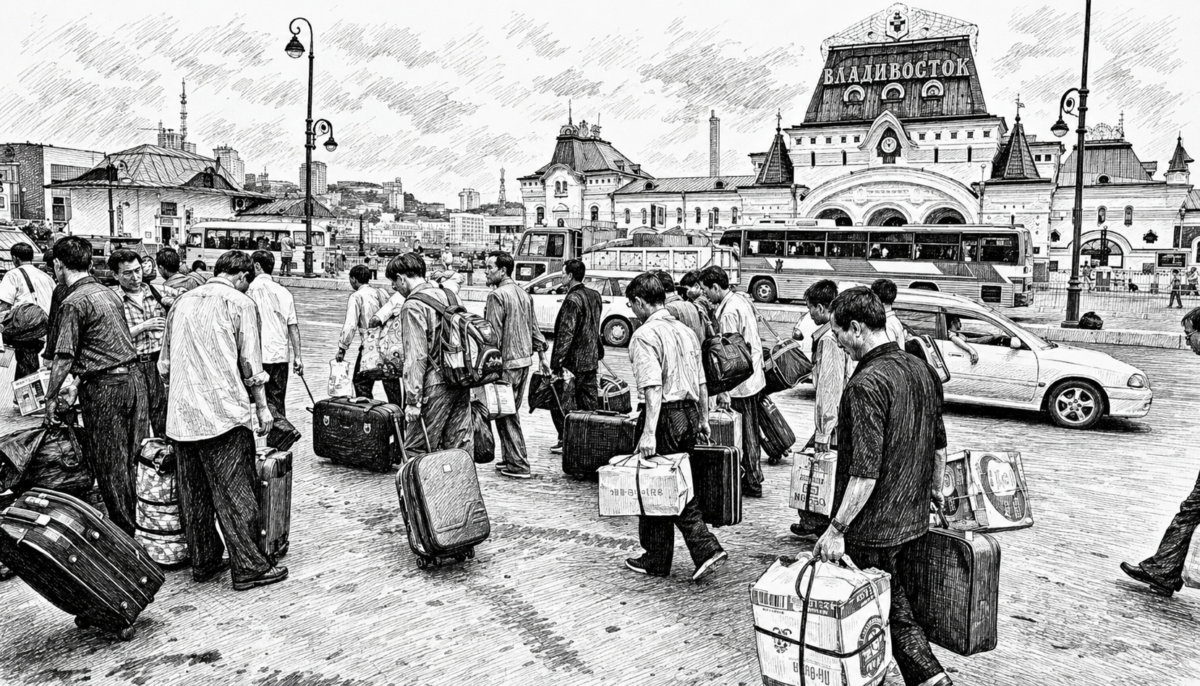
One of the workers, Jin, said that upon arriving in Russia’s Far East, he was accompanied from the airport by a North Korean security agent who ordered him not to speak to anyone or look at anything. “The outside world is our enemy,” the agent told him. According to Jin, he was immediately sent to work at a construction site, where he worked for more than 18 hours a day. All six workers interviewed by the BBC journalist described similarly exhausting working days — getting up at 6 a.m. and working until 2 a.m. the following day. They were given only two days off a year.
In 2024, according to a South Korean intelligence official who spoke to the BBC on condition of anonymity, more than 10,000 North Korean workers were sent to Russia. In total, Pyongyang intended to send more than 50,000 people to Russia.
At the same time, the opportunity to go abroad for work is highly sought after in North Korea because wages there are promised to be higher than at home. Obtaining such an opportunity is not easy. Most workers leave in the hope of escaping poverty. But most of the migrants’ earnings are sent directly to the North Korean state as “payment for loyalty.” The remainder — usually $100 to $200 a month — is recorded in an accounting ledger. Workers receive the money they have earned only upon returning home — according to experts, this is a new tactic designed to prevent escapes. The freedom of movement of North Korean workers is also restricted for this purpose — they are rarely allowed to leave their places of work and residence, only in groups and under escort.
Bypassing Sanctions?
Following Moscow’s example in actively using North Korean labor, Minsk appears to have decided to do the same. To plug demographic gaps in the workforce. And to obtain, in place of the Belarusians it has itself driven out of the country, an obedient workforce that does not even need to be controlled — specially trained North Korean comrades will take care of that.
The ideal model — there is no need even to negotiate wages with the workers. All issues are resolved promptly in the North Korean capital. The only expenses are for transportation, accommodation and relatively low wages. I assume that even the working conditions — or, more accurately, the conditions of confinement — of North Korean migrant workers in Belarus will be better than in Russia, where the scale of theft, arbitrariness and impunity is simply off the charts. But even so, this form of hiring foreign labor cannot be called anything other than exploitation.
Such migrants will not complain about their working conditions either. And even if they decide to, their own escorts will once again deal with suppressing unrest. No headaches. This is precisely what the Belarusian regime and its leader have dreamed of — an army of disenfranchised slaves who can be manipulated at will.
There is, however, one “but.” In December 2017, the UN Security Council imposed further sanctions on North Korea that included a complete ban on hiring workers from North Korea. By the end of 2019, countries where such workers were employed were required to send them back home. All joint companies with North Korea were also to be liquidated. All members of the UN Security Council, including Russia, unanimously voted for the resolution at the time.
After the sanctions were imposed, Russia did indeed begin expelling North Korean workers. The Russian Interior Ministry even reduced the permitted period of stay for workers from North Korea further — to one year from two. And the Russian Labor Ministry stopped issuing quotas for hiring workers from North Korea.
But the war against Ukraine changed the situation. North Korean workers became necessary for Moscow. In addition, in April 2024, the mandate of the panel of experts overseeing sanctions against North Korea expired, and Moscow blocked an extension of its mandate, using its veto power at the Security Council. It is now impossible to officially verify whether, and to what extent, a particular country is complying with the sanctions regime. And countries can say whatever they want publicly.
Still, despite Moscow’s efforts, the UN Security Council sanctions have not been lifted. So the risk remains. And concealing the arrival of a significant number of North Korean workers in relatively small Belarus will not be easy. Perhaps that is why BelTA prudently removed Lukashenka’s reference to North Korea from the quote cited above.
Perhaps they will start with small groups of workers and see how people react. So it appears that, in some numbers, slave labor from North Korea may indeed come to Belarus. Without unnecessary publicity or fanfare. As for possible sanctions, it remains anyone’s guess, while the regime urgently needs to plug demographic gaps. And where else could it find such intimidated and frightened workers, with supervisors already assigned to them under the terms of their employment contracts?
***
The views and assessments expressed by the author may not coincide with those of the Reform.news editorial board