
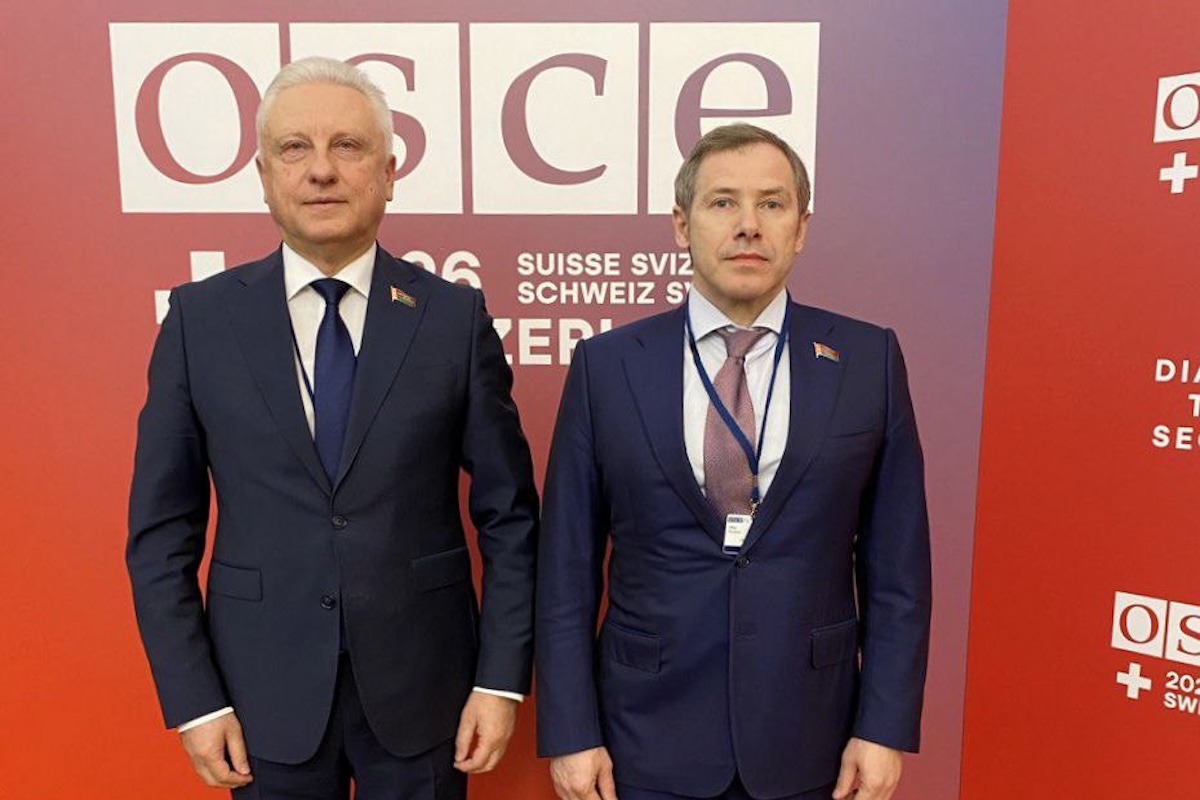
The planned participation of Belarusian democratic forces leader Sviatlana Tsikhanouskaya in a side event on the margins of the OSCE Parliamentary Assembly session in Vienna triggered a tense reaction from representatives of the Lukashenka regime.

The 25th Winter Meeting of the OSCE Parliamentary Assembly is taking place in Vienna on February 19–20, with the participation of representatives of democratic forces in exile and a delegation from Minsk. Tsikhanouskaya is set to speak at the side event “Belarus and the OSCE PA: A Round Table on the Path to Democracy and Humanitarian Priorities,” organised by the delegations of Sweden and Norway together with the Office of Tsikhanouskaya.
This did not go unnoticed by the Lukashenka regime. The head of the Lukashenka-aligned delegation, Chairman of the Standing Commission on International Affairs of the House of Representatives Siarhei Rachkou, speaking at a meeting of the General Committee on Political Affairs and Security, launched criticism of the organisation.
“Recently, unfortunately, the OSCE has done nothing and is doing nothing to ensure a safe and conflict-free situation in Europe. Today it is necessary to work on resolving one’s own problematic issues, primarily in the economy and security, in order to ensure stability, a decent standard of living for people and the economic competitiveness of the region…
…We also draw attention to the inadmissibility of using the OSCE PA platform by extremist elements who are prosecuted under the law in Belarus,” he said.
According to Rachkou, the Minsk regime “consistently advocates a return to the organisation’s mandate-based logic, the restoration of full-fledged professional discussion of military-political risks, confidence-building measures, incident prevention and arms control. There is a need to develop a new architecture of Eurasian security.”
“This goal is served precisely by the initiative put forward by the Belarusian side to form a Eurasian Charter of Diversity and Multipolarity in the 21st Century. This is about creating an inclusive conceptual basis for security that does not contradict the UN Charter and is oriented toward developing agreed principles of peaceful coexistence in Eurasia,” Rachkou recalled.
The press service of the House of Representatives of the National Assembly reported that Rachkou held meetings with the OSCE PA Secretary General, as well as parliamentarians from Mongolia, Cyprus, Azerbaijan and Tajikistan.
On the margins of the event, a meeting was also held with Co-Chair of the Belarusian-Austrian Business Council Hubert Berch, during which issues of parliamentary support for the development of bilateral trade and economic relations in the current conditions were discussed.