
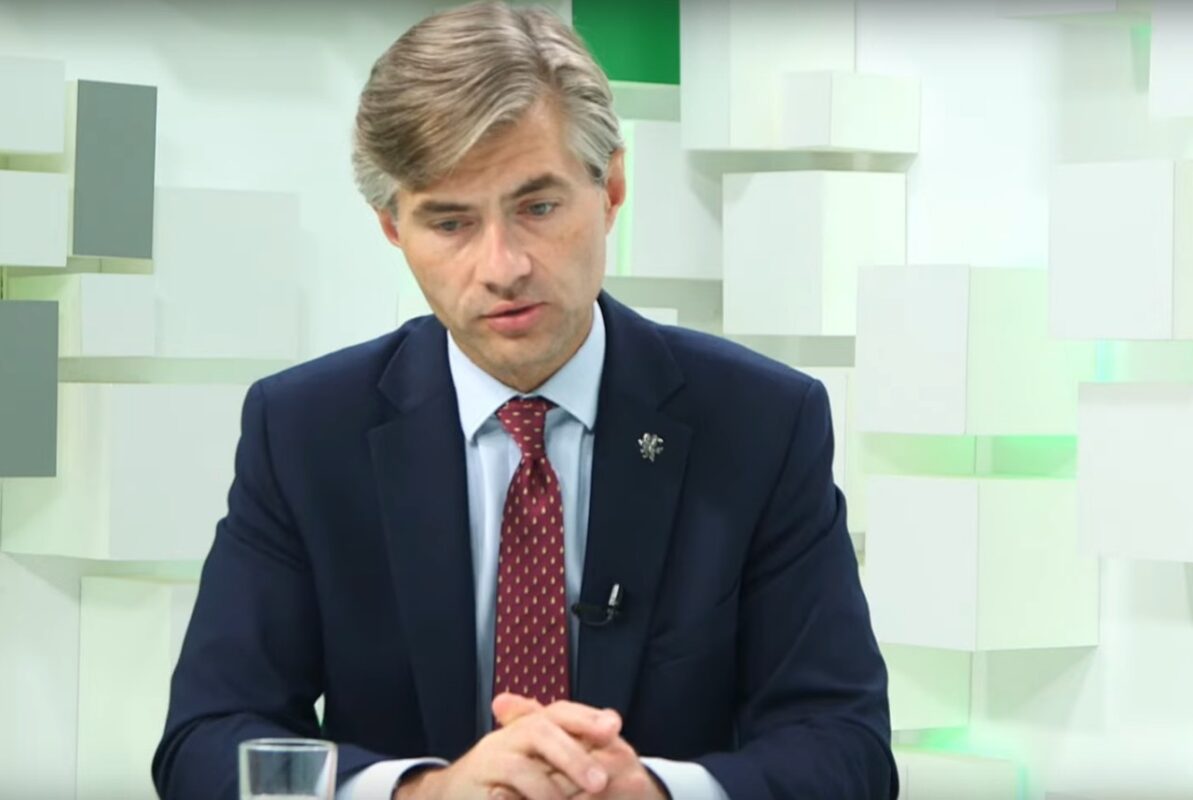
Lithuanian Foreign Minister Kęstutis Budrys said that emerging discussions about the country’s policy toward Minsk do not mean its revision or an intention to urgently change course. According to him, the very fact of discussion should not be interpreted as doubt about the correctness of the current line, LRT reported, citing BNS.

The head of the foreign policy department noted that such discussions are necessary to assess how well the policy being pursued corresponds to the stated goals.
“It seems to me that, for example, it is incorrectly interpreted that if we discuss something, it means that we are questioning the current policy and therefore assume that it will be immediately revised. No, we need to check whether what we are doing is actually correct,” the minister said in an interview published on Wednesday by the Lrytas portal.
In this way, Budrys commented on increasingly frequent statements by representatives of the ruling coalition about a possible resumption of dialogue with Minsk. Earlier, the chairman of the Lithuanian Social Democratic Party, Mindaugas Sinkevičius, had allowed for the possibility of a meeting at the level of deputy ministers, emphasizing that Vilnius must take into account the actions of partners — the European Union and the United States.
At the same time, Budrys believes that returning to discussions of political dialogue with Minsk will only be possible after the EU extends sanctions against Belarus.
The head of Lithuanian diplomacy said that he supports ongoing discussions about sanctions policy and assured that he has “a whole bunch of arguments” in favor of the view that sanctions are one of the most effective economic and political tools.
“If someone believes that sanctions do not work, let us discuss whether the area of their application has been chosen incorrectly or, for example, whether their implementation is not working, because there are also some problems here. Sanctions circumvention is a big topic, and the situation with our carriers has shown that here, too, we probably have more than one grey area,” Budrys said.
According to the minister, discussions about the results achieved and the usefulness of sanctions may continue, but it cannot be claimed that they have failed to produce the desired results until all resources have been exhausted.
“Until we exhaust all resources in sanctions policy toward both Russia and Belarus, seeking to change their behavior, I do not agree that in this situation sanctions are an ineffective tool, because we have not yet verified this. We must implement the sanctions package in full. America has reserves, Europe has reserves. And we still have to act. There are no changes in policy or position on this issue,” he said.
The minister stressed that Lithuania’s position regarding the reasons that led to the imposition of sanctions against Belarus has not changed, and therefore he sees no grounds for their lifting.
“Sanctions were imposed because of human rights violations, assistance in aggression against Ukraine, assistance to Russia in committing war crimes related to the abduction and ideological indoctrination of children. Until the situation changes, there are no grounds to talk about changing sanctions or any easing of them. On the contrary, Lithuania has expanded the sanctions regime against Belarus,” he said.
As a reminder, in mid-December, U.S. President Donald Trump’s special envoy John Coale reached an agreement with the administration of Alyaksandr Lukashenka on the release of some political prisoners and the lifting of sanctions on Belarusian potash fertilizers. After that, political observers began to discuss that Washington might try to persuade the EU and Lithuania to again allow the transit of this product through the port of Klaipėda.
The transit of products from the company Belaruskaliy through Lithuania was halted in February 2022. In December last year, the company filed a claim in arbitration demanding compensation from Lithuania in the amount of $12.09 billion. The European Union has also imposed restrictions on Belarusian fertilizers, and the issue of their extension is scheduled to be considered in February.