
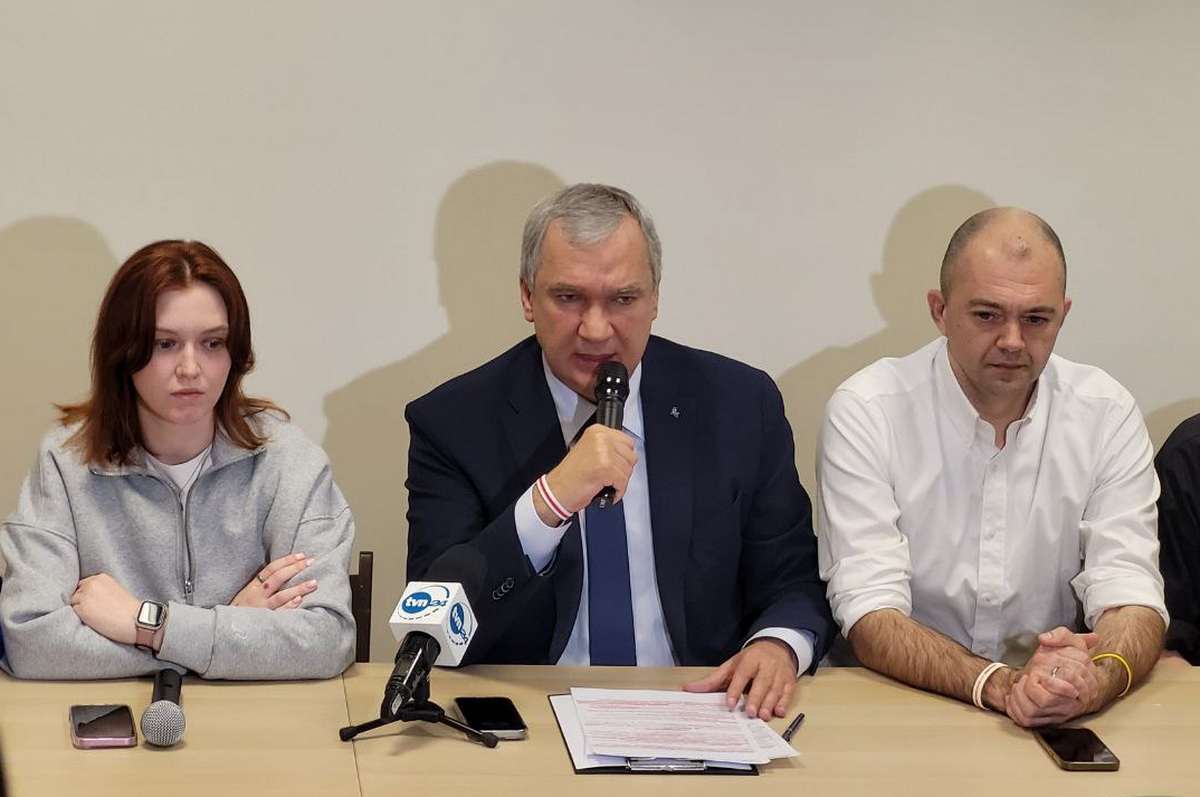
Belarusian political prisoners who are currently in Poland after being freed and evacuated from the country in December are working on their legalisation procedures. They have submitted applications for international protection. Now Belarusian democratic forces are asking Poland to accelerate the legalisation process. This was stated at a press conference in Warsaw by Deputy Head of the UTC and Head of the National Anti-Crisis Management Pavel Latushka.
According to him, 83 political prisoners have already submitted applications for international protection. Polish border guards received them before the New Year without days off, in several cities across the country. Pavel Latushka thanked the Border Guard Service, Poland’s Ministry of Foreign Affairs, Poland’s Ministry of Interior and Administration, and the Office for Foreigners for their assistance in this process. He also expressed gratitude to every border guard who accepted applications from Belarusians over a period of 13 days.
“This work was carried out on Saturdays, on Sundays, and on the eve of holidays in various cities — in Warsaw, Białystok, Gdańsk, Wrocław. I would like to express my gratitude to every border guard who helped us resolve this very important matter,” Pavel Latushka said.
Now, he noted, the task is to speed up the legalisation procedure.
“We know that a large number of Ukrainian citizens and Belarusian citizens — these are the main groups — submit documents for legalisation in Poland, and the relevant institutions are overloaded with applications. But we appeal to the Polish authorities with a great request to accelerate the resolution of the legalisation of freed political prisoners in Poland. This is extremely important in terms of their socialisation and their access to the labour market. It is also very important given the financial burden placed on our human rights organisations, on everyone who helps us, on ordinary Belarusians — because during this time everyone must be supported, housed, fed, and everyday issues must be resolved,” he said.
Pavel Latushka added that he already has a scheduled meeting with the head of the Polish Office for Foreigners, Tomasz Cytrynowicz, to discuss this matter.
Another task being worked on by democratic representatives, human rights defenders and volunteers is organising reunification with relatives. The Belarusian political prisoners expelled from Belarus have, in most cases, been separated from their families, relatives and loved ones.
“It is very important for us to assist the freed political prisoners so that their relatives and loved ones can obtain visas to enter the territory of Poland,” Latushka added.
This includes both national visas for family reunification and Schengen visas for relatives wishing to visit the former political prisoners. Lists have already been prepared and will be submitted to the Polish Foreign Ministry.