
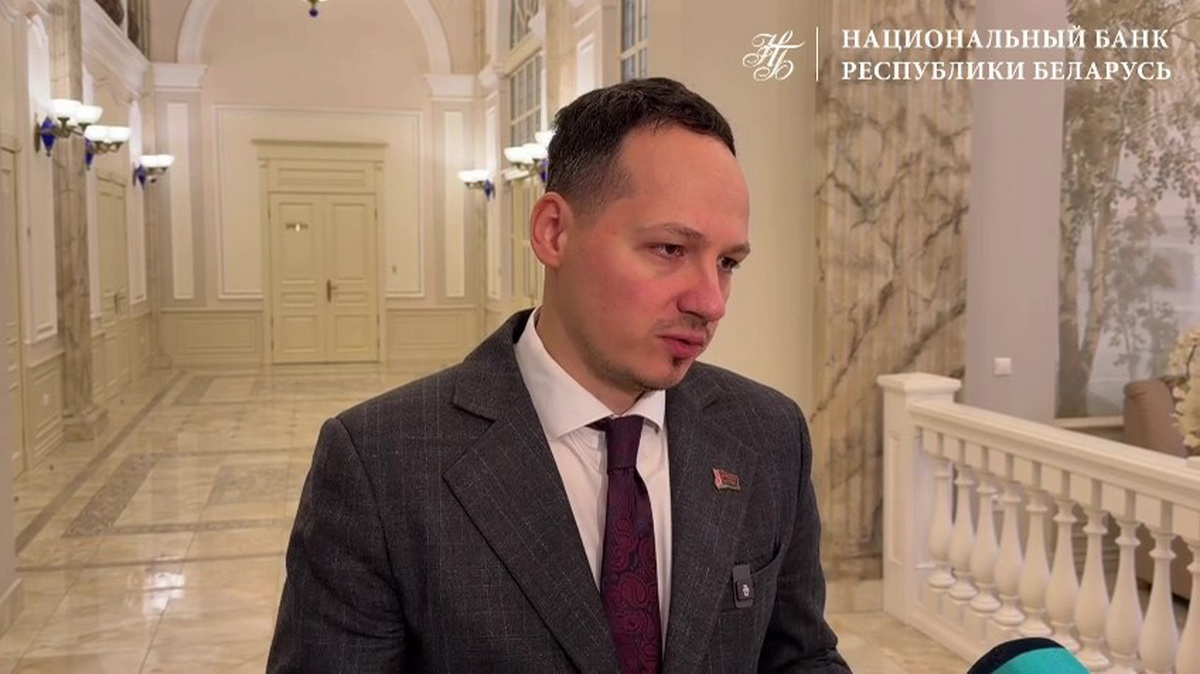
The decree on cryptobanks creates an opportunity for the self-employed to receive salaries in cryptocurrencies. This was stated by First Deputy Chairman of the Board of the National Bank Alyaksandr Yagorau, commenting on the document signed today. According to him, the decree was eagerly awaited in the fintech community.
“It seems to me this was one of the most anticipated regulatory acts not only in the Belarusian fintech community, but also globally, because it is quite a unique development for the global cryptocurrency market,” he said.
Yagorau noted that before the decree was issued, the banking sphere and crypto exchanges in Belarus were clearly separated. Now, with the introduction of the cryptobank, new possibilities are opening up.
“Before this decree and, accordingly, before the possibility of a cryptobank operating in Belarus, we had two very distinct contours. One contour is the classical banking system, where banks operate with fiat money — regular money we use every day.
On the other hand, we had crypto exchanges that could provide services to citizens to buy, sell, and exchange cryptocurrencies. Now, under this decree, an institution such as a cryptobank is envisaged, which will combine both the functions of a classical bank and the functions of an exchange, with additional functionalities and expanded cryptocurrency operations,” he continued.
The first deputy chairman listed several new possibilities, including receiving salaries in cryptocurrency.
“What does this provide? First, it means a unified balance. There will be no distinction within this institution between fiat money and crypto money.
Second, and this is important, the decree stipulates that self-employed citizens will be able to receive their salaries in cryptocurrency, provided they receive it through a cryptobank. There are a number of other innovations that significantly expand the possibilities of using cryptocurrencies, but specifically within the created institution of cryptobanks,” he said.
Yagorau stressed that cryptobanks will be supervised by the National Bank, and the regulatory approaches will be based on those applied to regular financial institutions.
“Cryptobanks will be subject to National Bank supervision. This is a very important innovation, because the canonical supervisory approach will ensure several aspects. First and foremost, the security of storing funds, both fiat and crypto.
The second important aspect is compliance with financial stability indicators and the stability of the institution itself. Accordingly, the National Bank will set requirements for which regulatory standards a cryptobank must meet so that everyone can be confident that by placing their funds there — whether fiat or crypto — these funds will be (a) securely stored and (b) accessible to citizens or legal entities at any time,” he said.
According to him, the emergence of cryptobanks should help attract foreign investment.
“The third important factor is that the creation of such an institution is expected to give an impulse to the inflow of investment, including direct foreign investment, into our country. This is provided for in the decree in terms of forming the authorised capital of such organisations, and forming their guarantee funds.
And in general, this should give an additional boost to the development of the IT sector in our country. New areas of work will appear, highly qualified specialists will emerge. This includes salaries and increased household incomes. Therefore, overall, the effect of the decree will be felt both in terms of market development and in terms of its influence on the entire economy,” Yagorau concluded.