
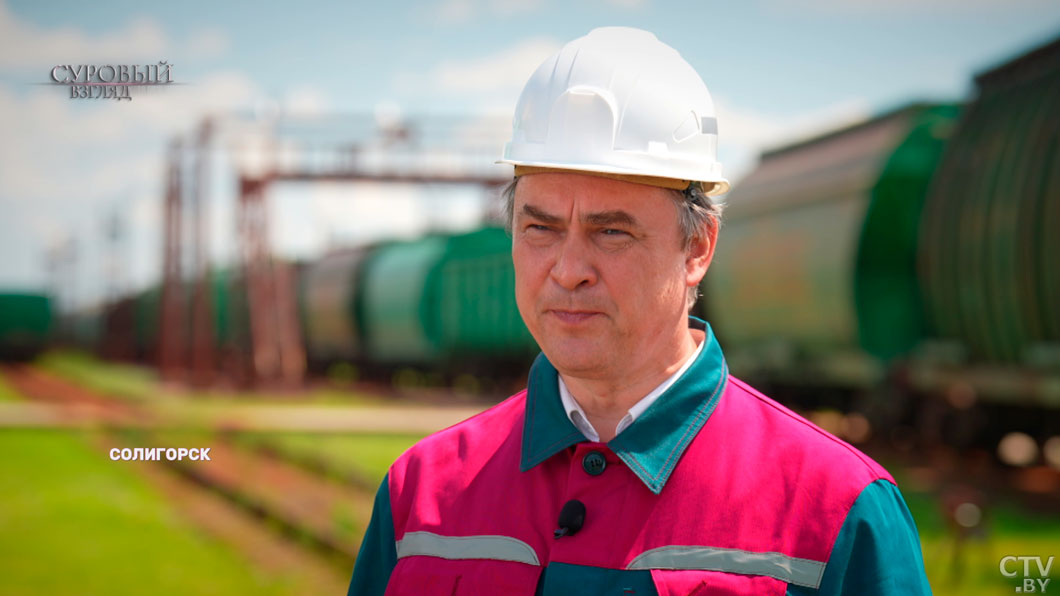
Belaruskali uses several types of rolling stock for fertilizer deliveries, ranging from containers to open-top rail wagons. This was stated on STV by Dzmitry Klishevich, head of the No. 2 Sylvinite Processing Plant at Belaruskali.
“Loading is carried out on an industrial scale. We load several types of rolling stock. These can include bulk containers and open-top rail wagons, depending on the destination and the customer. Our mining division, as one of four, ships fairly large volumes every day. On average, this amounts to between 6,000 and 8,000 tonnes of fertilizer.
Therefore, shipments continue day and night without stopping for a single minute. Our fertilizers are stored in large industrial warehouses and then delivered to loading facilities, where operators use loading equipment to fill the railcars. Until 2021, we mainly worked with specialized mineral fertilizer railcars, and shipments generally proceeded smoothly, with large volumes being transported. Everything went through Lithuania and Lithuanian ports. Then Lithuania closed that route, and all the established logistics chains came to a halt. As a result, in 2022 and 2023 we had to look for new shipping solutions,” he said.
According to him, the company initially shipped fertilizers in big bags weighing between 500 kg and 1,000 kg. However, that format was too small for Belaruskali’s scale of operations.
“Then, in 2022, together with our Russian partners, we adopted a type of bag capable of holding 14 tonnes. These are soft containers known as MK-14. They are reusable, airtight and allow 14 tonnes to be loaded at once. At first, it took us two or even three hours to load each open-top rail wagon because we lacked experience. We developed technical solutions and gained practical expertise, so to speak. As work progressed, we understood how the process could be improved and refined. It can already be said that in 2023 and 2024, substantial volumes of potash shipments were being handled using this technology,” he said.
The company has now phased out the MK-14 containers. Russian ports have begun accepting traditional railcars as well.
“Russian ports have now also learned how to handle our potash, so we currently load several types of rolling stock. The last MK-14 bags were loaded at the end of 2025 because they had fulfilled their purpose. They helped us greatly in 2023-2025, but other solutions have since emerged.
We continue to use mineral fertilizer railcars because port infrastructure has improved and some ports are now able to handle them. We have also introduced a new type of rolling stock in the form of bulk containers. Before sanctions were imposed, we did not use this type of container, but because we had to adapt, bulk containers came into widespread use. This is now a good solution for us because it allows loading and unloading on an industrial scale at a fairly rapid pace. As a result, Belaruskali is able to ship large volumes of products on an industrial scale,” Klishevich concluded.