
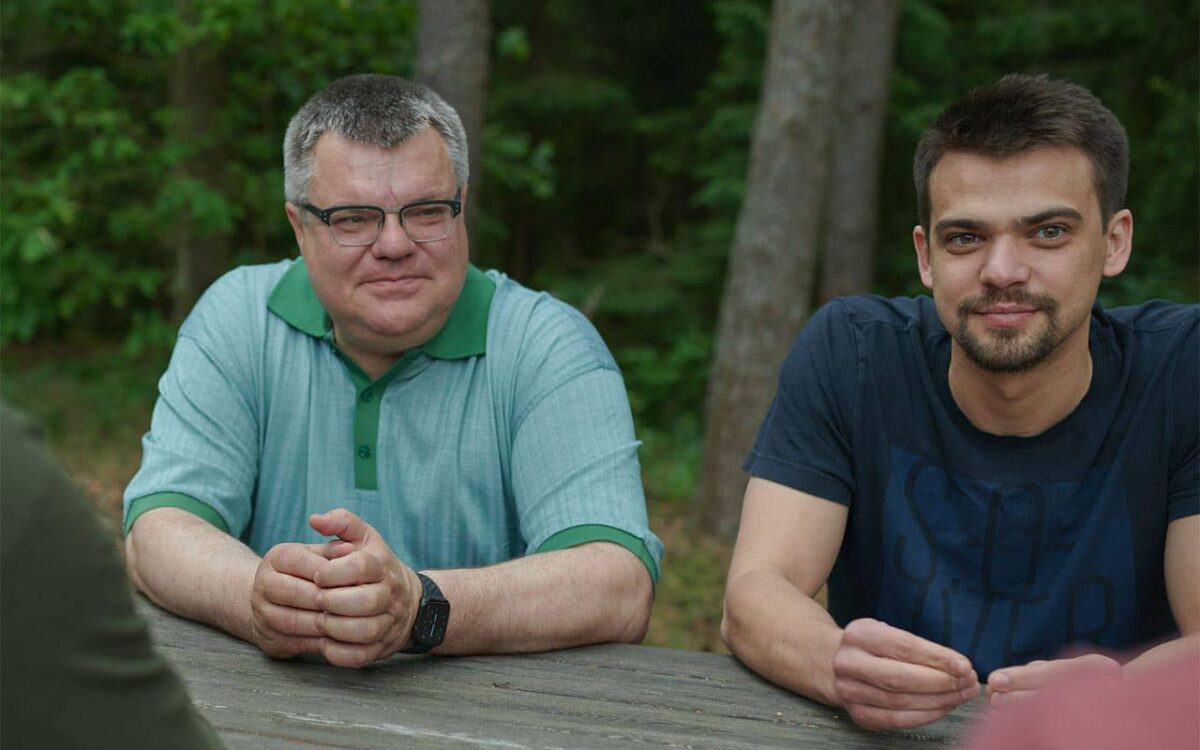
One of the leaders of the 2020 campaign and former political prisoner Viktar Babaryka has announced his return to politics. He said that he currently has “no precise action plan,” but is beginning “a movement toward its formation.” The politician wrote about this today on his Facebook blog.

Babaryka believes that the main issue is “not who will be the president of Belarus or what our new Belarus will be.” Instead, he says, the key task is “to create conditions under which Belarusians themselves will be able to decide these and other important issues that determine both the fate of each individual and the common future for Belarusians.”
Reform.news published his reflections in full:
Dear friends,
After a long absence from the ‘real world’ and now, being in forced emigration, a picture of a significantly changed world has opened up before me:
1. The diversity of ‘colors’ that people once took pride in and found joy in has disappeared. Only white or black remains, one’s own or чужой, friend or enemy. Principles dominate such as: ‘might makes right’; every man for himself; and any problem can be solved not on the basis of achieving a common compromise built on a shared foundation, but through armed confrontation. As a consequence of the triumph of such rules — Russia’s unleashing of a war from which the Ukrainian people are now suffering, and our country has found itself a co-participant of the aggressor.
2. Belarusians have found themselves physically divided into those inside the country and those outside it. There is a sense that these two groups have different pains and interests, and that they do not hear or understand one another. Moreover, even within these ‘divided Belarusians’ there is no unity or consensus.
3. There is a clearly defined goal of the regime that has persisted in Belarus — to retain its own power and that perverted ‘stability’ which allows it to do everything that ensures the achievement of this goal. In this, the regime is greatly helped by an ‘eastern ally’ providing all possible means — economic, political, military, security-related, and so on.
4. There is no shared understanding of a common image of the future among Belarusians who do not accept the ‘optimism’ of the existing regime.
5. There is no single position in Europe regarding Belarus and its ability to support movement toward the implementation of necessary changes. And without a counterbalance to the ‘eastern neighbor,’ it is practically impossible to ensure the achievement of these changes. This was clearly shown in 2020, when we were very close to the possibility of implementing our program of change, but it was precisely Russia’s actions that became the main ‘argument’ in the regime’s struggle at that time and remain its support today.
But I do not agree that today’s picture of the world is the only possible and correct one. It is not based on universal human values that are close to me and that have taken shape and remained unchanged for many centuries. When we speak about a shared image of the future for Belarusians, it is important to understand that this is not about rolling back to a previous state, but about forming conditions for a free, independent, and safe country for its residents, where everyone has the opportunity to realize themselves and build their own well-being. Such a state of affairs has not existed in Belarus before and does not exist now.
I understand that with a single goal, the paths to achieving it may differ, but this does not devalue the idea itself. Everyone can go their own way and at their own pace, but the goal remains the same — the formation of conditions for the development of Belarus.
And I know that very often it is precisely the paths and methods of achieving a common goal that become the causes of rifts and confrontations, but this does not change my attitude toward the principles that are close to me. The sad experience of recent years has only confirmed this: the external world is only a boundary condition for your physical freedom. Undoubtedly, it is very important, as it determines your possibilities, but it should not lead to abandoning the system of values that you adhere to.
As of today, I do not have a precise action plan, either my own or yours, but I am beginning a movement toward its formation. I do not think it will take much time. Certainly not years.
And in conclusion, I want to say the following: the main thing is not who will be the president of Belarus or what our new Belarus will be. The main thing is to create conditions under which Belarusians themselves will be able to decide these and other important issues that determine both the fate of each individual and the common future for Belarusians.
As a reminder, on December 13, 2025, 123 political prisoners were released. Of these, 114 were expelled to Ukraine and the rest to Lithuania. Some did not have passports on hand. On December 17, the political prisoners left Ukraine. Eighty-seven arrived in Poland and 20 in Lithuania. Maria Kalesnikava and Babaryka went to Germany. On December 19, they arrived in Berlin, where they were met by German Foreign Minister Johann Wadephul.
Babaryka’s son, Eduard, remains in a Belarusian prison.