
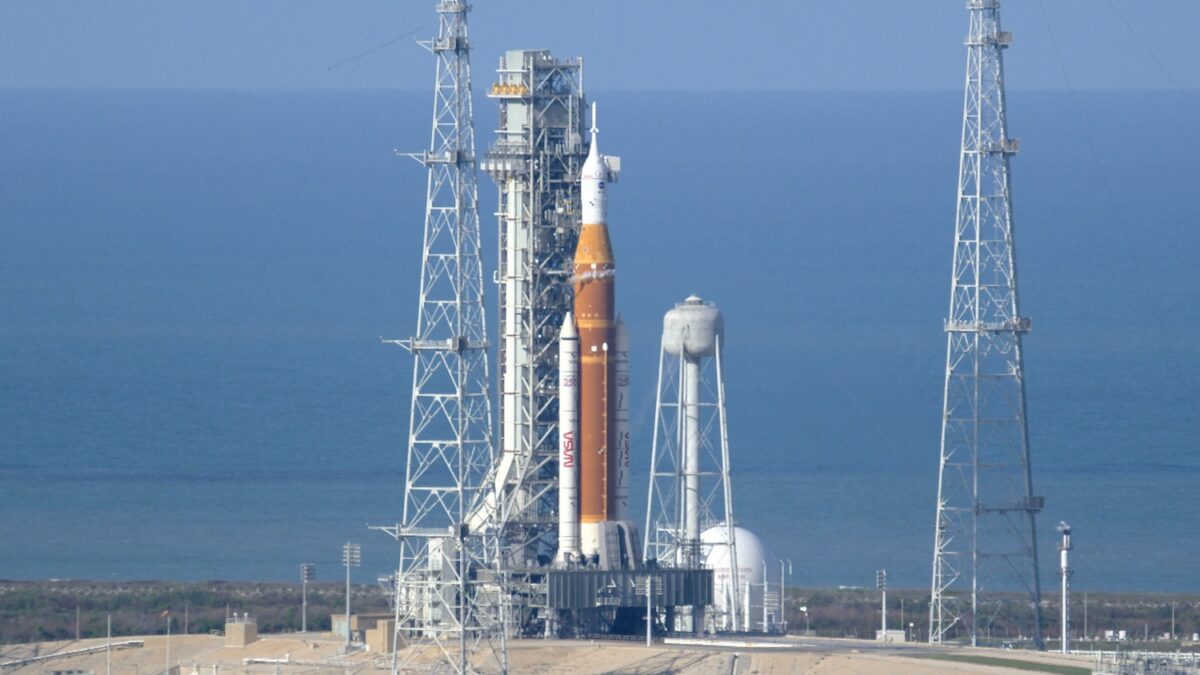
The National Aeronautics and Space Administration (NASA) has successfully launched the Artemis II mission, sending four astronauts on a historic flight around the Moon — the first crewed launch under the new deep space exploration program.

The Space Launch System (SLS) rocket lifted off at 18:35 local time from Launch Complex 39B at the Kennedy Space Center in Florida. On board the Orion spacecraft are NASA astronauts Reid Wiseman, Victor Glover, and Christina Koch, as well as Canadian Space Agency astronaut Jeremy Hansen.
Immediately after liftoff, two solid rocket boosters ignited, providing more than 75% of the thrust needed to lift the rocket, which weighs about 5.75 million pounds. Together with four RS-25 engines operating at full power, the system generated approximately 8.8 million pounds of thrust, making it one of the most powerful launches in NASA’s history.
As the rocket ascended, communication umbilicals supplying power, fuel, and data during pre-launch operations were disconnected and retracted, allowing the vehicle to transition to fully autonomous flight.
The Artemis II mission is expected to last about 10 days. The crew will perform a lunar flyby, testing key systems required for future deep space expeditions. The flight marks a major milestone in the Artemis program, which aims to establish a sustainable human presence on the Moon and prepare for crewed missions to Mars.
During ascent, the rocket quickly passed several key milestones: within seconds it cleared the launch tower, in under a minute it reached supersonic speed, and shortly thereafter it experienced maximum aerodynamic pressure. The solid rocket boosters separated just over two minutes after liftoff, followed by the jettison of the launch abort system.
The core stage main engines shut down about eight minutes after launch, after which the stage separated from the upper stage, completing the primary phase of placing the spacecraft onto its flight trajectory.
The Artemis program is NASA’s modern initiative to return humans to the Moon and advance deep space exploration. Its key objectives include establishing a sustainable presence in lunar orbit and on the Moon’s surface, developing technologies for long-duration missions, and preparing for crewed flights to Mars. The program uses the super-heavy Space Launch System (SLS) rocket and the Orion spacecraft, capable of carrying crews beyond low Earth orbit. Artemis II will be the first crewed mission of the program and a critical step toward future lunar landings.
Historically, the program builds on the legacy of the Apollo program, under which the United States first landed humans on the Moon in 1969 during the Apollo 11 mission. After the end of Apollo in the 1970s, crewed missions beyond low Earth orbit were paused for nearly half a century. The revival of lunar exploration through Artemis reflects a new strategy — not one-off expeditions, but long-term exploration of the Moon involving international partners and private companies, laying the groundwork for humanity’s further expansion into the Solar System.