
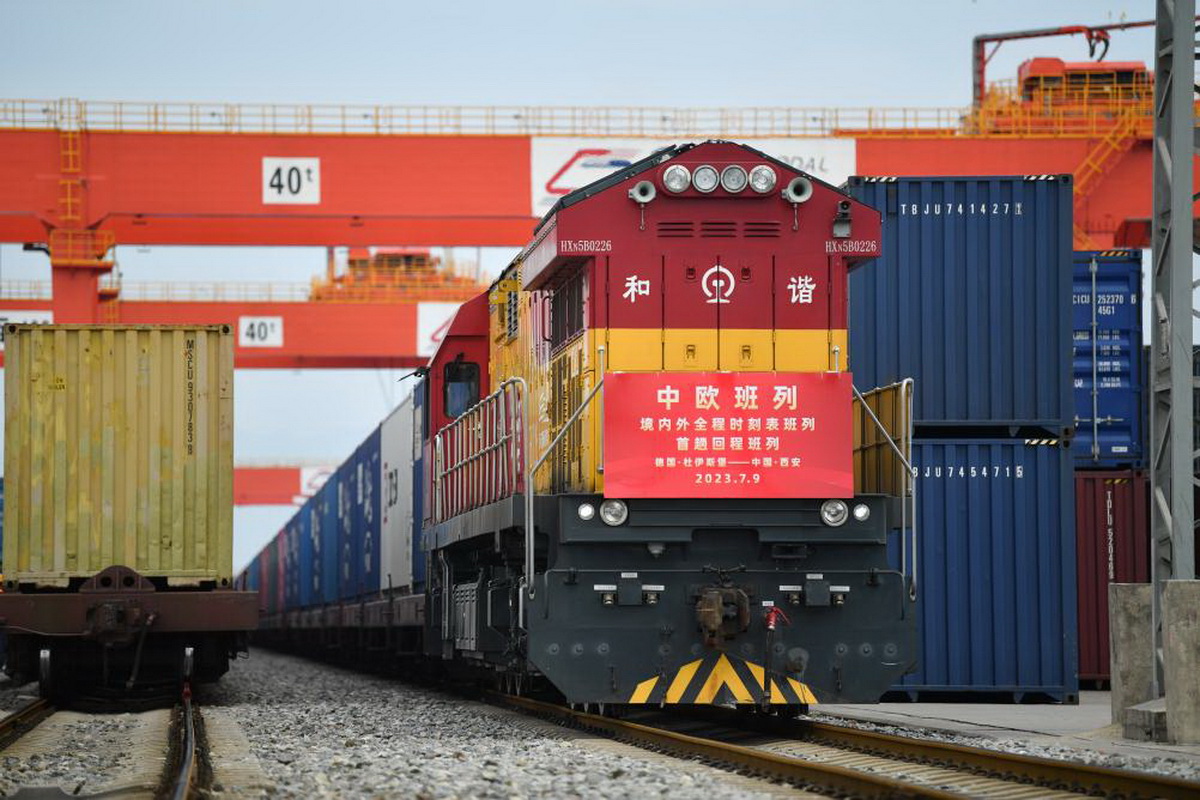
Since its launch in 2011, the regular international freight train service “China–Europe”, connecting China with European countries, has completed almost 120,000 trips. It currently links 232 cities in 26 European states and more than 100 cities in 11 Asian countries. The figures were presented at the Second China–Europe Cooperation Forum held on 18 November in Xi’an, Shaanxi Province, according to Xinhua.
There are now three operational routes — eastern, central, and western — and a southern route via the Caspian and Black Seas is under development. New logistics corridors, such as the “New Western Land–Sea Corridor” and the “Golden Yangtze River Route”, are being integrated with existing networks, creating a multi-vector transport infrastructure, the report notes.
The Belt and Road Leading Group Office, together with China State Railway Group, presented the “China–Europe Train Development Report (2025)”. The document highlights that countries including Belarus, Germany, Kazakhstan, Mongolia, Poland, and Russia actively participate in the China–Europe route, and that Almaty, Moscow, and Minsk have become key hub nodes.
At present, the service transports more than 50,000 product types across 53 industries. China’s main exports via the route include vehicles and components, machinery, and electronics. In the opposite direction, Europe ships machinery, electrical equipment, precious metals, medical equipment, food products, and alcohol to China.
By the end of 2024, the total freight volume transported along the route reached 426.4 billion USD. In 2024, the train’s freight volume increased roughly 34-fold compared to 2013, while its share in China–Europe trade grew from 0.4% to 8.5%.